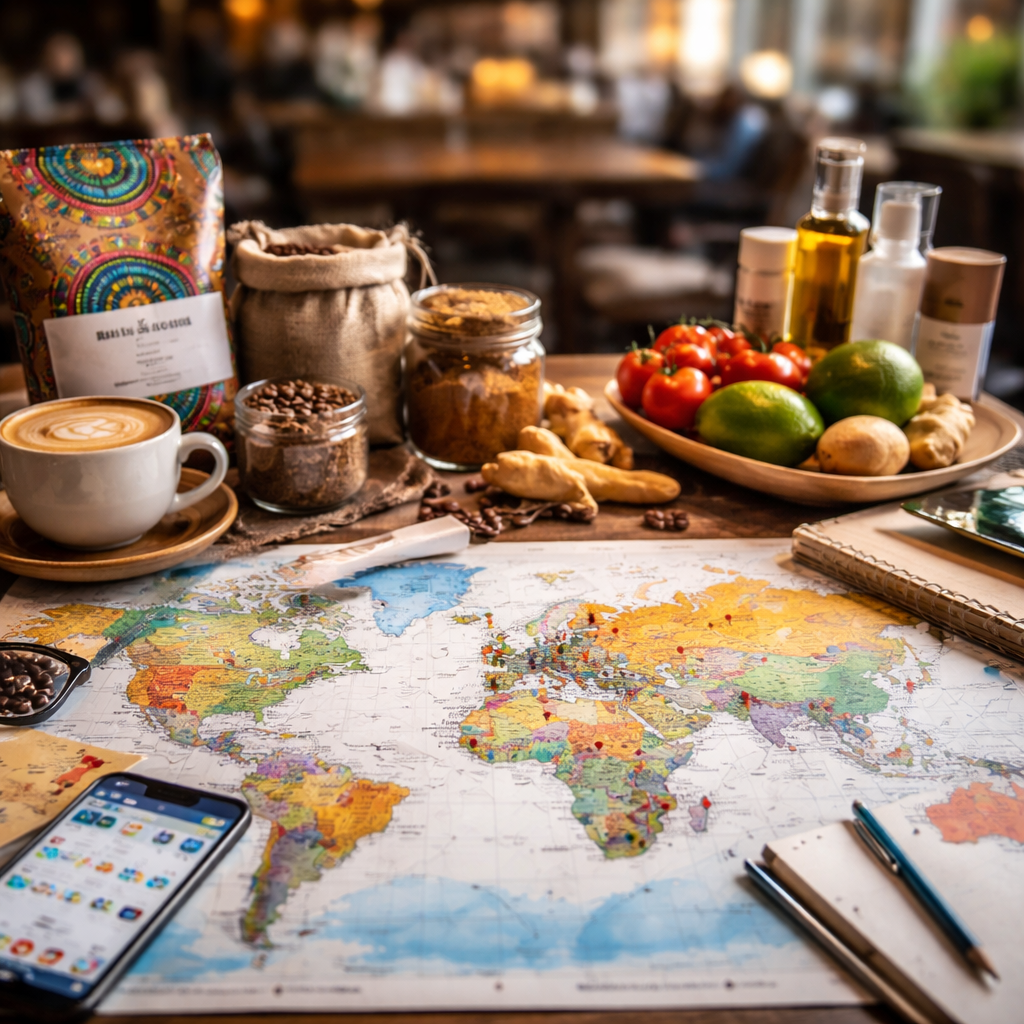
When a small coffee shop in Kyiv sources its beans from Ethiopia, trains its baristas using techniques from Tokyo, and serves customers who discovered it through an app built in California — that is not a coincidence. That is the advantages of globalization playing out in real life, quietly and constantly. Most people interact with its effects every single day without stopping to think about what is actually behind them.
Trade without borders: what it actually changes for ordinary people
One of the most tangible outcomes of global economic integration is the way it reshapes access. A consumer in Poland can buy electronics manufactured in South Korea, wear clothing stitched in Bangladesh, and cook with spices imported from India — all within a modest budget. This is not magic. It is the result of decades of trade liberalization, supply chain development, and international agreements that reduced tariffs and simplified cross-border commerce.
For businesses, especially small and medium enterprises, the shift has been equally significant. A craft producer in Portugal now has a realistic path to selling products in markets that were once completely out of reach. Digital platforms, international logistics networks, and standardized payment systems have collectively removed barriers that previously required enormous capital to overcome.
“Economic openness correlates strongly with higher average incomes and lower poverty rates across developing nations — not uniformly, but consistently enough to be a recognized pattern in economic research.”
Knowledge transfer and innovation: the less obvious engine of progress
Beyond goods and services, globalization has dramatically accelerated how knowledge moves across societies. Scientific research published in one country becomes the foundation for a medical breakthrough in another. Engineering methods developed for aerospace in the United States get adapted for automotive manufacturing in Germany. This cross-pollination of ideas — sometimes called technology diffusion — is one of the more understated benefits of an interconnected world.
Universities now collaborate internationally as a default rather than an exception. Students from dozens of countries share classrooms, both physical and virtual. This creates a kind of intellectual ecosystem where diverse perspectives sharpen problem-solving and drive innovation in ways that isolated systems simply cannot replicate.
| Area | Impact of global knowledge exchange |
|---|---|
| Medicine | Faster development of treatments through shared clinical research |
| Technology | Open-source software built collaboratively across continents |
| Agriculture | Crop improvement techniques spread to food-insecure regions |
| Education | Access to world-class learning materials regardless of geography |
Cultural exchange: enrichment rather than erasure
There is a common concern that globalization flattens culture — that it turns the world into one homogeneous place where everyone eats the same fast food and watches the same streaming shows. That concern deserves to be taken seriously. But the fuller picture is more nuanced. Alongside the obvious spread of dominant cultural products, there has been a remarkable rise in global appetite for local and regional culture.
South Korean cinema wins international awards. Nigerian music reaches listeners across five continents. Peruvian cuisine is recognized among the most sophisticated in the world. These are not accidents — they are the direct result of global distribution channels making previously invisible cultures visible. When people have access to variety, they often choose it.
- Minority languages gain online platforms and new audiences
- Traditional crafts find international buyers through e-commerce
- Diaspora communities maintain and share their cultural identity globally
- Food traditions travel and evolve, creating entirely new culinary forms
What global labor markets mean for individual careers
For working professionals, the globalized labor market has created opportunities that did not exist a generation ago. Remote work has made it possible to be employed by a company headquartered on a different continent while living wherever suits you best. Freelancers in lower-cost regions compete for — and win — contracts with clients in high-income economies. Skills, rather than geography, have become the primary currency.
This shift is not without its tensions. Competition increases, and industries in some regions face pressure from cheaper production elsewhere. But for individuals willing to invest in transferable, high-demand skills, the global market offers a wider and more varied playing field than any domestic economy could provide alone.
Practical tip: If you want to benefit from global labor demand, focus on skills with international recognition — digital marketing, software development, data analysis, UX design, and multilingual communication consistently rank among the most globally transferable competencies.
Global cooperation on shared challenges
Some problems are simply too large for any single country to solve. Climate change, pandemic preparedness, food security, and financial instability do not respect national borders. The infrastructure built through decades of globalization — international institutions, diplomatic channels, shared data systems — provides the framework for the kind of coordinated response these challenges require.
The rapid development and global distribution of vaccines during recent health crises demonstrated both the strengths and weaknesses of this system. Where cooperation worked, it worked faster than anything previously seen in human history. Where it broke down, the consequences were equally visible. The lesson is not that global cooperation fails — it is that the mechanisms need continuous improvement and greater equity in access.
The bigger picture does not erase the personal one
It is easy to talk about globalization in abstract terms — trade flows, GDP growth, international agreements. But the most compelling argument for its benefits is often the most personal one. A first-generation student in a developing country accessing a free online course from a top university. A small business owner in a rural area selling handmade products to customers across the world. A researcher collaborating with colleagues she has never met in person but whose work has shaped hers entirely.
These are not statistical abstractions. They are the human texture of what economic and cultural integration actually produces when it functions well. Understanding this helps move the conversation beyond ideology and toward something more useful: thinking clearly about how to preserve and extend what works, while honestly addressing what does not.