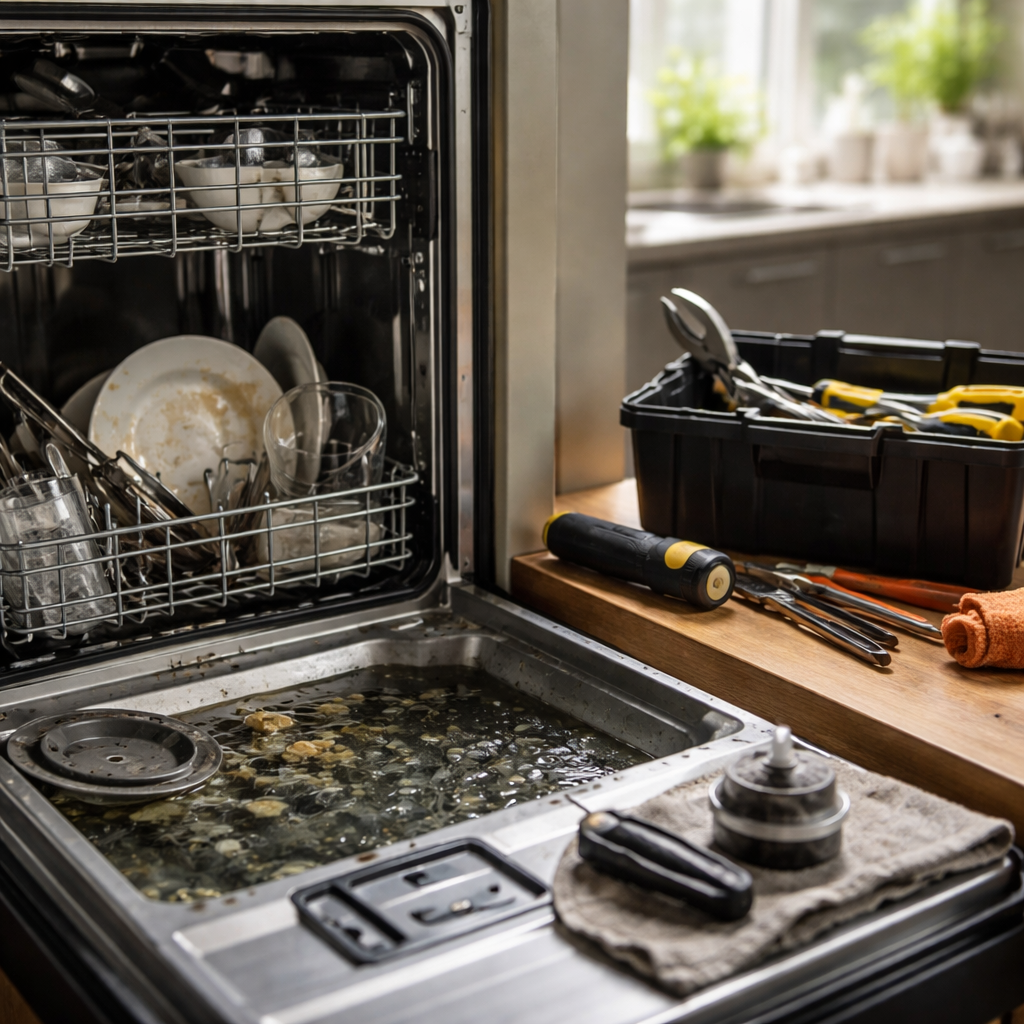
A dishwasher not working properly is one of those household situations that feels minor until you’re standing in front of a pile of dirty dishes with no backup plan. Before you call a repair technician or start pricing new appliances, it’s worth knowing that the majority of dishwasher problems have surprisingly simple fixes — and most of them don’t require any special tools or technical background.
Why your dishwasher might suddenly stop doing its job
Most dishwasher failures fall into a few predictable categories: power issues, water supply problems, drainage failures, and mechanical faults. Understanding which category your problem belongs to is the first step toward fixing it without guessing. The symptoms your machine shows — whether it won’t start, won’t drain, or leaves dishes dirty — are actually quite informative once you know what to look for.
Let’s go through the most common scenarios and what’s actually happening inside the machine when they occur.
The dishwasher won’t start at all
If pressing the start button produces absolutely nothing — no sounds, no lights, no response — the issue is almost always electrical. Here’s what to check in order:
- Make sure the door is fully latched. Dishwashers have a door latch switch that must be engaged for the machine to operate. A slightly open door won’t trigger any error — the machine simply won’t respond.
- Check the circuit breaker. Dishwashers are typically on a dedicated circuit, and a tripped breaker is a common and easy fix.
- Inspect the power cord and outlet if your model is plug-in rather than hardwired.
- Look at the control panel for a child lock or delay start feature that may have been activated accidentally.
A surprisingly high number of “broken” dishwashers are simply in delay start mode or have an engaged child lock — always check the control panel settings before assuming a fault.
Water isn’t filling, or filling too slowly
When a dishwasher runs its cycle but dishes come out dirty and dry — without any sign of water contact — the water inlet valve is the most likely culprit. This valve opens to allow water into the machine at the beginning of a cycle, and it can become clogged with mineral deposits over time, especially in areas with hard water.
Before replacing the valve, check two other things first. Make sure the water supply valve under the sink is fully open — it’s easy for this to get partially closed during under-sink work. Also check the inlet hose for kinks or blockages. If the valve itself is faulty, it will need to be replaced, which is a moderately straightforward repair for most dishwasher models.
Dishwasher not draining — and what’s causing it
Standing water at the bottom of the dishwasher after a cycle is one of the most frequently reported issues. In most cases, the cause is a clog somewhere in the drainage system rather than a mechanical failure. Here’s where to look:
| Location | What to check | How to fix |
|---|---|---|
| Filter basket | Food debris and grease buildup | Remove and rinse under running water with a brush |
| Drain hose | Kinks, clogs, or improper routing | Straighten hose and clear any blockages |
| Air gap or garbage disposal | Blockage at connection point | Clear the knockout plug or clean the air gap cap |
| Drain pump | Debris caught in the impeller | Access and manually clear obstruction |
Cleaning the filter alone resolves a significant portion of drainage complaints. Many users don’t realize the filter requires regular manual cleaning — unlike older self-cleaning models, modern dishwashers typically have a removable filter that needs attention every few weeks depending on usage.
Dishes coming out dirty or with residue
A dishwasher that runs but doesn’t actually clean is frustrating in a different way than one that won’t start. The causes here tend to be related to maintenance, water quality, or incorrect loading rather than any mechanical breakdown.
Spray arms are a common culprit. These rotating components distribute water throughout the machine, and their small holes can become clogged with mineral scale or food particles. You can remove them and rinse them out manually — most simply unscrew or unclip without any tools.
Beyond spray arms, consider these factors:
- Water temperature below 49°C (120°F) prevents proper cleaning and sanitizing. Check your water heater settings.
- Using too little detergent, or detergent that has clumped due to humidity, leads to poor results regardless of cycle length.
- Overloading the machine or blocking the spray arm rotation is one of the most common reasons for uneven cleaning.
- Rinse aid levels directly affect drying performance and spotting on glassware.
Unusual noises during operation
A humming or soft mechanical sound during a cycle is normal. Grinding, banging, or loud rattling typically isn’t. A grinding noise often points to something caught in the drain pump impeller — a piece of broken glass, a small utensil, or even a food fragment that hardened. A banging sound is usually caused by spray arms hitting items that are loaded too close to them. Rattling may simply mean dishes aren’t secured properly in the rack.
If you hear a persistent high-pitched squeal or whining, the wash motor or drain pump motor may be wearing out. This type of noise, especially if it gets worse over time, is a signal worth taking seriously rather than ignoring.
When regular maintenance prevents most problems
The single most effective thing you can do to avoid dishwasher problems is to keep up with basic maintenance. Most issues — from poor cleaning to drainage failures to foul odors — trace back to neglected upkeep rather than hardware failure.
Running a cleaning cycle with a dishwasher-safe descaler or white vinegar once a month can extend the machine’s lifespan significantly, especially in hard water areas.
A practical routine worth building:
- Clean the filter every two to four weeks depending on how often you run cycles.
- Wipe the door gasket with a damp cloth regularly to prevent mold buildup.
- Check the spray arm holes for blockages monthly.
- Refill rinse aid and salt (for European-style machines with built-in softeners) before they run out completely.
- Run the hot water tap in your sink for a minute before starting a cycle — this ensures the dishwasher begins with already-hot water.
Knowing when a repair makes sense — and when it doesn’t
Not every problem is worth fixing. If the machine is older, has already required multiple repairs, and the new fault involves a major component like the control board or main wash motor, the cost of repair may approach or exceed the value of the appliance. As a rough guideline, if a repair costs more than half the price of a comparable new machine, replacement often makes more practical sense.
On the other hand, if the machine is relatively new and the fault is something like a worn door latch, a faulty door latch switch, a clogged valve, or a failed drain pump — all of these are parts that cost relatively little and can be replaced at home with basic mechanical confidence. Manufacturer parts databases and repair guides are widely available online for most major brands, which makes DIY repairs far more accessible than they used to be.
The bottom line: a broken dishwasher is rarely the disaster it feels like at first. Take a methodical approach, work through the most common causes first, and you’ll often find the solution is closer — and simpler — than expected.