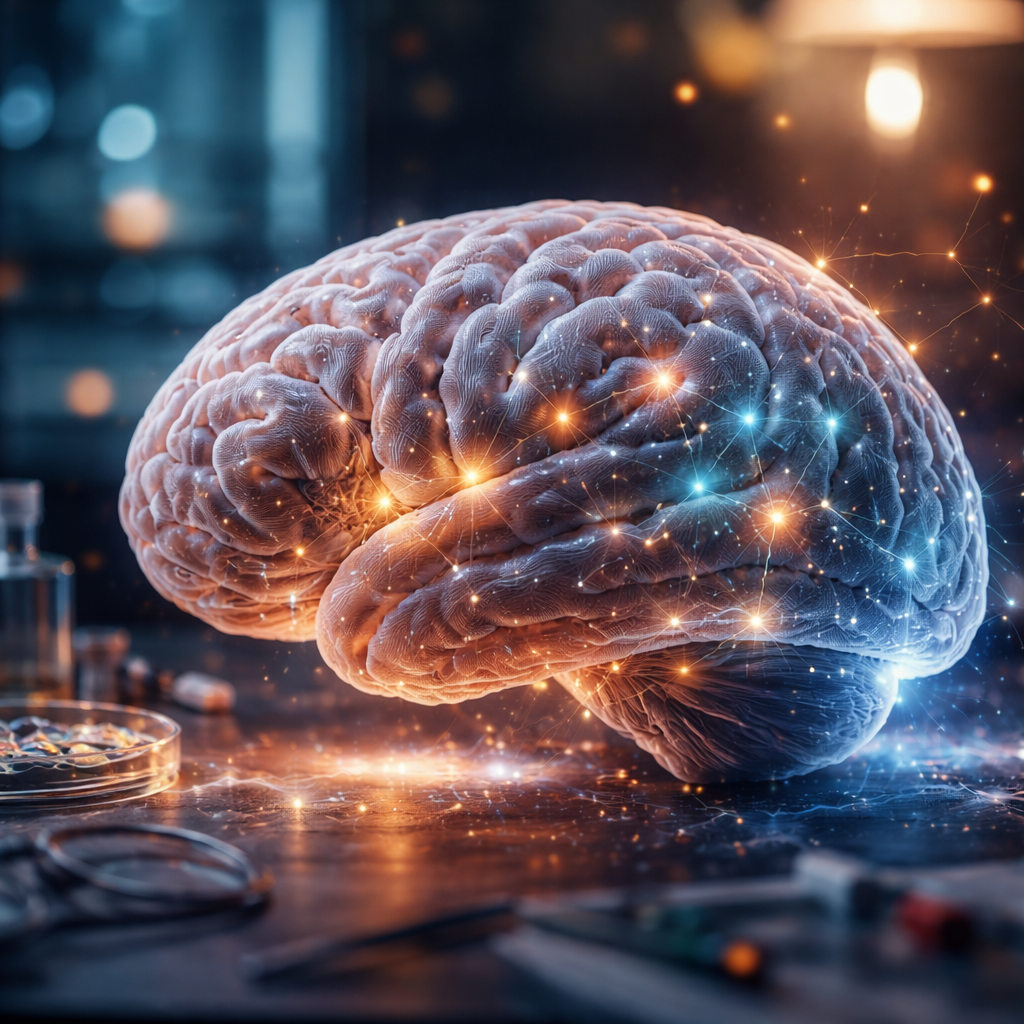
Your brain never fully shuts down — not even during deep sleep. That single detail captures why facts about the human brain remain so endlessly fascinating: the more you learn, the more you realize how little we’ve scratched the surface of understanding this three-pound structure inside our skulls.
It’s not the biggest, but it’s the most complex
The human brain contains roughly 86 billion neurons. Each of those neurons can form thousands of connections with others, which means the number of possible synaptic combinations exceeds the number of stars in the observable universe. Size-wise, though, the brain is surprisingly modest — it accounts for only about 2% of total body weight. Yet it consumes nearly 20% of the body’s energy supply at rest. That imbalance alone tells you something important: cognitive work is metabolically expensive, which is why mental fatigue feels just as real as physical exhaustion.
What makes the human brain stand out isn’t raw volume but the density and organization of its prefrontal cortex — the region tied to planning, decision-making, impulse control, and abstract thought. Other animals have prefrontal regions, but none developed to this degree relative to overall brain size.
How the brain actually processes information
Nerve signals travel through the brain at speeds ranging from about 1 to 120 meters per second, depending on whether the nerve fiber is myelinated or not. Myelin — the fatty sheath that wraps around axons — acts like insulation on an electrical wire. Thicker myelin means faster signal transmission. This is why conditions that damage myelin, such as multiple sclerosis, disrupt so many different bodily functions at once.
The brain processes sensory input, emotions, language, and movement in parallel, not sequentially. Different regions handle different tasks simultaneously, and they communicate through intricate neural networks. This parallel architecture is part of why multitasking feels possible — though research consistently shows that what we call multitasking is actually rapid switching between tasks, not true simultaneous processing.
The brain is not a single organ with one job. It is more like a city — dozens of specialized districts working in constant coordination, each contributing something the others can’t replace.
Brain development doesn’t stop at childhood
One of the most important shifts in neuroscience over the past few decades is the understanding that the brain remains plastic — capable of change — well into adulthood. The prefrontal cortex, in particular, continues developing until a person’s mid-twenties. This explains a lot about adolescent risk-taking behavior: the emotional centers of the brain mature earlier than the regions responsible for long-term consequence evaluation.
Neuroplasticity also means that habits, skills, and even thought patterns physically reshape neural pathways over time. Learning a new language, practicing a musical instrument, or changing how you respond to stress — all of these leave measurable structural traces in brain tissue. That’s not a motivational metaphor. It’s biology.
| Brain Region | Primary Function | Interesting Detail |
|---|---|---|
| Prefrontal Cortex | Planning, decision-making | Fully matures around age 25 |
| Hippocampus | Memory formation | New neurons can form here in adults |
| Amygdala | Emotional processing | Activates faster than conscious thought |
| Cerebellum | Motor coordination | Contains about half of all brain neurons |
| Broca’s Area | Speech production | Damage here causes expressive aphasia |
Sleep, memory, and why forgetting is a feature
Sleep is not downtime for the brain — it’s maintenance mode. During slow-wave and REM sleep stages, the brain consolidates memories, clears metabolic waste through the glymphatic system, and strengthens neural connections formed during waking hours. Skipping sleep consistently doesn’t just make you tired; it impairs memory encoding, slows reaction time, and over longer periods, has been linked to increased risk of neurodegenerative conditions.
Forgetting, meanwhile, is not a flaw. The brain actively prunes information it deems irrelevant, which helps prevent cognitive overload and keeps useful memories more accessible. Research from the University of Toronto suggests that a good memory system is one that forgets the right things, not one that retains everything equally.
Pain, emotion, and the brain-body connection
The brain itself has no pain receptors. Surgeons can operate on brain tissue while a patient is conscious because the organ that processes pain cannot feel it directly. What causes headaches is typically tension in surrounding muscles, blood vessel changes, or pressure on nerves — not the brain tissue itself.
Emotional pain, however, activates some of the same neural pathways as physical pain. Brain imaging studies show that social rejection lights up regions associated with physical discomfort. This overlap helps explain why loneliness and grief can manifest as genuine physical symptoms — the brain isn’t drawing a sharp line between bodily and emotional experience.
- The brain generates roughly 12–25 watts of electrical power — enough to power a dim LED bulb.
- Humans use virtually all of their brain, not the commonly cited 10%. Different regions are active at different times, but no large portion sits permanently idle.
- The gut contains about 500 million neurons and communicates continuously with the brain via the vagus nerve — which is why gut health increasingly appears in discussions of mood and cognition.
- Short-term memory can typically hold 7 items (plus or minus 2) at a time, a concept introduced by psychologist George Miller in the 1950s that still holds up in cognitive research.
- The brain’s default mode network — active when you’re daydreaming or mind-wandering — plays a significant role in creativity and self-referential thinking.
What this changes about how you think about yourself
Understanding how the brain actually works has real implications for everyday life — not just for scientists. Knowing that willpower is a finite cognitive resource that depletes throughout the day helps explain why decisions made late in the evening tend to be worse than morning ones. Knowing that stress hormones physically shrink the hippocampus over time reframes chronic stress not as a personality problem but as a health issue that warrants the same attention as high blood pressure.
The brain is neither fixed nor fragile. It’s adaptive, responsive, and shaped by almost everything you do — your sleep, your social relationships, your physical activity, even the environments you regularly spend time in. That doesn’t mean you can rewire yourself overnight, but it does mean the direction of change is rarely locked in. And for most people, that’s a genuinely useful thing to know.