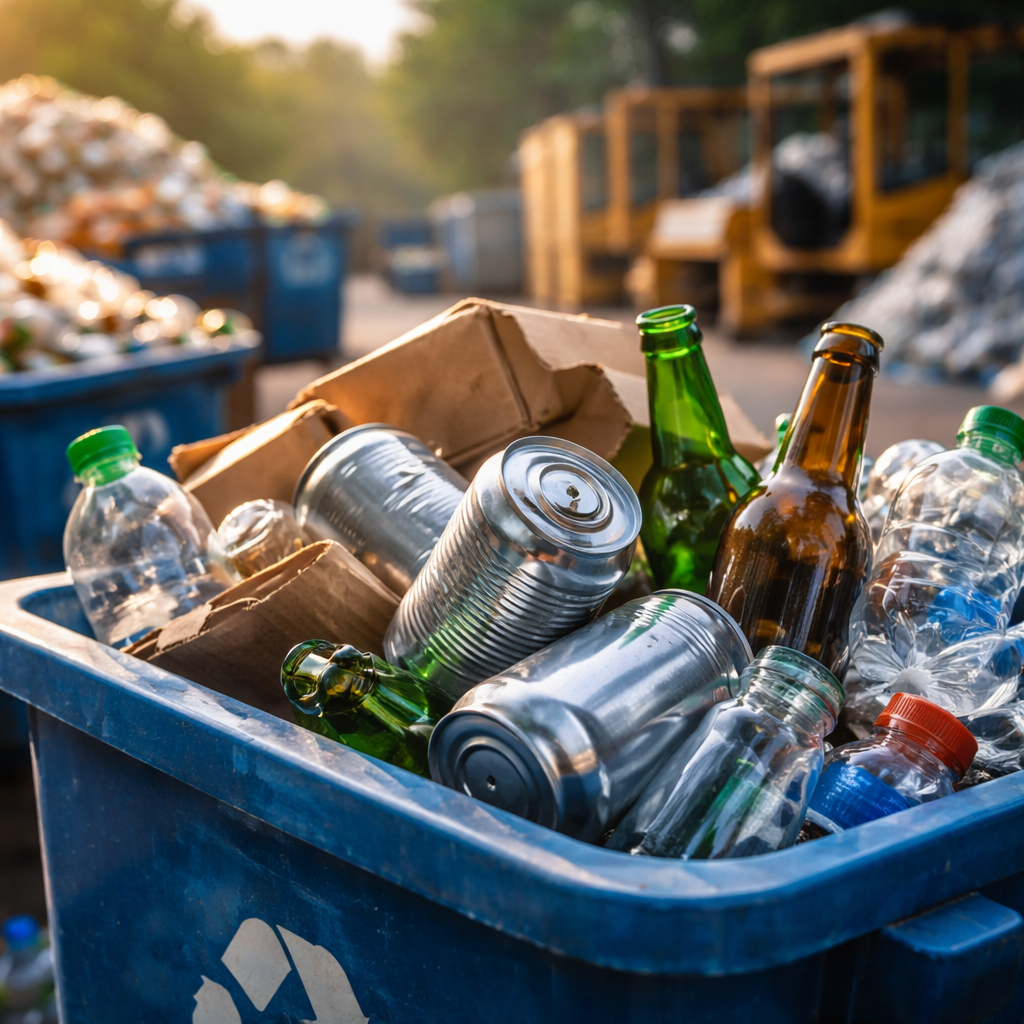
Most people recycle without thinking too deeply about it — tossing a bottle into the blue bin, folding a cardboard box flat. But the real advantages of recycling go far beyond keeping streets tidy. They touch the economy, public health, energy systems, and the very stability of ecosystems we depend on every day.
Why raw materials are not as infinite as they seem
Extracting virgin materials — whether it is bauxite for aluminum, pulpwood for paper, or silica for glass — requires enormous energy, heavy machinery, and land disruption. Mining and logging operations alter landscapes for decades, sometimes permanently. When a material is recycled instead of extracted from scratch, that entire chain of extraction is either shortened or bypassed altogether.
Consider aluminum: recycling it uses roughly 95% less energy than producing it from raw ore. Steel recycling saves about 60–74% of the energy needed for primary steel production. These numbers are not abstract — they translate directly into lower carbon emissions, reduced industrial water use, and less pressure on land ecosystems.
| Material | Energy saved through recycling | CO₂ reduction (approx.) |
|---|---|---|
| Aluminum | Up to 95% | Up to 9 kg CO₂ per kg recycled |
| Steel | 60–74% | 1.5–2 tonnes CO₂ per tonne recycled |
| Paper | ~40% | Reduces deforestation-related emissions |
| Glass | ~25–32% | Cuts furnace fuel use significantly |
The economic side that often goes unnoticed
Recycling is not just an environmental act — it is an economic one. The recycling industry employs workers in collection, sorting, processing, and manufacturing. Secondary raw materials markets provide businesses with cheaper inputs, reducing production costs and, in many cases, final product prices for consumers.
Municipalities that invest in well-organized waste management systems also spend less on landfill maintenance. Landfills require ongoing management, liner systems to prevent leachate from contaminating groundwater, and methane capture infrastructure. Every ton of material diverted from a landfill reduces these long-term costs.
According to the U.S. Environmental Protection Agency, recycling and reuse activities in the United States account for hundreds of thousands of jobs and generate billions in wages annually — a figure that continues to grow as circular economy models expand globally.
What happens to waste that is not recycled
Understanding recycling benefits becomes clearer when you look at the alternative. Non-recycled waste follows one of several paths: landfill, incineration, or — in cases of poor waste infrastructure — open dumping and waterway contamination. Each of these paths carries measurable environmental and health costs.
- Landfills produce methane, a greenhouse gas more potent than CO₂ over a 20-year horizon.
- Leachate from decomposing waste can contaminate local groundwater and soil.
- Plastic waste in oceans breaks into microplastics, entering food chains including human diets.
- Incineration without energy recovery releases toxins and particulate matter affecting air quality.
- Open dumping contributes directly to habitat destruction and species stress in affected areas.
None of this is inevitable. Waste reduction and material recovery through proper recycling systems interrupt this chain at the source.
How recycling supports climate goals in practical terms
Climate discussions often focus on energy production and transportation. But the waste and materials sector is a significant contributor to global greenhouse gas emissions. Reducing the demand for virgin material production — through higher recycling rates — is one of the more actionable levers available at both individual and industrial scales.
When organic waste is composted rather than sent to landfill, methane emissions drop. When paper is recycled, fewer forests are felled — and forests are among the most effective carbon sinks on the planet. When electronic waste is properly processed, toxic heavy metals like lead and mercury are recovered rather than leaching into soil and water near dump sites.
The social dimension: communities and behavior change
Recycling culture within communities has a compounding effect. When households consistently sort waste, local recycling programs become economically viable, which in turn funds better infrastructure, education campaigns, and expanded collection services. Cities with strong participation rates tend to develop more resilient waste systems overall.
Schools that incorporate waste sorting into daily routines report higher environmental awareness among students — awareness that carries into adult consumer behavior. This is not speculation; it is a pattern documented across environmental education research in multiple countries. The social value of normalized recycling behavior extends well beyond the materials themselves.
Where the real change begins
It would be easy to frame recycling as a personal virtue — something you either do or do not do. But the fuller picture shows it as part of a much larger system connecting industrial design, municipal policy, consumer behavior, and global supply chains. Individual participation matters precisely because it feeds into that system, making the economics of recycling viable and signaling demand for sustainable production models.
The material benefits — energy savings, emission reductions, resource conservation — are real and measurable. So are the economic and social ones. Recycling is not a solution to every environmental challenge, but it remains one of the most accessible, scalable, and evidence-backed strategies available to both individuals and institutions working toward a lower-impact future.