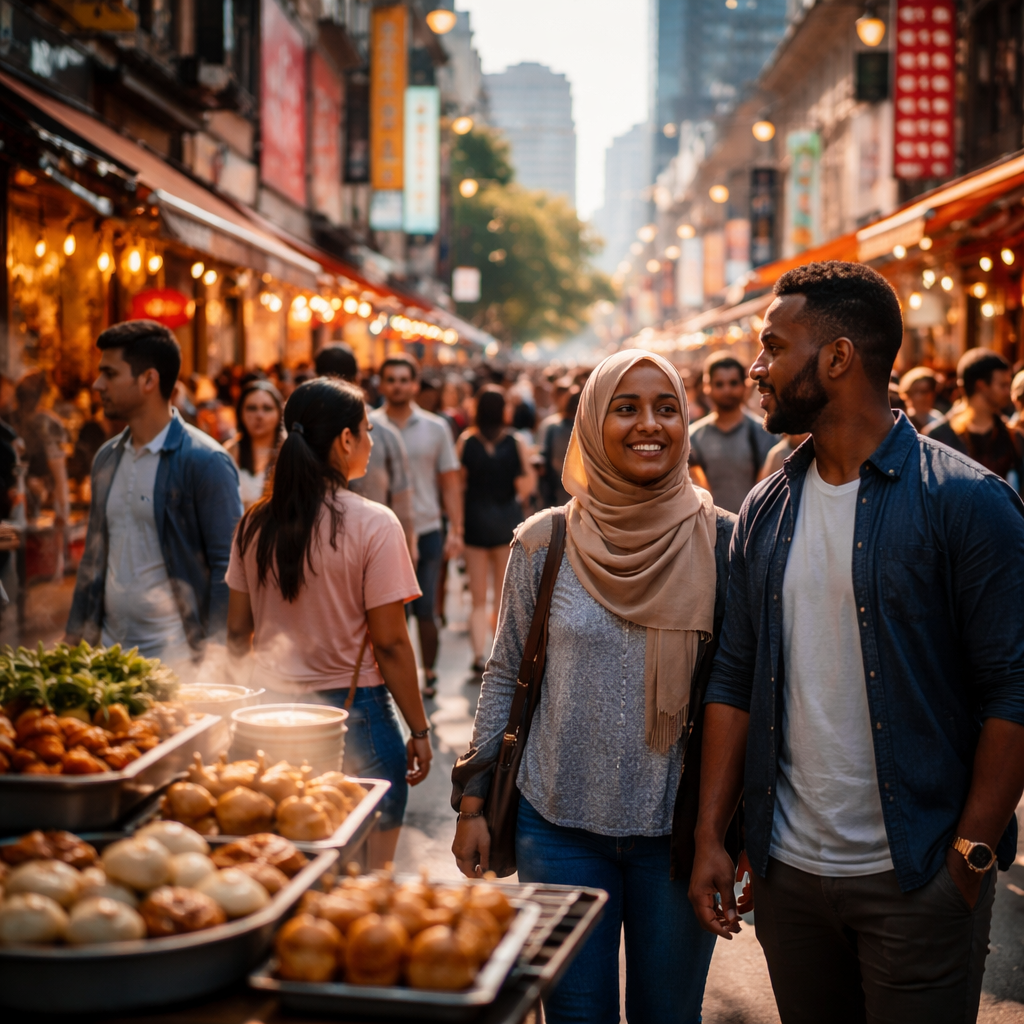
Walk into any major city today and you’ll notice something remarkable: within a single block, you might hear three languages, smell food from four different continents, and pass by buildings that blend architectural traditions from across the globe. The advantages of multiculturalism aren’t just theoretical talking points — they show up in daily life in ways that are surprisingly concrete and measurable.
Why diversity makes societies more adaptable
When people from different cultural backgrounds share a common space, they bring distinct problem-solving approaches shaped by entirely different histories, philosophies, and practical experiences. Research in organizational behavior consistently shows that diverse teams outperform homogeneous ones when it comes to complex challenges — not because any one perspective is superior, but because the range of viewpoints catches blind spots that a single cultural lens would miss.
This adaptability extends well beyond the workplace. Communities that have historically welcomed cultural mixing tend to develop more flexible social norms, more resilient economies, and a broader capacity to absorb change. Think about how cities like Toronto, Amsterdam, or Singapore have built reputations not just for tolerance, but for genuine innovation driven by the collision of different ideas.
The economic case is stronger than most people realize
Multicultural societies often benefit from a natural expansion of trade networks, language skills, and market understanding. A workforce that includes people with roots in different regions carries embedded knowledge about consumer behavior, business etiquette, and supply chains in those regions — knowledge that takes years to acquire through formal study alone.
| Economic benefit | How multiculturalism contributes |
|---|---|
| Export competitiveness | Multilingual staff and cultural familiarity with target markets |
| Innovation output | Cross-cultural teams generate more diverse solutions |
| Talent attraction | Inclusive environments attract skilled professionals globally |
| Entrepreneurship | Immigrant communities historically show high rates of business creation |
Beyond macro-level economics, cultural diversity enriches local economies in ways people experience every day — through restaurants, markets, cultural festivals, and creative industries that draw visitors and generate revenue for entire neighborhoods.
Language, art, and the expansion of what we consider “normal”
One of the quieter but most lasting benefits of living in a culturally diverse society is the gradual expansion of what people consider ordinary. Exposure to different cuisines, musical traditions, storytelling styles, and family structures naturally broadens individual perspectives — often without anyone making a deliberate effort to “learn about other cultures.”
Children raised in multicultural environments consistently demonstrate higher levels of cognitive flexibility, according to studies in developmental psychology — they’re more comfortable with ambiguity and better at switching between different frameworks of thought.
Language acquisition is another concrete gain. Communities where multiple languages coexist tend to produce higher rates of bilingualism and multilingualism among younger generations, which carries well-documented cognitive benefits including stronger working memory and delayed onset of age-related cognitive decline.
Social cohesion: a more nuanced picture
It would be dishonest to present multiculturalism as a frictionless process. Cultural integration can bring genuine tensions, and those tensions deserve honest acknowledgment. But the evidence suggests that the problems most often associated with diverse societies — social fragmentation, distrust, inequality — are products of poor policy and economic exclusion rather than diversity itself.
When multicultural policies are paired with meaningful investment in language education, equal access to housing and employment, and active anti-discrimination frameworks, the outcomes shift dramatically. Communities that feel genuinely included develop social trust across cultural lines rather than retreating into parallel societies.
Personal growth that doesn’t require a passport
For individuals, living or working in a multicultural environment offers a form of personal development that’s genuinely difficult to replicate through books or travel alone. Regular, everyday contact with people whose assumptions about the world differ from your own creates a kind of low-level cognitive challenge that builds empathy, critical thinking, and self-awareness over time.
- You become more aware of which of your own assumptions are cultural rather than universal
- Navigating different communication styles builds interpersonal intelligence
- Exposure to different approaches to conflict, family, and community challenges your defaults in productive ways
- Shared experiences across cultural lines tend to create some of the most durable social bonds
None of this means that discomfort doesn’t arise — it does. But most people who’ve lived or worked in genuinely diverse environments report that the discomfort itself was part of what made the experience valuable.
What actually makes it work
The countries and cities that have drawn the most benefit from cultural diversity share a few common traits. They tend to have clear legal protections against discrimination, strong public institutions that are accessible regardless of background, and a cultural narrative that frames diversity as an asset rather than a problem to be managed.
Equally important is the presence of shared public spaces — schools, parks, civic institutions — where people from different backgrounds interact around common goals rather than simply occupying the same geography. Integration, in the meaningful sense, happens in those shared spaces, not through policy documents alone.
The conversation about cultural diversity is often pulled toward extremes — either uncritical celebration or defensive rejection. The more useful position sits somewhere in between: a clear-eyed recognition that the benefits are real and substantial, that the challenges are real and manageable, and that how a society chooses to structure its institutions makes all the difference in which outcome it gets.