Few household problems are as immediately inconvenient as a washing machine that refuses to spin. You open the door expecting damp but wrung-out laundry, and instead find clothes soaking in standing water. The machine ran, the timer counted down, but the spin simply didn’t happen — or barely started before stopping. Before calling a repair service, it’s worth understanding what actually causes this, because a surprising number of spin cycle failures have simple explanations that require no tools at all.
Start with the obvious: why simple causes are often overlooked
When something stops working, the instinct is to assume a significant mechanical failure. But spin cycle problems are frequently caused by conditions the machine itself has detected and responded to deliberately.
An unbalanced load is probably the most common cause of spin failure in modern machines. When laundry bunches together on one side of the drum — which happens easily with large single items like duvets or jeans — the machine’s sensors detect the imbalance and either slow the spin dramatically or stop it entirely to prevent damage from vibration. The fix is simply to redistribute the clothes, add a few smaller items to balance the load, and run the spin cycle again.
Overloading has a similar effect. A drum stuffed beyond its capacity can’t build momentum to spin properly, and the weight distributes unevenly under centrifugal force. Check the machine’s rated capacity and be honest about whether the load exceeded it.
A door or lid that hasn’t latched fully will prevent spinning in virtually all modern machines, which use door interlock switches as a safety mechanism. If the door doesn’t feel completely closed or there’s any play in it, open and firmly re-close it before running the cycle again.
Drainage problems and how they prevent spinning
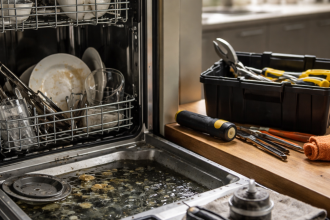
Most washing machines won’t attempt a spin cycle if water hasn’t drained properly. The logic is straightforward: spinning a drum full of water would put enormous stress on bearings and motor, so the machine waits. If you find standing water in the drum at the end of a cycle, the spin failure is a symptom rather than the root problem — drainage is what needs attention first.
The drain filter is the first place to check. On front-loading machines, it’s typically accessed through a small panel at the lower front. It catches lint, coins, buttons and other debris, and when clogged, it prevents water from leaving efficiently. The filter should be cleaned every few months as routine maintenance, but many people discover it for the first time only when something goes wrong.
Before opening the drain filter, place a shallow tray and some towels beneath it — there will almost always be residual water, sometimes quite a lot. This is normal and expected; the tray prevents what could otherwise be a surprisingly large puddle on your floor.
The drain hose itself can become kinked, especially if the machine has been moved or if it’s pressed against the wall. A kinked hose restricts water flow in the same way a blocked filter does. Check that the hose has a gentle curve rather than a sharp bend, and that the end sits at the correct height in the standpipe — too low and water can siphon back in, too high and it may not drain at all.
Mechanical and electrical components that commonly fail
When simple causes have been ruled out, the issue is more likely a component failure. Several parts are statistically more likely to be responsible than others.
The drive belt connects the motor to the drum on belt-driven machines. Over years of use, it can stretch, crack or snap entirely. A broken belt means the motor runs but the drum doesn’t turn. You may hear the motor running during the spin cycle with the drum staying still, or the machine may display an error code related to drum movement. Replacing a drive belt is a moderately straightforward repair for someone comfortable with appliances, but requires access to the back or underside of the machine.
The motor carbon brushes wear down gradually and eventually lose contact, causing the motor to run intermittently or stop producing enough torque for spinning. Brushes are a consumable component and are designed to be replaced — they’re inexpensive and the replacement process, while requiring some disassembly, is within reach for a competent DIY repair.
| Component | Symptoms when failing | DIY difficulty |
|---|---|---|
| Drive belt | Motor runs, drum doesn’t move; belt smell | Moderate |
| Carbon brushes | Intermittent spinning; sparking sound from motor | Moderate |
| Door interlock switch | Machine won’t spin even with door closed properly | Moderate |
| Control board | Erratic behaviour; error codes; partial cycle completion | Complex |
| Drum bearings | Loud rumbling or grinding during spin | Complex — often not cost-effective |
Error codes and what they’re telling you
Modern washing machines display error codes when they detect a fault, and these codes are genuinely useful rather than just cryptic numbers. Common codes related to spin problems typically reference door lock failure, drainage timeout, motor fault or drum position sensor error.
The specific code and its meaning vary between manufacturers, but the model number on your machine combined with a search for that error code will almost always bring up a precise diagnosis. Manufacturer documentation, repair forums and video tutorials for specific models have made component-level troubleshooting significantly more accessible than it used to be.
When the repair calculation tips toward replacement
- If drum bearings have failed on an older machine, the repair cost often approaches or exceeds the value of the appliance
- Control board failure on a machine outside warranty is expensive to diagnose and replace professionally
- Multiple simultaneous faults on an older machine suggest cumulative wear across components
- Machines over ten years old with a major mechanical failure may not be worth repairing economically
If you’re uncertain whether repair is worthwhile, get a written diagnostic quote from a repair service before committing. A good technician will be honest about whether the repair makes financial sense. The quote itself is useful information even if you decide not to proceed — it tells you exactly what’s wrong and gives you the option to source parts and attempt the repair yourself if the labour cost is the main barrier.
Spin cycle failures sit across a wide spectrum of severity. Some resolve in two minutes by redistributing the laundry. Others require a forty-pound part and an afternoon of work. And some signal that the machine has reached the end of its economically useful life. Working through the diagnostic steps in order — from the simplest explanations first — saves time, money and the frustration of replacing parts that weren’t actually the problem.