Those white flakes on your shoulders often have less to do with poor hygiene than most people assume — and knowing how to get rid of dandruff starts with understanding what’s actually causing it. Whether you’ve been dealing with it for years or it suddenly appeared out of nowhere, the good news is that it’s manageable, and in many cases, fully controllable with the right approach.
What’s really behind dandruff
Dandruff is primarily caused by a yeast-like fungus called Malassezia, which lives on everyone’s scalp. In some people, it triggers an accelerated shedding of skin cells, leading to the visible flaking. Other contributing factors include seborrheic dermatitis, dry scalp, sensitivity to certain hair products, and hormonal fluctuations. It’s worth noting that oily scalp and dry scalp can both cause dandruff — but for completely different reasons, which means the treatment approach differs too.
Understanding your specific scalp type is the first practical step. If your flakes are large, yellowish, and accompanied by oiliness or redness, seborrheic dermatitis is likely involved. If the flakes are small, white, and your scalp feels tight or itchy without much oiliness, a dry scalp is more probable.
Medicated shampoos — where to actually start
For most people, the most effective first-line treatment is an anti-dandruff shampoo with clinically proven active ingredients. Not all dandruff shampoos work the same way, so matching the ingredient to your scalp condition matters.
| Active ingredient | How it works | Best for |
|---|---|---|
| Zinc pyrithione | Antifungal and antibacterial action | Mild to moderate dandruff |
| Selenium sulfide | Slows down skin cell turnover | Oily scalp, persistent flaking |
| Ketoconazole | Targets Malassezia directly | Stubborn or recurring dandruff |
| Coal tar | Reduces scaling and inflammation | Seborrheic dermatitis |
| Salicylic acid | Exfoliates and removes buildup | Flaky, product-clogged scalp |
A common mistake is switching shampoos too frequently. Give any medicated formula at least four weeks of consistent use before deciding whether it’s working. Leave it on your scalp for two to three minutes before rinsing — most people wash it off too quickly to let the active ingredients do anything.
Habits that quietly make dandruff worse
Beyond product choices, certain everyday habits create an environment where dandruff thrives. These aren’t always obvious, which is why addressing them alongside treatment makes a real difference.
- Washing your hair too infrequently allows sebum and dead skin cells to accumulate, feeding the Malassezia fungus.
- Hot water strips natural oils and disrupts the scalp’s microbiome, increasing irritation.
- Stress is a well-documented trigger — cortisol can amplify inflammatory scalp conditions.
- Tight hats or helmets worn for long periods trap heat and moisture, worsening flare-ups.
- Overusing dry shampoo creates product buildup that can aggravate the scalp.
Dermatologists consistently point out that stress management is one of the most underrated tools in scalp health — not because it’s a cure, but because chronic stress measurably worsens inflammatory skin conditions, including seborrheic dermatitis.
Natural remedies — what has evidence behind it
There’s a lot of noise online about home remedies for dandruff, but only a few have meaningful research to back them up. Tea tree oil is one of them — studies have shown that shampoos with a 5% concentration of tea tree oil can significantly reduce dandruff severity. It has antifungal properties that target Malassezia without being as harsh as pharmaceutical options.
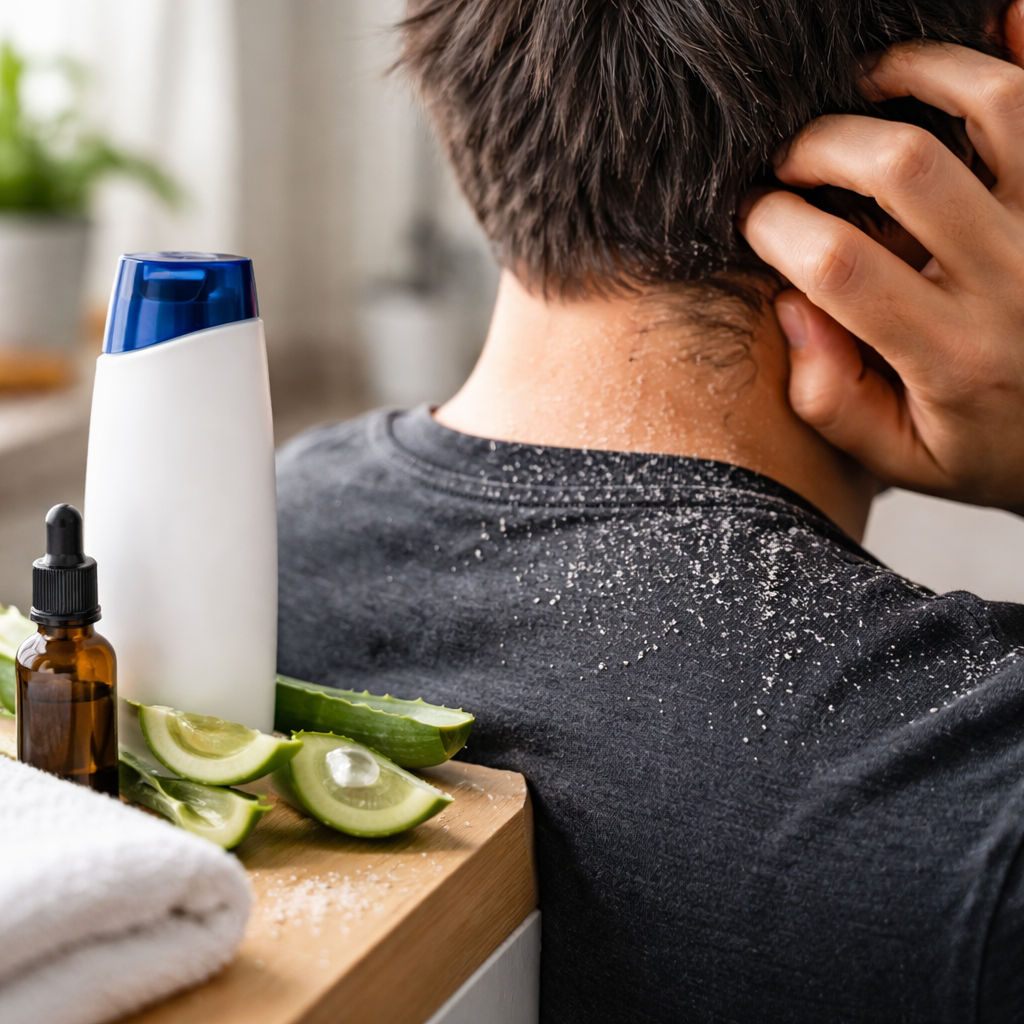
Apple cider vinegar is frequently recommended, but the evidence here is anecdotal. It may help temporarily by adjusting scalp pH, but it can also cause irritation if used undiluted or too often. Aloe vera, on the other hand, has demonstrated anti-inflammatory and antifungal activity in multiple small studies, making it a reasonable addition to a scalp care routine — particularly for soothing itchiness.
Diet, hydration, and scalp health
Your scalp is skin, and skin health is closely tied to what you eat. Deficiencies in zinc, B vitamins (particularly B6 and B12), and omega-3 fatty acids have been linked to increased sebum production and a weakened skin barrier — both of which create better conditions for dandruff to develop.
Foods rich in these nutrients include fatty fish, eggs, legumes, nuts, and leafy greens. Highly processed foods and excessive sugar may amplify inflammatory responses that worsen scalp conditions in people already prone to them. Staying well hydrated helps maintain the skin barrier, though it won’t reverse dandruff on its own.
When to talk to a dermatologist
Most cases of dandruff respond well to over-the-counter treatment within a few weeks. However, there are situations where professional evaluation makes sense — not because dandruff is dangerous, but because what looks like dandruff might be something else entirely.
- Symptoms persist after six to eight weeks of consistent medicated shampoo use.
- There’s significant redness, swelling, or sores on the scalp.
- Hair thinning or loss appears alongside the flaking.
- The condition spreads to the eyebrows, sides of the nose, or ears — common in seborrheic dermatitis.
- Over-the-counter antifungal shampoos provide no relief at all.
A dermatologist can prescribe stronger topical treatments, including corticosteroids for inflammation or prescription-strength ketoconazole, and can rule out psoriasis or eczema, which sometimes mimic dandruff in appearance.
Making peace with long-term scalp care
For many people, dandruff isn’t something that gets “cured” once and never returns — it’s a condition that requires ongoing management. That doesn’t mean daily medicated shampoo forever. Once symptoms are under control, many people find that using an anti-dandruff shampoo once a week is enough to keep flaking from coming back, while using a gentler formula for regular washes in between.
Paying attention to your scalp’s signals — whether it feels irritated after switching products, whether stress seems to trigger flare-ups, whether certain seasons make it worse — builds a personalized approach that works far better than any generic routine. The scalp is often treated as an afterthought in skincare, but giving it consistent, informed attention pays off visibly and quickly.