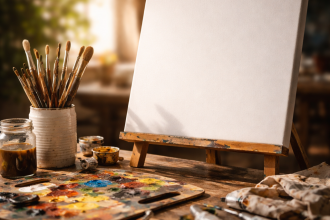
Most people who sit down with a blank page don’t lack talent — they lack a starting point. That’s exactly where ideas for drawing become more valuable than technique itself. A single prompt or an unexpected angle can turn hesitation into a full creative session without forcing anything.
Why your subject matter shapes everything
The choice of what to draw affects not only the result but also how much you enjoy the process. Repeating the same subjects out of habit gradually drains motivation, even for experienced artists. Switching themes — even slightly — reactivates curiosity and sharpens observation skills in ways that technical exercises rarely do.
That said, not every idea works equally well at every skill level. Some concepts demand a solid understanding of proportion and perspective, while others are genuinely accessible to beginners and still rewarding for seasoned illustrators. The goal here is to offer a range that serves both ends of that spectrum.
Drawing from everyday surroundings
One of the most underrated approaches is drawing objects already around you. A coffee cup, a pile of books, a window view at different times of day — these mundane subjects carry real complexity when observed closely. Shadows, textures, and reflections in ordinary objects offer genuine challenges without requiring special references.
Observation is the foundation of all drawing. Before you look for exotic subjects, try truly seeing what’s already in front of you.
Still life drawing in particular is a classic exercise for a reason. It teaches light source awareness, compositional thinking, and patience — all transferable skills regardless of your preferred style or medium.
Subject categories worth exploring
If you’re looking to push beyond your usual range, here’s a breakdown of categories that consistently generate strong creative output across different styles:
| Category | Example subjects | Skills developed |
|---|---|---|
| Nature & botany | Leaves, mushrooms, tree bark, flower cross-sections | Detail work, organic line quality |
| Urban environments | Street corners, rooftops, fire escapes, storefronts | Perspective, architectural proportion |
| Human figure | Hands, expressive faces, seated poses, gesture sketches | Anatomy, movement, proportions |
| Imaginary worlds | Invented creatures, fantasy maps, surreal landscapes | Conceptual thinking, world-building |
| Texture studies | Fabric folds, water surfaces, cracked walls, fur | Rendering technique, patience |
Each of these categories also branches naturally into more specific prompts. Urban environments, for example, open up into night scenes with artificial lighting, rainy reflections on pavement, or the geometry of construction sites — all visually distinct challenges with their own technical demands.
Concept-driven prompts that push creative thinking
Sometimes the most useful drawing prompts aren’t about objects at all — they’re about ideas or emotions. These concept-driven subjects force you to make decisions about symbolism, composition, and visual storytelling rather than just reproducing a reference.
- Draw a feeling without using a human face — represent sadness, joy, or tension purely through environment and objects
- Illustrate a moment just before or just after an event, leaving the key action implied
- Create a visual diary entry for a specific day using only symbols and small sketches
- Design a space that belongs to a fictional character whose personality is implied by the objects inside
- Draw the same simple subject — a chair, a doorway — in three completely different moods using only line weight and composition
These kinds of exercises are used in illustration and concept art education precisely because they demand intentional decision-making. They’re not just warm-ups — they’re the foundation of visual communication skills.
How to use limitations as creative fuel
Constraints are among the most effective tools for generating ideas when inspiration feels scarce. Limiting yourself to a single pen, a five-minute timer, or one specific color forces the brain to work differently — and often produces more interesting results than total freedom.
Other useful constraints include drawing only in silhouette, working in extreme close-up so the full subject isn’t visible, or combining two unrelated objects into a single coherent image. Each of these produces a genuinely different visual problem to solve.
Building a personal idea bank that actually works
Rather than searching for inspiration each time you sit down to draw, many artists maintain a running list of ideas collected throughout their daily life. This doesn’t need to be elaborate — a notes app, a small notebook, or even a folder of saved photos works perfectly.
The habit of collecting visual references, interesting textures photographed on a walk, or fragments of scenes noticed in passing builds a personal archive that reflects your actual interests. Over time, it becomes far more useful than generic prompt lists because it’s filtered through your own sensibility.
- Photograph interesting light conditions whenever you notice them
- Save examples of compositions that caught your eye, regardless of style
- Note down fleeting mental images or dream fragments — they’re often strong visual concepts
- Revisit the list during creative blocks rather than starting from zero
The real starting point is the decision to begin
No list of drawing subjects replaces the act of actually picking up a pencil. Inspiration tends to follow action more reliably than it precedes it — the clarity about what to draw often comes after the first few marks, not before. Treating the blank page as a problem to solve rather than a barrier removes a significant amount of pressure.
Keep the process low-stakes when you’re searching for ideas. Not every session needs to produce finished work. Sketching loosely, experimenting with unfamiliar subjects, and drawing badly on purpose are all legitimate parts of the creative process — and frequently lead to the most interesting directions to pursue seriously.