Most people can name a penguin, but very few can tell you why these birds never get frostbite or how they manage to drink seawater without getting sick. The facts about penguins go far beyond black-and-white feathers and awkward waddling — and once you start digging into the biology, behavior, and social lives of these birds, it becomes genuinely hard to stop.
They are birds that chose the ocean over the sky
Penguins are flightless seabirds that evolved from flying ancestors millions of years ago. Over time, their wings transformed into flippers — a trade-off that made them extraordinary swimmers rather than aerial creatures. In water, penguins are remarkably agile, reaching speeds of up to 25 km/h and diving to depths exceeding 500 meters in the case of Emperor penguins.
What makes this even more fascinating is how perfectly their bodies adapted to aquatic life. Their bones are denser than those of flying birds, which helps with buoyancy control underwater. Their feathers, despite looking soft, are tightly packed — up to 100 feathers per square inch — forming a waterproof, insulating layer that functions like a wetsuit.
Where penguins actually live might surprise you
Antarctica gets most of the attention, but penguins inhabit a much wider range of environments. Of the 18 recognized species, only a handful live in polar regions. The rest are distributed across sub-Antarctic islands, coastal South America, South Africa, New Zealand, and even the Galápagos Islands — where the Galápagos penguin lives just a short distance from the equator.
| Species | Habitat | Interesting trait |
|---|---|---|
| Emperor penguin | Antarctica | Deepest diver among all penguin species |
| Little Blue penguin | Australia, New Zealand | Smallest penguin species, about 33 cm tall |
| Galápagos penguin | Galápagos Islands | Only penguin found north of the equator |
| African penguin | South Africa, Namibia | Also called the jackass penguin due to its call |
| Macaroni penguin | Sub-Antarctic islands | Most numerous penguin species in the world |
The social life of a penguin colony is more complex than it looks
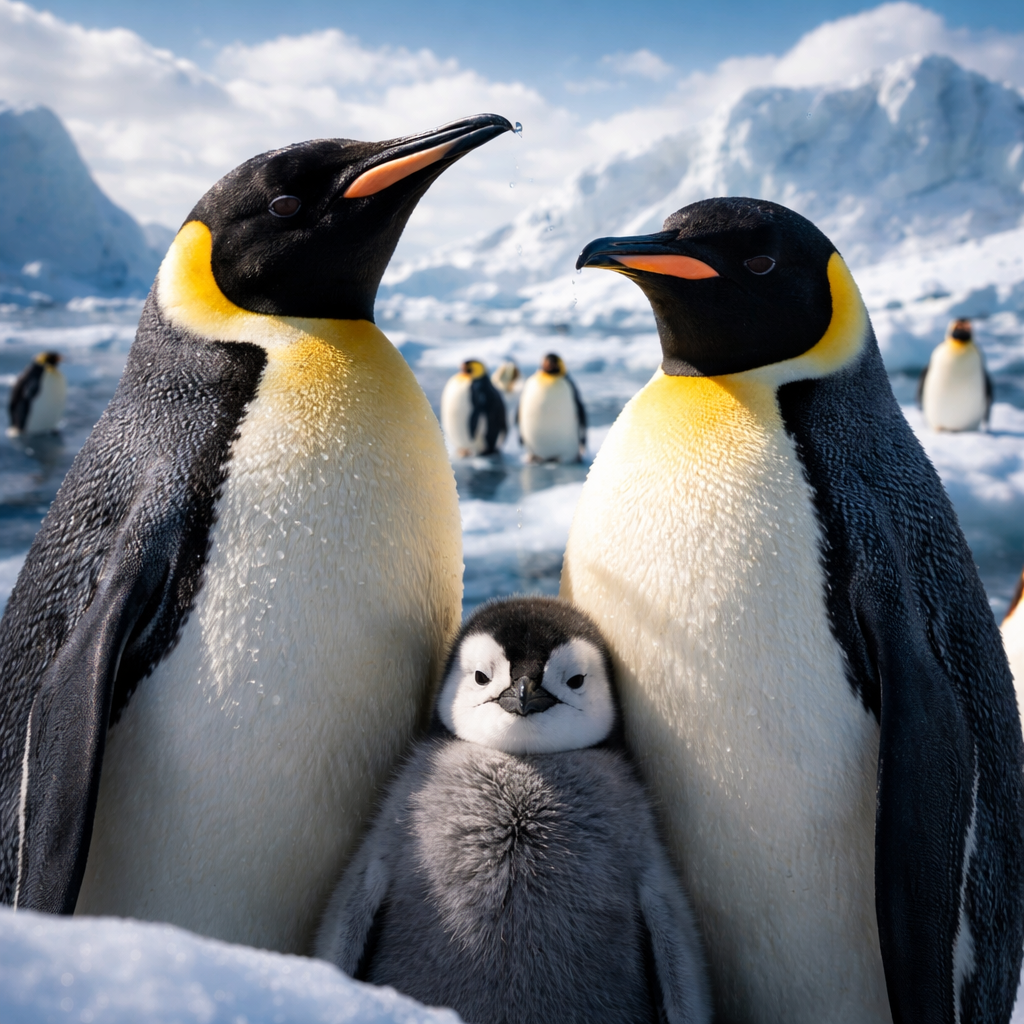
Penguin colonies — sometimes called rookeries — can contain hundreds of thousands of birds. Within that noise and density, individual penguins identify their partners and chicks by voice alone. Each bird has a unique call, and the accuracy of this recognition is remarkably precise even in the middle of a massive, loud colony.
Emperor penguin males incubate a single egg for around 65 days in Antarctic winter temperatures that can drop to –60°C — doing so while standing upright, balancing the egg on their feet, and going without food the entire time.
Many penguin species are monogamous within a breeding season, and some pairs reunite year after year. Courtship rituals vary by species — some exchange pebbles as gifts, while others perform elaborate synchronized movements. These behaviors are not simply instinct; they involve recognition, memory, and choice.
Penguin biology: built for survival in extreme conditions
One of the most common questions people have is how penguins handle the cold. The answer involves several overlapping systems working together:
- Counter-current heat exchange in their flippers and legs keeps warm blood from losing heat to the environment before it reaches extremities.
- A thick layer of subcutaneous fat acts as thermal insulation and an energy reserve during fasting periods.
- Their dense, overlapping feathers trap a layer of warm air close to the skin.
- Huddling behavior in Emperor penguins allows the group to conserve heat collectively — individuals rotate from the cold outer edge to the warmer center of the huddle.
On the other side of the temperature challenge, species living in warmer climates — like African or Galápagos penguins — have bare patches of skin around the eyes and face that help dissipate excess body heat. Evolution, in this case, worked in both directions.
What penguins eat and how they drink
Penguins are carnivores that feed primarily on fish, squid, and krill, depending on the species and geographic location. They catch prey underwater using their beak and swallow it whole, often head-first to avoid spines and fins getting stuck.
As for hydration — penguins have a supraorbital gland located above the eye that filters salt from seawater. This allows them to drink ocean water directly and excrete the excess salt through their nasal passages. It is an elegant biological solution that means they are never far from a source of fresh water, even in the middle of the ocean.
Conservation status and the real pressures penguins face
Of the 18 penguin species, the majority face some level of conservation concern. Several are classified as vulnerable or endangered. The pressures they face are interconnected and ongoing: shifts in ocean temperature affect prey availability, overfishing reduces food sources, plastic pollution poses ingestion and entanglement risks, and oil spills can destroy the waterproofing of their feathers — which is life-threatening in cold environments.
Climate change is particularly significant for ice-dependent species. Emperor penguins rely on stable sea ice to breed, and reductions in ice extent directly affect their reproductive success. Research stations in Antarctica track these colonies year after year, providing data that feeds into broader climate models.
The penguin brain: smarter than the stereotype
Penguins are often portrayed as clumsy and comical — which makes the reality of their cognitive abilities all the more striking. Studies have shown that penguins demonstrate spatial memory, can recognize individual humans who interact with them regularly, and display problem-solving behavior in captivity. Their social intelligence, particularly around communication and parental cooperation, is well-documented across multiple species.
Interestingly, captive penguins have been observed developing preferences — for certain keepers, certain objects, and certain locations within their enclosures. While this does not place them among the most cognitively complex animals, it does challenge the idea that they are operating purely on instinct.
Once you know these birds, you see them differently
Penguins are genuinely remarkable animals — not in a vague, feel-good way, but in specific, verifiable terms. They have solved problems that evolution poses to very few creatures: how to thrive in extreme cold, how to navigate vast oceans and return to exact locations, how to recognize individuals within enormous crowds, and how to sustain themselves in environments with almost no fresh water. Each of those solutions is built into their biology and behavior in ways that researchers are still working to fully understand. If there is one thing that following the science on penguins makes clear, it is that the most interesting details are rarely the ones that make it into popular culture.