You press the start button, and nothing happens — or the drum spins but your clothes come out just as damp as they went in. A dryer not working is one of those household problems that can throw off your entire routine, especially on a busy day. The good news is that most dryer issues have identifiable causes, and a fair number of them can be resolved without calling a technician.
Start with the obvious: power and settings
Before diving into mechanical causes, it’s worth checking a few things that are easy to overlook. A surprising number of service calls turn out to be unnecessary — the problem was something simple.
- Make sure the dryer is properly plugged in and the outlet is functioning
- Check your home’s circuit breaker — electric dryers use a double breaker, and if one leg trips, the drum may spin but produce no heat
- Verify the door is fully latched; most dryers won’t start at all if the door switch isn’t engaged
- Confirm the cycle settings — some eco or delicate modes run at very low heat and take much longer than expected
If everything looks fine on the surface and the machine still won’t respond, it’s time to look a little deeper.
No heat? The thermal fuse is usually the first suspect
One of the most common reasons a dryer runs but produces no heat is a blown thermal fuse. This small component is a safety device — it cuts off heat if the dryer overheats. Once it blows, it doesn’t reset on its own.
A thermal fuse is a one-time device. Unlike a circuit breaker, it cannot be reset — it must be replaced once it has blown.
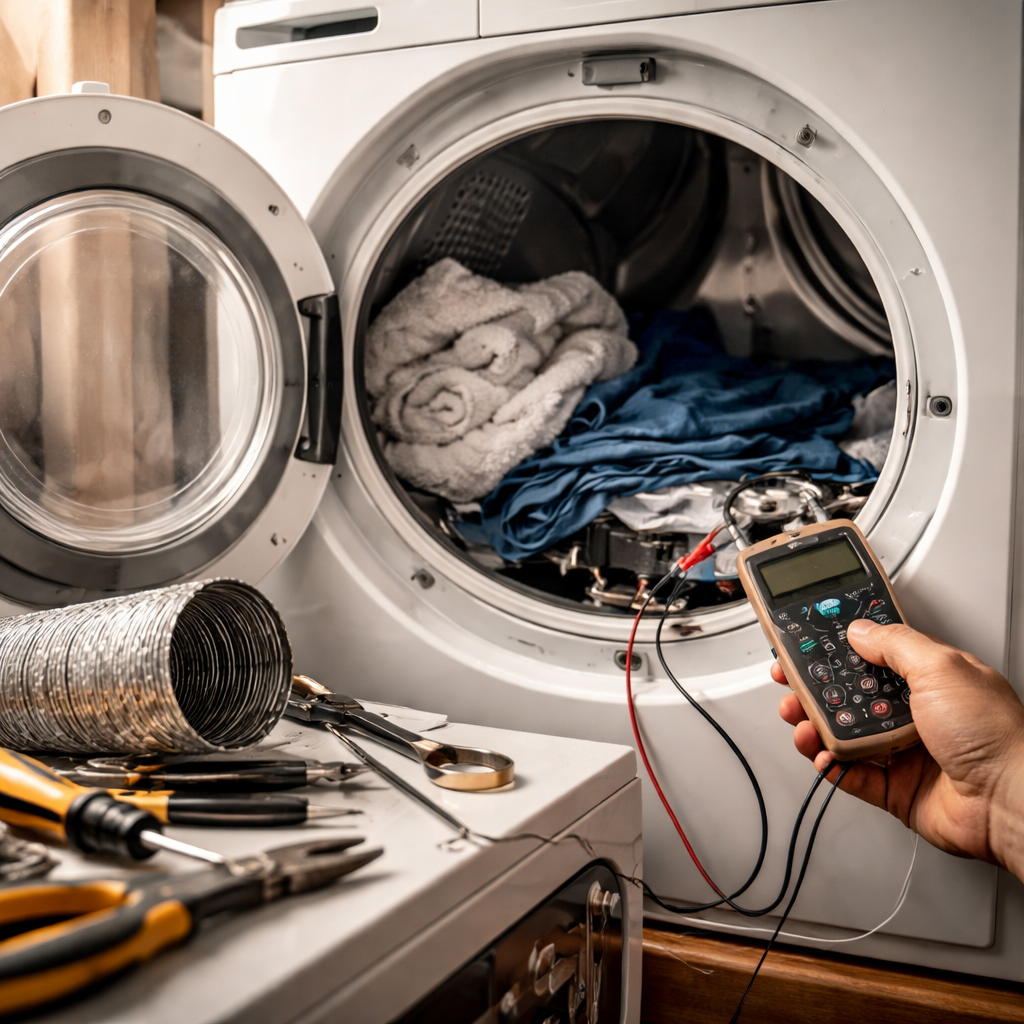
The thermal fuse is typically located near the exhaust duct inside the dryer cabinet. You can test it with a multimeter — if there’s no continuity, it needs to be replaced. They’re inexpensive parts, usually under $10, and fairly straightforward to swap out if you’re comfortable with basic appliance repair.
But here’s the important part: replacing the fuse without addressing why it blew in the first place means it will likely blow again. The most frequent cause is restricted airflow — which brings us to the next section.
Clogged lint trap and venting: the root of most dryer problems
Restricted airflow is behind a huge share of dryer malfunctions. When hot, moist air can’t escape efficiently, the dryer has to work harder, takes longer to dry clothes, and can overheat — triggering safety cutoffs or causing component failures over time.
| Symptom | Likely airflow-related cause |
|---|---|
| Clothes take two or more cycles to dry | Partially blocked vent duct |
| Dryer gets very hot on the outside | Lint buildup restricting exhaust |
| Burning smell during operation | Lint accumulation near heating element |
| Dryer shuts off mid-cycle | Thermal overload protection triggered |
Clean the lint filter before every load — this is non-negotiable. But the lint trap alone isn’t enough. The exhaust duct that runs from the back of your dryer to the outside wall also collects lint over time and should be cleaned at least once a year, more often if you do laundry frequently.
When the drum spins but nothing else works right
If the drum is turning but the dryer isn’t heating, and the thermal fuse checks out fine, there are a few other components worth investigating depending on whether you have a gas or electric model.
For electric dryers, the heating element itself can burn out. It’s a coiled wire that generates heat, and over time it can break. A visual inspection often reveals the break, but a multimeter test is more reliable.
Gas dryers rely on an igniter and gas valve coils. If the igniter glows but the burner doesn’t stay lit, the radiant flame sensor or valve coils may have failed. These are common wear parts on gas models and can be replaced as a set.
In both cases, a high-limit thermostat — separate from the thermal fuse — can also fail and interrupt heating. It’s a good idea to test it alongside the fuse when troubleshooting.
The dryer won’t start at all
A completely unresponsive dryer — no lights, no sounds, no movement — points toward an electrical issue or a failed control component. Here’s a logical order for checking:
- Test the wall outlet with another device or use a multimeter to confirm voltage
- Inspect the power cord for damage, especially where it connects to the terminal block at the back of the machine
- Check the door switch — this small switch can wear out and prevent startup even when the door appears closed
- On models with a control panel, a failed start switch or timer motor can be the culprit
- Some dryers have a push-to-reset thermal overload button located on the back panel — worth checking if your model has one
If the control board has failed, diagnosis becomes more complex and the cost of replacement may push you toward a professional assessment or a decision about whether repair makes financial sense compared to replacement.
Unusual noises and what they mean
Strange sounds during operation are often the first warning that something is wearing out — and catching it early can prevent a more serious breakdown.
- Squealing or squeaking: worn drum support rollers or a dry idler pulley — these need lubrication or replacement
- Thumping or banging: drum glides (also called drum slides or bearing pads) may be worn down
- Rattling: a loose item inside the drum, or an object caught between the drum and the cabinet
- Grinding: a failing drum bearing or worn drum seal
These aren’t emergencies, but they shouldn’t be ignored. Running a dryer with worn support rollers or a failing bearing puts stress on the drive belt and motor, which are significantly more expensive to replace.
Knowing when to repair and when to replace
A useful general guideline: if the repair cost exceeds 50% of the price of a comparable new dryer, and the machine is already more than 8–10 years old, replacement often makes more economic sense. Dryers have an average lifespan of around 10–13 years with regular maintenance.
That said, many repairs — a thermal fuse, drum rollers, an igniter — cost very little and can extend the life of a machine by several more years. If the drum, motor, and control board are all in good shape, fixing a single component is almost always worthwhile.
Most dryer problems follow predictable patterns. With a bit of patience and a willingness to look under the hood, you can often diagnose the issue yourself — and decide from an informed position whether to fix it, hire help, or move on to something new.