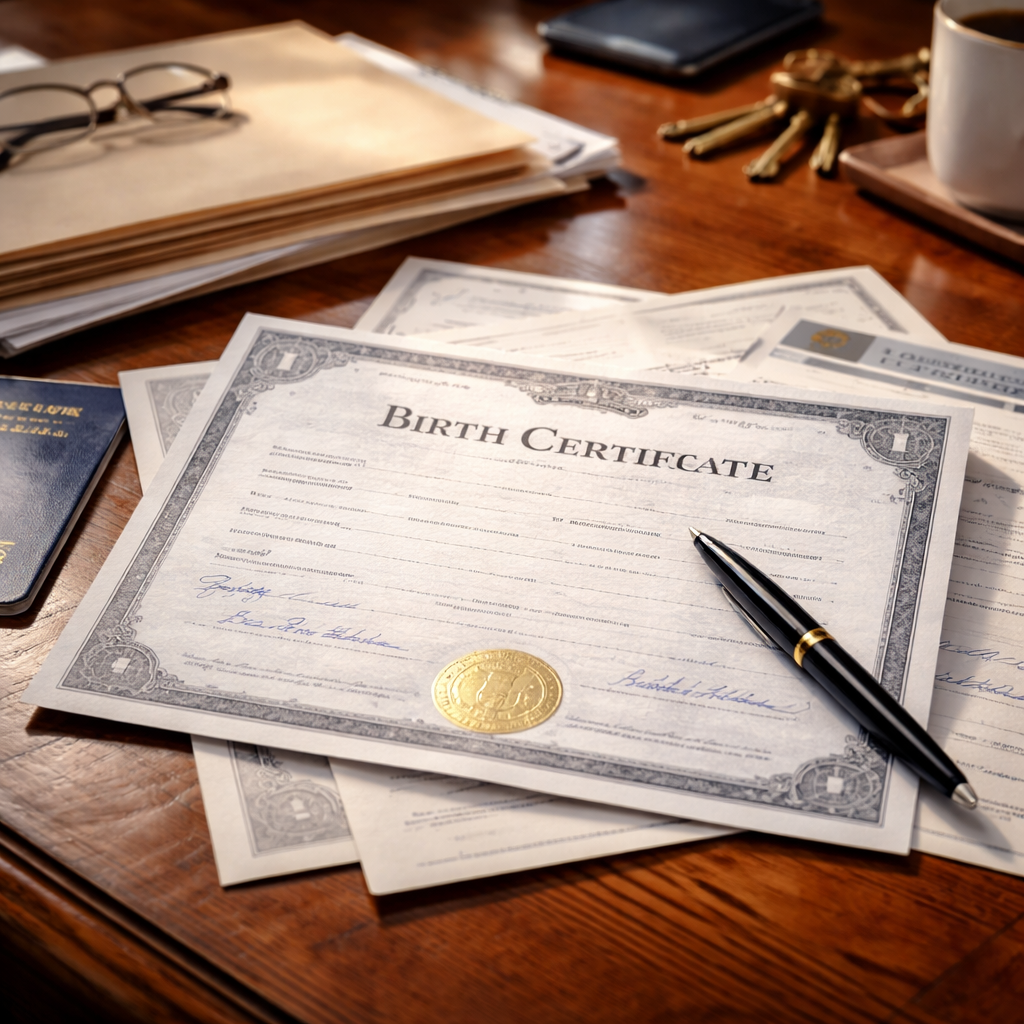
Most people only realize how many doors a birth certificate opens when they suddenly need one — for a passport application, school enrollment, a marriage license, or even a new job. Knowing how to get a birth certificate before you’re in a rush can save you a surprising amount of stress and time.
What a birth certificate actually is (and why it matters more than you think)
A birth certificate is an official civil registration document that records the facts of a person’s birth — full name, date, place, and parentage. It serves as the foundation of your legal identity. Without it, you can’t prove citizenship, obtain government-issued ID, access social services, or register a child in school. In many countries, it’s the very first document a person receives in life, and in many ways, it remains the most important one.
What surprises many people is that even if they were born in a hospital, a birth certificate isn’t automatically handed to the parents and stored forever in some perfectly organized archive. Records can be lost, damaged, or simply not requested in the first place. Understanding the system behind vital records registration helps you navigate the process with confidence.
Who can request a birth certificate — and who cannot
Not everyone can walk up and request any birth certificate. Most jurisdictions have strict rules about who qualifies as an authorized requester. Generally, the following individuals are eligible:
- The person named on the certificate (if they are an adult)
- A parent or legal guardian listed on the record
- A spouse or domestic partner (with documentation)
- A legal representative or attorney acting on behalf of the registrant
- Certain government agencies with a legitimate purpose
If you’re requesting a certificate on behalf of someone else — for instance, an elderly parent or a minor child — be prepared to provide supporting documentation that proves your relationship or legal authority. This step is often overlooked, and it’s one of the most common reasons applications get delayed.
The main ways to obtain a certified copy
There is no single universal method, but most jurisdictions offer several options. The right one for you depends on how quickly you need the document and where you’re located.
| Method | Processing Time | Best For |
|---|---|---|
| In-person at the vital records office | Same day to a few days | Urgent needs, local residents |
| Mail-in application | Several weeks | Those who prefer paper processes |
| Online through official government portals | Varies (often 1–3 weeks for delivery) | Convenience-focused applicants |
| Through a third-party service | Depends on the service | People unfamiliar with the process |
Whichever route you choose, always verify that you’re dealing with the official vital records office for the state, province, or country where the birth occurred. A birth certificate must be obtained from the jurisdiction of birth — not where you currently live.
Step-by-step: what the application process looks like
While specific requirements vary by location, the general process follows a consistent pattern. Here’s what to expect:
- Identify the correct issuing authority — this is typically the state or county vital records office, civil registry, or equivalent government body in the country of birth.
- Gather your required documents — a valid government-issued photo ID, proof of relationship if requesting for someone else, and any additional supporting paperwork the office requires.
- Complete the application form — most offices have downloadable forms on their official websites. Fill it out carefully, as errors or omissions can cause delays.
- Pay the applicable fee — fees vary widely but typically range from a nominal amount to around $30 USD or the local equivalent per certified copy.
- Submit your application — in person, by mail, or online depending on what the office accepts.
- Wait for processing — and follow up if you haven’t received confirmation within the stated timeframe.
Always request at least two certified copies at once. Many legal processes — immigration applications, estate proceedings, school enrollment — require an original certified copy each time, and ordering them together is almost always cheaper than reordering later.
What if the birth was never registered?
Late registration of birth is more common than most people assume, particularly for individuals born at home, in rural areas, or in countries where civil registration systems were inconsistent. If no record exists in the official database, the process becomes more involved but is still very much possible.
In these cases, you’ll typically need to gather secondary evidence of birth — hospital discharge records, baptismal certificates, school enrollment records, sworn affidavits from witnesses such as midwives or family members, and census or household records. The exact combination of documents required depends heavily on local law and how long ago the birth occurred.
It’s worth consulting a legal aid organization or a family law attorney if you’re dealing with a late registration, especially if the birth happened in another country and you’re trying to establish citizenship or residency rights.
Replacing a lost or damaged birth certificate
A common misconception is that a replacement birth certificate is somehow a lesser document. In reality, a certified copy issued today by the vital records office carries exactly the same legal weight as the one issued the day after the birth was registered. The original record lives in the government archive — what you hold in your hands is always a certified copy of that record.
The replacement process follows the same steps as any other request. You don’t need to explain why your previous copy was lost or damaged — you simply apply for a new certified copy as you normally would.
Practical tips to avoid common mistakes
A few small missteps can turn a simple process into a weeks-long ordeal. Keep these points in mind before you submit anything:
- Double-check the spelling of all names on the application — even a minor discrepancy can flag your request for manual review.
- Use certified mail or a tracked delivery option if submitting by post, and keep copies of everything you send.
- Only use official government websites when applying online — third-party services can be legitimate, but they also charge additional fees and are not required.
- Check whether the office requires a notarized signature — some do, especially for mail-in requests.
- Be aware that processing times can increase significantly during peak periods or following natural disasters and other disruptions to government services.
When you finally have it in hand
Once you receive your certified copy, store it somewhere safe — a fireproof document box or a secure folder kept in a consistent location at home. Scanning it and keeping a digital backup is also wise, though digital copies are not accepted as legal substitutes for certified paper copies in most official contexts.
If you anticipate needing it frequently — for immigration proceedings, ongoing legal matters, or adoption processes — having two or three certified copies on hand is a practical investment. The peace of mind that comes from knowing your vital records are in order is genuinely one of those small life admin wins that pays off in unexpected moments.