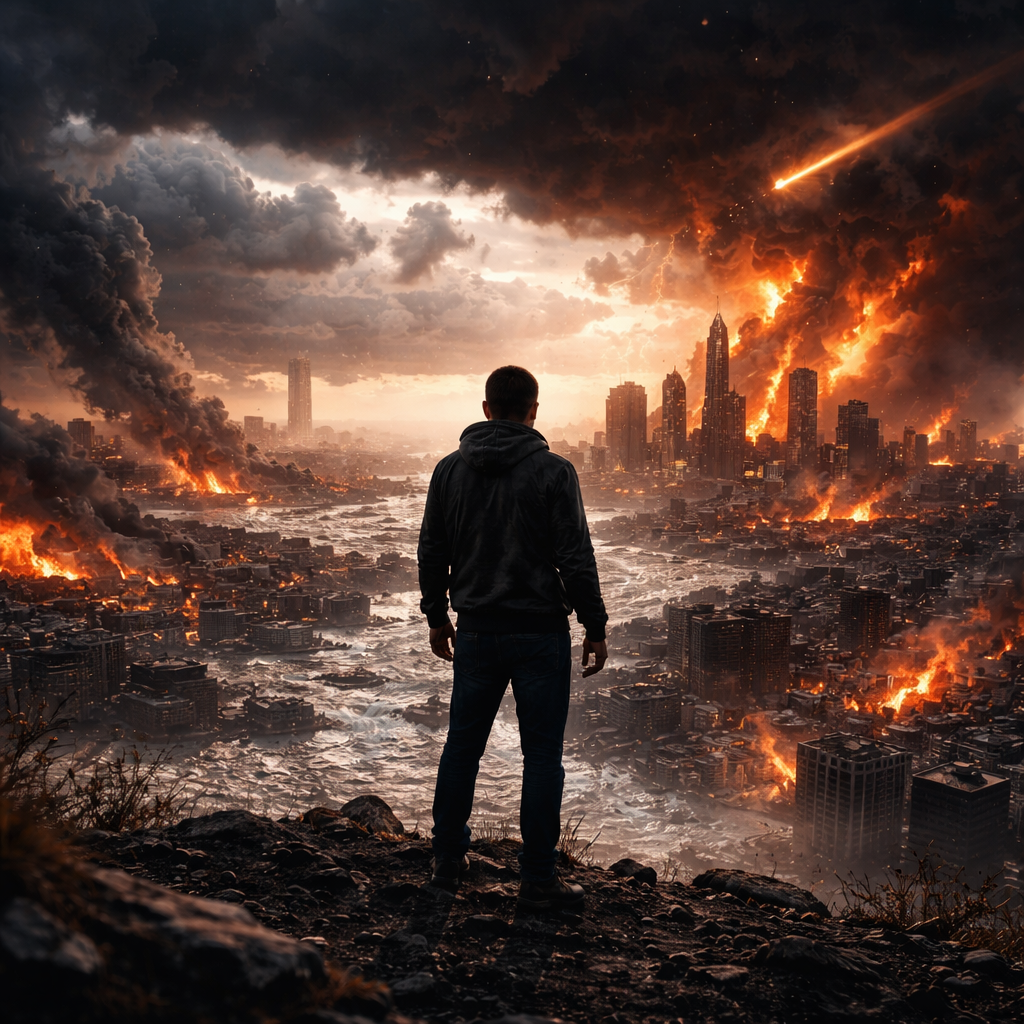
Most people wake up from an apocalyptic dream with their heart racing — and immediately wonder what dream about the end of the world mean in terms of their inner life, psychology, or even their waking circumstances. Interestingly, these dreams are far more common than most people realize, and they rarely signal anything catastrophic about your future.
Why the brain stages apocalyptic scenarios while you sleep
Dreams of floods swallowing cities, skies turning red, or the ground splitting apart are not random noise. The sleeping brain draws on the imagery it knows best — and in a media-saturated world, apocalyptic visuals are everywhere. But beyond cultural exposure, researchers in the field of dream psychology consistently point to one core mechanism: the brain uses dramatic, large-scale imagery to represent emotional states that feel equally overwhelming in waking life.
When something in your daily reality feels out of control — a relationship reaching a breaking point, a career shift that threatens your sense of stability, or prolonged anxiety — the subconscious mind doesn’t whisper. It stages a disaster film. The scale of the dream destruction often mirrors the scale of the internal pressure you’re carrying.
What different end-of-the-world scenarios tend to reflect
Not all apocalyptic dreams carry the same emotional weight. The specific type of catastrophe you dream about can offer meaningful clues about what’s going on beneath the surface.
| Dream scenario | Common psychological association |
|---|---|
| Flood or rising water | Feeling emotionally overwhelmed, suppressed feelings surfacing |
| Fire or burning world | Intense anger, burnout, or passionate transformation |
| Nuclear explosion | Fear of sudden, irreversible change or conflict |
| Meteor or asteroid impact | Sense of an uncontrollable external force disrupting your life |
| Zombie apocalypse | Feeling surrounded by people who seem emotionally absent or threatening |
| Darkness swallowing everything | Depression, fear of loss, or grief processing |
These associations come from decades of clinical dream analysis and cognitive behavioral research, not from mystical interpretation. That said, no single meaning fits every dreamer — context always matters.
Survival vs. helplessness: the detail that changes everything
One of the most telling elements in an end-of-the-world dream is not the disaster itself, but your role within it. Pay attention to this distinction:
- If you are actively trying to save others or find a way out, the dream often points to a strong sense of responsibility — perhaps one that’s become a burden.
- If you stand frozen and watch the world collapse around you, it may reflect a feeling of powerlessness in a real-life situation.
- If you feel strangely calm or even relieved during the apocalypse, this can indicate a subconscious desire for a major reset — a wish for something overwhelming in your life to simply end.
- If you wake up feeling grief rather than fear, the dream may be connected to loss — not just of a person, but of an era, a version of yourself, or a relationship dynamic you’ve outgrown.
The emotional residue of a dream — what you feel when you open your eyes — is often more diagnostically meaningful than the visual content of the dream itself.
Dream researchers note that recurring apocalyptic dreams, especially those that follow the same script night after night, deserve particular attention. Repetition in dream content is the subconscious mind’s way of flagging an unresolved issue that your waking self hasn’t yet addressed.
The connection to stress, anxiety, and life transitions
There is a well-documented link between heightened stress levels and the frequency of intense or disturbing dreams. During periods of major life transition — starting a new job, ending a long relationship, relocating, or facing health challenges — apocalyptic dream content tends to spike.
This happens because the brain continues processing unresolved emotional material during REM sleep. The more unresolved tension exists in waking life, the more dramatic the dream theater becomes. In this sense, an end-of-the-world dream can actually be a healthy sign: your mind is working through something difficult rather than shutting it out entirely.
Cultural and collective dimensions of these dreams
It’s also worth acknowledging that apocalyptic dreams don’t always originate entirely from personal psychology. During periods of widespread social uncertainty — economic instability, public health crises, political upheaval — reports of end-of-the-world dreams increase across entire populations. Psychologists refer to this as collective anxiety finding expression through shared dream imagery.
In other words, sometimes your apocalyptic dream is partly your own, and partly a reflection of the emotional atmosphere you’ve been absorbing from the world around you. News cycles, social media, and conversations with others all feed into the raw material the sleeping brain has to work with.
When to take these dreams seriously — and when to let them go
Most end-of-the-world dreams, even vivid and disturbing ones, do not require clinical attention. They are a natural part of how the human mind processes fear, uncertainty, and change. However, there are signals worth paying attention to:
- The dream recurs frequently and disrupts your sleep quality over an extended period.
- You experience significant anxiety or dread in the hours after waking that doesn’t fade.
- The dreams coincide with other symptoms of anxiety or depression that affect your daily functioning.
- You find yourself avoiding sleep because of anticipated nightmares.
If any of these apply, speaking with a therapist — particularly one familiar with dream-focused cognitive approaches or imagery rehearsal therapy — can be genuinely helpful. This isn’t about analyzing dream symbolism in a mystical sense, but about using dream content as a doorway into conversations about what’s actually weighing on you.
What your mind might actually be asking you
Underneath the fire and the falling sky, most apocalyptic dreams carry a quieter question. Something in your life is ending, or feels like it might — and part of you hasn’t fully made peace with that yet. The dream is rarely a warning about the future. More often, it’s a mirror held up to the present.
Instead of treating these dreams as something to be frightened of, try approaching them with genuine curiosity. Ask yourself: what in my current life feels unsustainable? What do I secretly wish would end so something new could begin? The answers won’t always be comfortable — but they tend to be honest. And honest self-knowledge, even when it arrives wrapped in fire and apocalypse, is rarely something to run from.