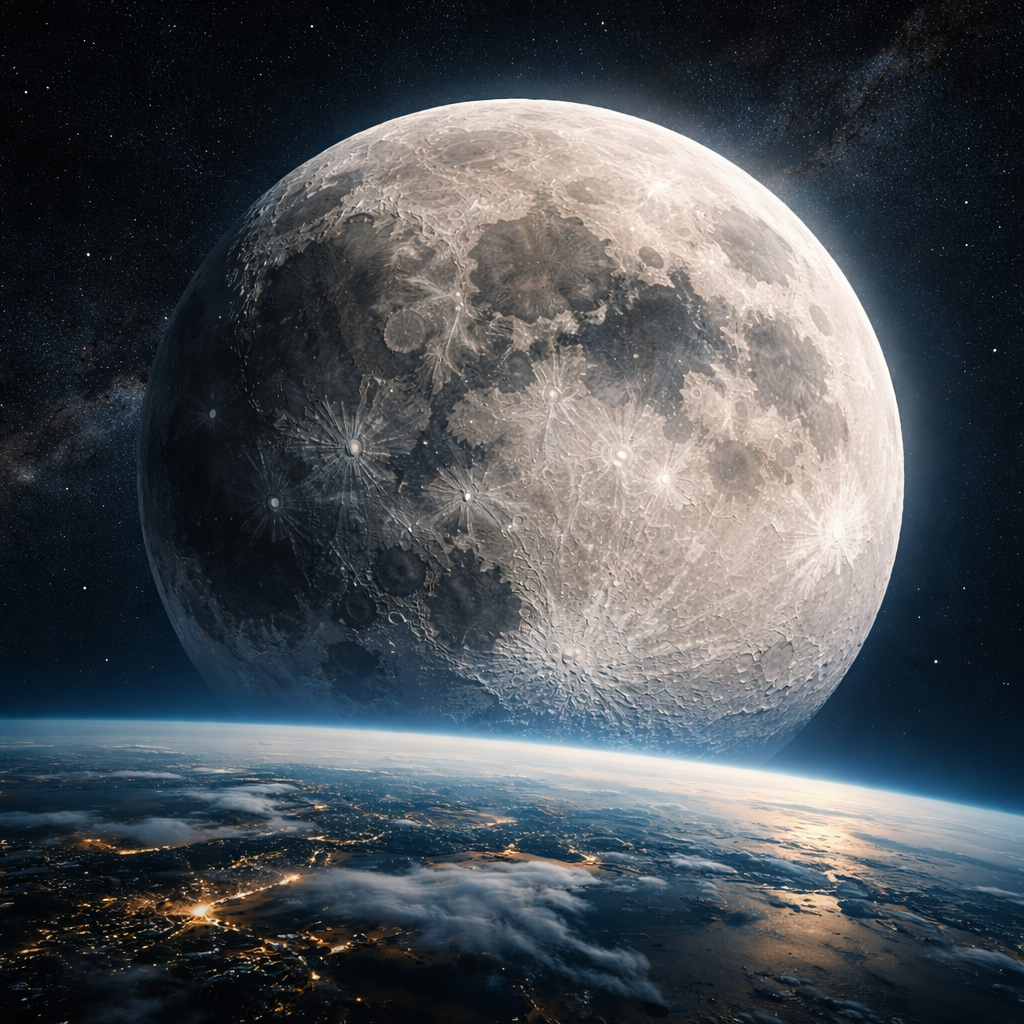
The Moon sits an average of 384,400 kilometers from Earth — close enough to influence our oceans, calendars, and imagination, yet strange enough to keep scientists actively researching its structure and origin. The facts about the moon stretch far beyond what most people learned in school, and some of them will genuinely change the way you look up at the night sky.
Not a perfect sphere — and not alone in its oddities
The Moon is not a true sphere. It bulges slightly on the side that faces Earth due to gravitational forces that have pulled and shaped it over billions of years. This phenomenon is called tidal deformation, and it means the Moon is technically an oblate spheroid — wider at the equator than at the poles. The difference is subtle but measurable.
What surprises many people is that the Moon also has a slightly asymmetrical crust. The near side — the face we always see — has a thinner crust than the far side. Scientists believe this asymmetry may be connected to the Moon’s turbulent formation history, likely involving a massive collision between early Earth and a Mars-sized body called Theia.
Why you always see the same face
The Moon rotates on its axis at almost exactly the same rate it orbits Earth. This is not a coincidence — it is the result of tidal locking, a gravitational process that gradually synchronized the Moon’s spin with its orbit over hundreds of millions of years. Because of tidal locking, the far side of the Moon remained completely unseen by human eyes until a Soviet spacecraft photographed it for the first time.
“The Moon is the first milestone on the road to the stars.” — Arthur C. Clarke
The far side is often called the “dark side,” but this is a misnomer — it receives just as much sunlight as the near side. The term persists mostly due to the fact that it was unknown to us for so long, not because it is actually dark.
The Moon’s surface: older than most things you can imagine
Much of the lunar surface has not changed significantly in over three billion years. With no atmosphere, no wind, no rain, and almost no geological activity, the Moon preserves its history in a way Earth simply cannot. Craters formed by asteroid impacts billions of years ago remain sharp and intact — a geological record that planetary scientists treat as extraordinarily valuable.
The Moon does experience something called moonquakes, however. These are seismic events caused by tidal forces from Earth, the cooling and contraction of the lunar interior, and occasional meteorite impacts. Instruments left on the surface by Apollo missions detected hundreds of moonquakes over several years. Some deep moonquakes occur at depths of around 700 kilometers — something that puzzled researchers for decades.
Key lunar facts at a glance
| Characteristic | Value |
|---|---|
| Average distance from Earth | 384,400 km |
| Diameter | 3,474 km |
| Surface temperature range | -173°C to +127°C |
| Orbital period | 27.3 days |
| Surface gravity | 1.62 m/s² (about 1/6 of Earth’s) |
| Age | Approximately 4.5 billion years |
Water on the Moon — yes, really
For most of the twentieth century, the Moon was considered bone-dry. That picture changed dramatically when multiple missions confirmed the presence of water ice in permanently shadowed craters near the lunar poles. These regions never receive direct sunlight, keeping temperatures low enough to preserve ice that may have been delivered by comets and asteroids over billions of years.
This discovery shifted the conversation around future lunar exploration significantly. Water ice can potentially be converted into drinking water, oxygen for breathing, and hydrogen for rocket fuel — making it a critical resource for any long-term human presence on the Moon.
How the Moon shapes life on Earth
The Moon’s gravitational pull is the primary driver of ocean tides. As the Moon orbits Earth, its gravity creates two tidal bulges — one on the side facing the Moon, and one on the opposite side. These bulges shift as Earth rotates, producing the rhythmic rise and fall of sea levels that coastal ecosystems, fisheries, and navigation have depended on throughout human history.
Beyond tides, the Moon plays a stabilizing role in Earth’s axial tilt. Without the Moon’s gravitational influence, Earth’s tilt — which currently sits at around 23.5 degrees — could vary chaotically over millions of years. That stability is considered one of the factors that allowed complex life to develop and persist on our planet.
- The Moon stabilizes Earth’s axial tilt, contributing to climate consistency over geological time.
- Lunar cycles influenced the development of early timekeeping and calendars across many cultures.
- Tidal forces generated by the Moon may have played a role in the chemistry of early life on Earth.
- The Moon’s reflective surface provides enough nighttime light to affect animal behavior and migration patterns.
The Moon still has unanswered questions
Despite being the most studied object beyond Earth, the Moon still holds genuine scientific mysteries. The exact composition and state of its inner core remain debated. The precise mechanism behind the formation of certain lunar magnetic anomalies — areas where the crust is inexplicably magnetized — is not fully understood. And the distribution of certain elements on the far side continues to challenge models of how the Moon formed and evolved.
Ongoing and planned missions aim to collect new samples, deploy better seismic instruments, and map the lunar surface in higher resolution than ever before. Each mission tends to answer some questions and raise entirely new ones — which is part of what makes lunar science such an active and rewarding field.
The Moon is familiar enough to feel like background scenery, but it is anything but static or fully understood. Every clear night it is up there, pulling at the oceans, slowly drifting away, and keeping its far side quietly to itself — with plenty of science still left to do.