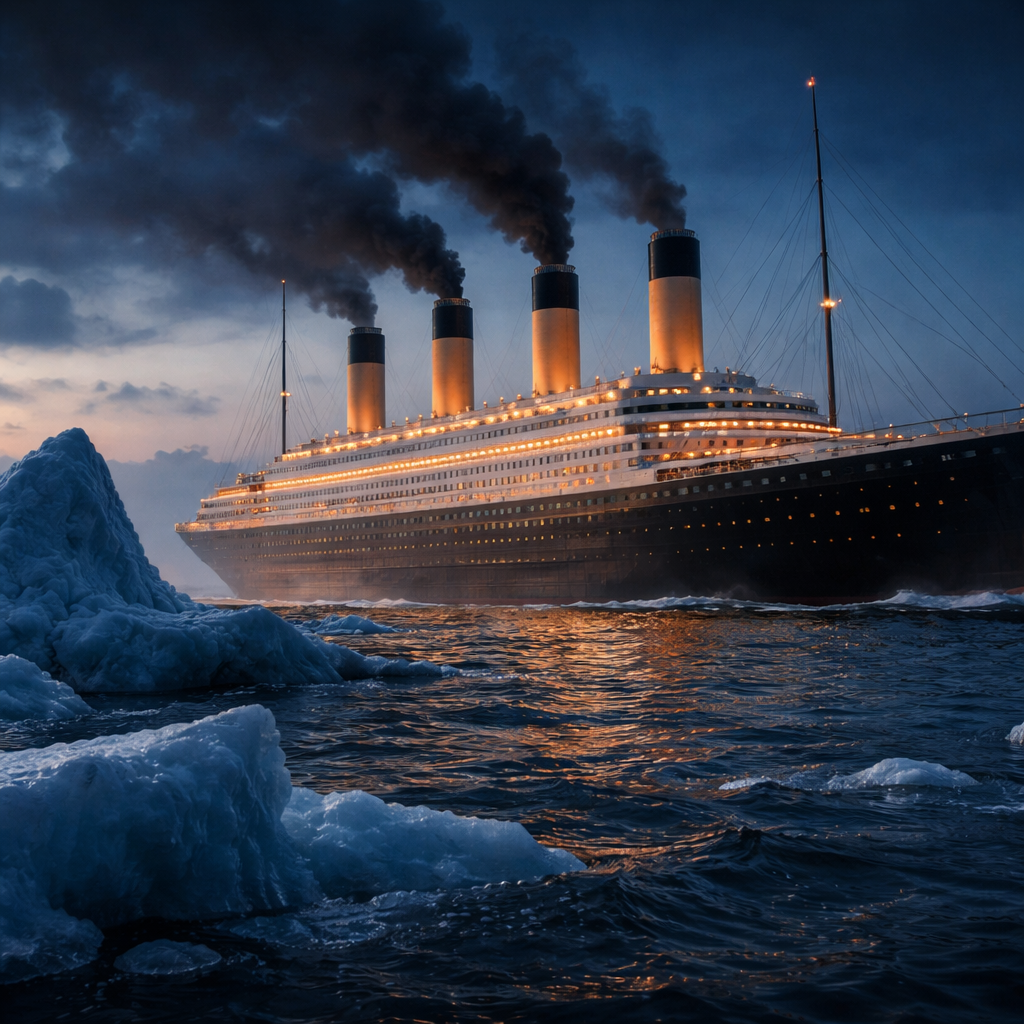
Most people know the Titanic sank — but the facts about the Titanic go far deeper than any Hollywood retelling. The ship’s story is layered with engineering ambition, human error, class inequality, and split-second decisions that changed thousands of lives in a single night.
The ship that was never called “unsinkable” by its builders
One of the most persistent myths surrounding the Titanic is that White Star Line officially promoted the ship as unsinkable. In reality, no such claim was ever made in the company’s official marketing materials. The phrase appeared in trade publications and was loosely attributed to naval engineers discussing the ship’s design — not as a guarantee, but as a reflection of confidence in the watertight compartment system. That distinction matters, because it shifts the narrative from arrogance to genuine technological optimism that was simply overtaken by circumstance.
RMS Titanic was the second of three Olympic-class ocean liners built by Harland and Wolff in Belfast. At the time of its construction, it was one of the largest moving objects ever built by human hands. The hull alone contained over three million rivets, and the ship stretched nearly 270 meters in length.
Numbers that tell the real story
Raw data often communicates what words struggle to capture. Here’s a closer look at some of the key figures behind the Titanic disaster:
| Detail | Figure |
|---|---|
| Total passengers and crew on board | approximately 2,224 |
| Number of lifeboats | 20 |
| Lifeboat capacity (total) | 1,178 people |
| Survivors | approximately 710 |
| Time to sink after collision | 2 hours 40 minutes |
| Depth of wreck on ocean floor | approximately 3,800 meters |
What’s striking about the lifeboat figure is that the ship actually carried more lifeboats than British maritime regulations required at the time. The regulations themselves were dangerously outdated — designed for ships significantly smaller than the Titanic. This regulatory gap played a direct role in the scale of the tragedy.
Class divisions that followed passengers into the water
The Titanic’s passenger manifest reflected the rigid social structure of the early twentieth century, and survival rates made that structure impossible to ignore. First-class passengers had significantly higher survival rates than those traveling in third class — not necessarily because of deliberate discrimination in every case, but because of the physical layout of the ship. Third-class accommodations were located deeper in the vessel, farther from the lifeboats, and many passengers were simply unfamiliar with the ship’s layout.
Approximately 62% of first-class passengers survived. In third class, that figure dropped to around 25%.
The contrast becomes even sharper when you separate the data by gender and class together. First-class women had a survival rate close to 97%. Third-class men survived at a rate of roughly 16%. These aren’t just statistics — they’re a map of how social hierarchies function under extreme pressure.
The iceberg warning that wasn’t ignored — and then was
In the hours before the collision, the Titanic received multiple iceberg warnings from nearby ships via wireless telegraph. Some of those messages were passed on to the bridge; others were not. The wireless operators were primarily focused on sending and receiving personal passenger telegrams — a commercially important task that inadvertently pushed safety communications lower in priority.
The final warning, sent by the SS Californian, reportedly went unacknowledged. The Californian itself was stopped in the ice field that night and was close enough that many historians believe a faster response from its crew could have saved hundreds of lives. The reasons for the delay in that ship’s response remain one of the most debated aspects of the entire disaster.
What the wreck continues to reveal
The Titanic wreck was discovered on the ocean floor decades after the sinking, and it fundamentally changed how researchers understood the disaster. Early theories suggested the iceberg had torn a long gash along the hull. Sonar imaging and later expeditions revealed a more complex picture: the damage consisted of several relatively small buckled sections and separated seams, not a single dramatic slash. The steel used in construction, when tested from recovered samples, showed increased brittleness at low temperatures — a property that likely accelerated the hull’s failure on impact.
The wreck itself is slowly disappearing. Iron-eating bacteria have been consuming the hull for decades, and marine scientists estimate that the visible structure will eventually collapse entirely. Expeditions continue to document what remains, creating detailed photographic and sonar records before the site is lost to time.
Lesser-known facts that rarely make it into the headlines
- The ship’s musicians famously played as passengers boarded lifeboats. According to survivor accounts, they continued playing on the deck until shortly before the ship went under.
- A lifeboat drill scheduled for the morning of April 14 was reportedly cancelled — the exact reasons remain unclear.
- Several dogs were on board, belonging to first-class passengers. Three of them survived, rescued in lifeboats alongside their owners.
- The Titanic carried a swimming pool, a squash court, and a gym — amenities virtually unheard of on ocean liners at the time.
- The ship was only four days into its maiden voyage when it sank. It never completed a single round trip.
A disaster that rewrote maritime law
The sinking didn’t just end lives — it fundamentally reformed international maritime safety standards. Within two years, the first International Convention for the Safety of Life at Sea was adopted, establishing requirements that ships carry enough lifeboats for everyone on board, that wireless radio operators maintain around-the-clock watches, and that ice patrol services be established in the North Atlantic. The International Ice Patrol, founded in direct response to the Titanic disaster, continues to operate to this day.
In that sense, the Titanic’s legacy isn’t just one of tragedy — it’s also one of accountability and structural change. Every ocean voyage that proceeds safely through iceberg-prone waters carries a quiet debt to the lessons extracted from that April night in the North Atlantic.