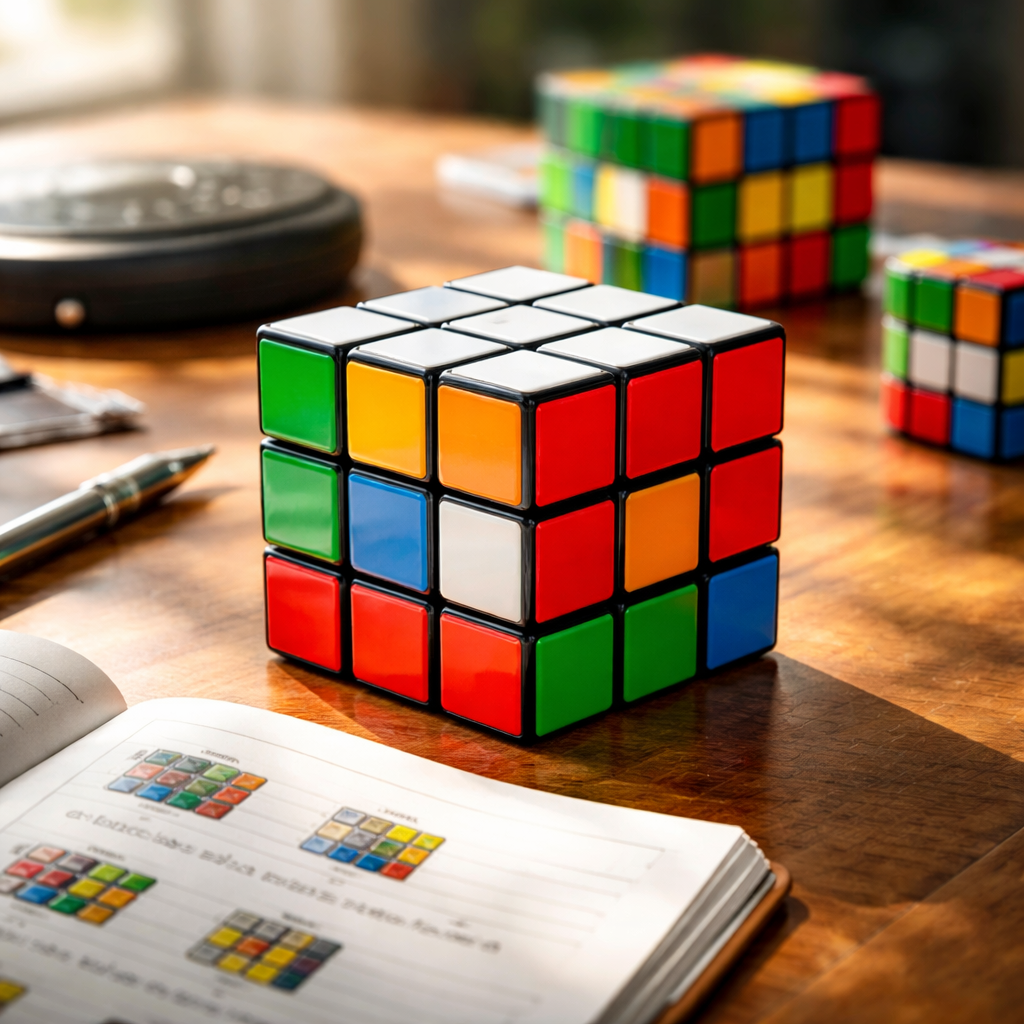
Most people who search for a cheat how to solve a rubik’s cube aren’t looking to become speedcubing champions — they just want to finally see all six sides match up without throwing the thing across the room. And honestly? That’s a perfectly valid goal. The good news is that solving a Rubik’s Cube doesn’t require a genius-level IQ. It requires a method, a bit of muscle memory, and knowing exactly which moves to repeat in which order.
Why “cheating” is actually just using a system
Let’s reframe the word “cheat” here. When someone learns a fixed algorithm to solve the cube, they’re not bypassing logic — they’re using it efficiently. Every competitive speedcuber in the world relies on memorized move sequences. The difference between a beginner and an expert isn’t raw intelligence; it’s knowing which patterns to apply and when. So if you’re looking for a shortcut, you’ve already found the right mindset.
The most popular beginner-friendly approach is called the Layer-by-Layer method (LBL). It breaks the cube into three horizontal sections and solves each one from top to bottom. This is exactly what most tutorial videos, guides, and apps teach — and for good reason. It works reliably every single time.
The Layer-by-Layer method broken down
Here’s how the full solve is structured. Each stage has its own algorithm — a repeatable sequence of moves notated with letters (U = Up face, R = Right face, F = Front face, etc.).
| Stage | Goal | Difficulty |
|---|---|---|
| 1. White Cross | Form a plus sign on the white face with correct edge colors | Beginner |
| 2. White Corners | Complete the first layer by placing corner pieces | Beginner |
| 3. Middle Layer Edges | Insert the four edge pieces in the second layer | Moderate |
| 4. Yellow Cross | Orient the yellow edges on the top face | Moderate |
| 5. Yellow Corners (Orient) | Flip corners so yellow faces up on all four | Moderate |
| 6. Corner Permutation | Move corners to their correct positions | Moderate |
| 7. Edge Permutation | Cycle the final edges into place | Moderate |
Each of these steps uses a specific algorithm that you apply repeatedly until the result clicks into place. You don’t need to understand the math behind it — you just need to recognize the pattern and execute the sequence.
The algorithms you actually need to memorize
People often get overwhelmed thinking they need to memorize dozens of formulas. In reality, the beginner method requires just a handful of core sequences. Here are the most essential ones written in standard cube notation:
- Right trigger (inserting white corners): R U R’ U’
- Left trigger (mirror version): L’ U’ L U
- Middle layer insert right: U R U’ R’ U’ F’ U F
- Middle layer insert left: U’ L’ U L U F U’ F’
- Yellow cross (F move): F R U R’ U’ F’
- Sune algorithm (orienting corners): R U R’ U R U2 R’
- Corner permutation (headlights fix): R U2 R’ U’ R U2 L’ U R’ U’ L
- Edge permutation cycle: R U’ R U R U R U’ R’ U’ R2
These sequences might look intimidating on paper, but they become natural after ten to fifteen practice runs. The trick is not to memorize them visually as letters, but to learn them as physical movements through your hands.
Muscle memory is the real cheat code. Once your hands know the sequence, your brain doesn’t have to think — it just watches.
Practical tips that actually speed up the learning process
Reading algorithms is one thing. Actually getting them into your fingers is another. Here’s what genuinely helps, based on how people actually learn physical skills:
- Learn one stage per session — don’t try to absorb all seven steps in a single sitting.
- Use a cube with smooth turning — a stiff or misaligned cube makes practice frustrating and slower.
- Slow down before you speed up — executing moves slowly and correctly builds better muscle memory than rushing through errors.
- Say the move names out loud while you do them — verbal reinforcement helps lock sequences in faster.
- Scramble and resolve the same stage repeatedly before moving on.
One thing many beginners overlook: cube recognition matters as much as algorithm knowledge. Knowing which algorithm to use depends entirely on reading the current state of the cube correctly. Spend time learning what each “case” looks like before panicking about which formula to apply.
Beyond the beginner method — what comes next
Once you can solve the cube consistently using LBL, you’ll likely notice that your solve times sit somewhere between two and five minutes. That’s completely normal. If you want to get faster, the next step is learning CFOP (also known as Fridrich method) — a more advanced system that reduces the number of steps by combining stages together.
CFOP stands for Cross, F2L (First Two Layers), OLL (Orientation of Last Layer), and PLL (Permutation of Last Layer). It requires learning significantly more algorithms — around 78 for OLL and 21 for PLL — but it’s what competitive solvers use to achieve times under 20 seconds. You don’t need to go that route unless the hobby genuinely pulls you in that direction.
There are also alternative methods worth knowing about: Roux method focuses on block-building rather than layers and is popular among those who prefer intuitive solving. Petrus method builds an extended 2x2x2 block first and then expands outward. Each system has its own logic and community of enthusiasts.
Tools and resources worth using
You don’t have to figure this out alone. Several well-established resources make the learning curve far less steep:
- Ruwix.com — comprehensive notation guides, interactive tutorials, and a visual cube solver.
- CubeSkills.com — built by former world record holder Feliks Zemdegs, focused on structured progression.
- GAN, MoYu, and QiYi — reputable cube brands with smooth, competition-grade hardware that makes learning much easier than using a cheap toy-store cube.
- CS Timer (cstimer.net) — a free browser-based timer used by beginners and competitors alike to track solve times and generate scrambles.
The moment it all clicks — and what to do then
There’s a specific moment that almost every solver describes: the first time they complete a full solve entirely from memory, without looking up a single algorithm mid-way. It happens faster than most people expect, usually within a week or two of consistent practice. That moment shifts the whole experience from frustrating to genuinely enjoyable.
After that point, the question becomes: what do you do with the skill? Some people frame the solved cube, forget about it, and move on satisfied. Others find themselves reaching for the cube daily, chasing faster times, exploring harder puzzles like the 4×4 Revenge or the Megaminx. There’s no right answer — the cube is as deep or as shallow as you want it to be.
Either way, the starting point is the same: pick one method, learn it one step at a time, and trust the process. The cube isn’t unsolvable. It just needs the right map.