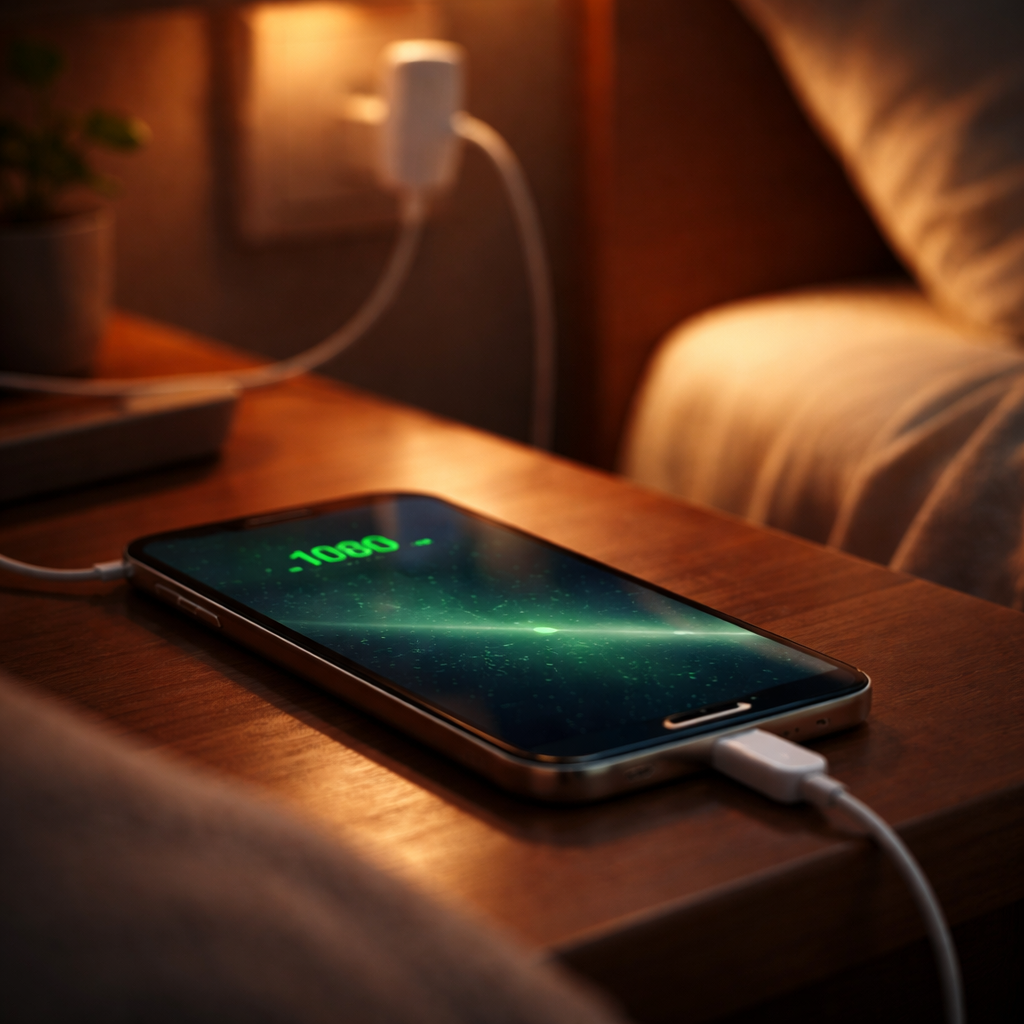
Most people plug in their phone before bed without giving it a second thought — but is it safe to charge phone overnight, or is this nightly habit quietly working against your battery? The answer is more nuanced than a simple yes or no, and understanding the mechanics behind it can genuinely change how long your device lasts.
What actually happens when your phone charges while you sleep
Modern smartphones use lithium-ion or lithium-polymer batteries, and these chemistries behave differently from the old nickel-based cells. Once your phone hits 100%, the charger doesn’t simply switch off — it enters a trickle-charge cycle, continuously topping up small amounts of power to compensate for natural discharge. This keeps the battery in a state of constant, low-level stress.
Battery researchers refer to this condition as “high-state-of-charge stress.” Lithium-ion cells degrade faster when held at full capacity for extended periods. It’s not dramatic — you won’t see the damage overnight — but across months and years, it contributes to reduced capacity and shorter battery lifespan.
Heat is the real villain here
Temperature plays a far bigger role in battery health than most users realize. Charging generates heat, and heat accelerates chemical aging inside the battery. When a phone charges under a pillow, inside a case, or in a poorly ventilated spot on a nightstand, that heat has nowhere to go.
According to battery health guidelines published by major manufacturers, lithium-ion batteries degrade significantly faster when regularly exposed to temperatures above 35°C — a threshold that’s easy to cross during overnight charging in warm environments.
This is why the physical placement of your phone during charging matters more than many people assume. A flat, hard surface with airflow — not fabric — is always the better choice.
Does overnight charging pose any safety risk?
For the vast majority of users with standard, manufacturer-approved chargers and undamaged cables, overnight charging does not present a meaningful fire or safety hazard. The danger increases significantly under specific conditions:
- Using counterfeit or uncertified third-party chargers
- Charging a phone with a visibly damaged battery (swelling, unusual heat)
- Leaving the phone charging under bedding or pillows
- Using a frayed or pinched charging cable
- Charging in direct sunlight or in a very hot room
If none of these conditions apply, the safety risk is low. The more relevant concern for most people is long-term battery health, not short-term safety.
How manufacturers are responding to this problem
Apple, Samsung, and Google have all introduced optimized charging features that address overnight charging directly. These systems learn your sleep schedule and delay charging to 100% until shortly before you typically wake up — keeping the battery at around 80% for most of the night.
| Feature Name | Platform | How It Works |
|---|---|---|
| Optimized Battery Charging | iOS (iPhone) | Learns routine, pauses at 80%, completes before wake time |
| Adaptive Charging | Android (Pixel) | Uses alarm data to time full charge completion |
| Protect Battery | Samsung One UI | Caps charging at 85% to reduce long-term stress |
Enabling one of these features is arguably the single most impactful thing you can do if you prefer to charge overnight and want to protect battery longevity at the same time.
Practical habits that make a real difference
You don’t need to overhaul your entire routine — small adjustments compound over time into noticeably better battery health.
- Enable your phone’s built-in optimized or adaptive charging setting
- Place your phone on a hard, open surface — never under a pillow
- Use the original charger or a certified alternative
- Consider removing a thick case during charging if your phone runs warm
- If battery health is a priority, aim to charge between 20% and 80% rather than running full cycles
The 20–80% rule comes directly from lithium-ion chemistry: the edges of the charge range — both near empty and near full — place more strain on the cells than the middle range does. Staying within that window extends the number of effective charge cycles your battery can deliver.
When overnight charging genuinely isn’t worth the trade-off
There are situations where the convenience simply doesn’t justify the risk or the wear. If your phone’s battery health (visible in settings on most modern devices) has already dropped below 80%, charging habits become even more important — degraded cells are less stable and more susceptible to heat damage.
Similarly, if you’re using an older device without optimized charging features, or if you’re relying on a cheap, unbranded charger, it’s worth reconsidering the habit. In these cases, plugging in for an hour or two before bed and unplugging before you sleep is a genuinely safer and smarter approach.
The bottom line your phone’s battery actually needs
Charging your phone overnight won’t destroy it, and for most people with modern devices and proper chargers, it remains a perfectly manageable habit — especially with optimized charging enabled. The nuance lies in the details: the charger quality, the surface you charge on, the ambient temperature, and whether your phone has tools to limit prolonged exposure to full charge.
Think of your phone’s battery like a long-term investment. The daily decisions seem minor, but they accumulate. A phone that holds 90% of its original battery capacity after two years of mindful charging habits is genuinely more useful — and more valuable at resale — than one sitting at 70% because it spent every night pinned between a charger and a warm pillow. The information is available, the settings already exist, and the changes cost nothing.