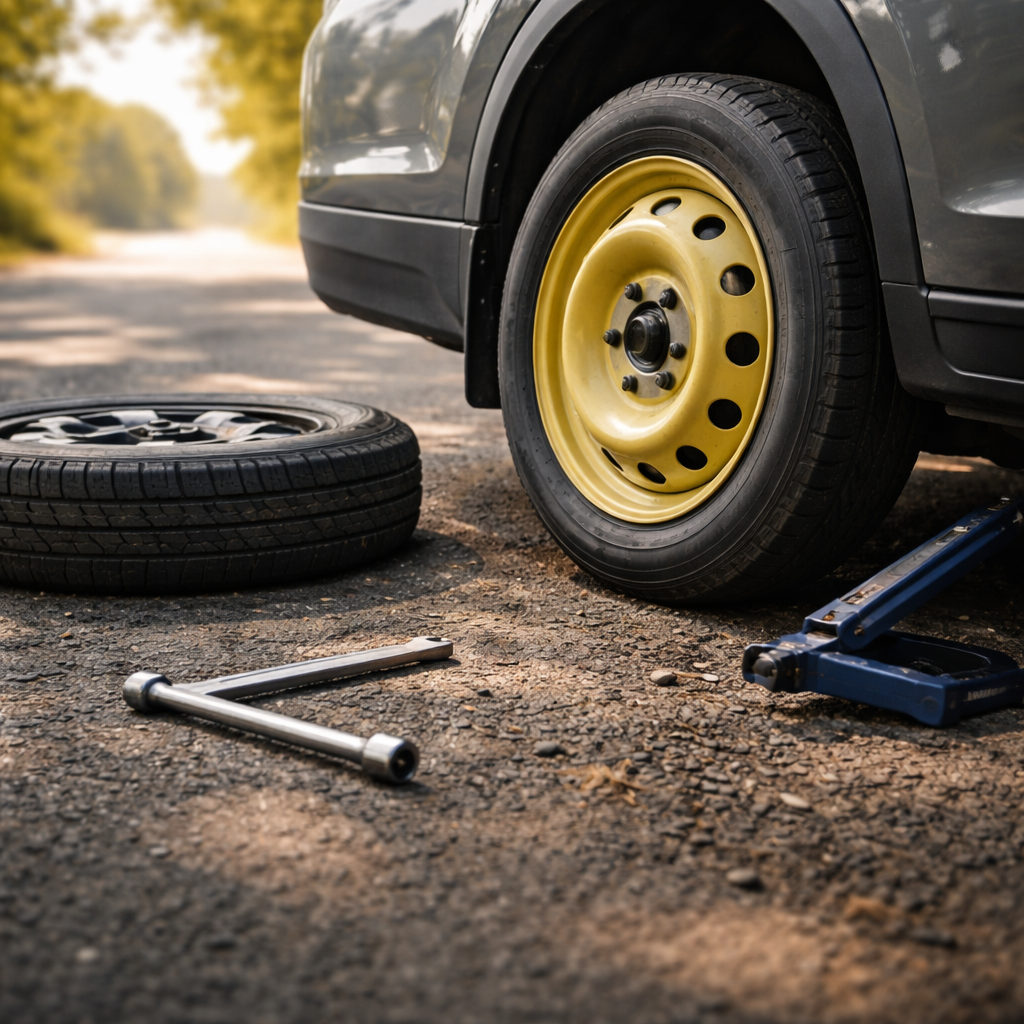
You glance at your dashboard, hear that unmistakable thump, and pull over — flat tire. You swap it for the spare sitting in your trunk, breathe a sigh of relief, and get back on the road. But here’s the part most drivers skip: understanding exactly what you just put on your car, and whether it’s actually safe to keep driving on it.
Not All Spare Tires Are Created Equal
Before answering whether it is safe to drive with a spare tire, you need to know which type you have. This matters more than most people realize, because different spares come with very different rules.
| Spare Tire Type | Max Speed | Max Distance | Full-Size Replacement? |
|---|---|---|---|
| Compact spare (“donut”) | 50 mph (80 km/h) | 50–70 miles (80–110 km) | No |
| Full-size matching spare | Same as regular tires | No strict limit | Yes, temporarily |
| Full-size non-matching spare | Limited — check manual | Short-term only | No |
| Run-flat tire | 50 mph (80 km/h) | Up to 50 miles (80 km) | No |
The compact spare — that narrow, undersized wheel most commonly found in passenger vehicles — is designed strictly as a temporary fix. It is not meant to replace a proper tire for any extended period. Ignoring this distinction is where most drivers get into trouble.
What Actually Happens to Your Car When You Drive on a Spare
A compact spare has a smaller diameter and narrower width than your standard tires. That difference isn’t just cosmetic — it directly affects how your car behaves on the road. When one wheel is rotating at a noticeably different speed than the others, your vehicle’s systems start compensating in ways they weren’t designed to sustain long-term.
- All-wheel drive and four-wheel drive systems can experience strain because the drivetrain expects uniform wheel rotation.
- Anti-lock braking systems (ABS) may not perform as expected, since they rely on consistent wheel speed data.
- Traction control and stability control sensors can send incorrect readings, reducing their effectiveness.
- Braking distances may increase, particularly in emergency stops.
- Handling becomes less predictable, especially during lane changes or sharp turns.
None of these effects are catastrophic in the short term — which is exactly what the spare is designed for. The issue arises when drivers treat a compact spare as if it’s a permanent solution and push it beyond its limits.
Driving on a compact spare at highway speeds or for more than 50–70 miles is not just inadvisable — it can cause the spare itself to fail, leading to a second blowout with far less warning than the first.
Speed Limits on a Spare Tire: Why 50 mph Is the Real Ceiling
Most compact spare tires have a maximum speed rating of 50 mph (approximately 80 km/h). This is not a conservative suggestion — it is an engineering limit. The tire’s construction, rubber compound, and heat tolerance are all calibrated for low-speed, short-distance use only.
At higher speeds, the compact spare generates excess heat that its structure cannot safely manage. Heat buildup is one of the primary causes of tire failure, and a donut spare has far less thermal resilience than a standard tire. Drivers who merge onto highways and cruise at 70 mph without thinking about the spare on their rear axle are taking a genuine risk — not a theoretical one.
Vehicles With AWD or 4WD Need Extra Caution
If you drive an all-wheel drive vehicle, the stakes are higher than average. AWD systems are engineered around the assumption that all four tires are essentially the same size and rotate at the same rate. Introducing a significantly smaller compact spare disrupts that balance and can put real stress on the center differential and transfer case — components that are expensive to repair.
Some AWD manufacturers explicitly state in their owner’s manuals that the vehicle should not be driven on a compact spare without first disabling the AWD system, or that the spare should only be used on the rear axle. Checking your vehicle’s manual before an emergency happens — not during one — is genuinely useful preparation.
Checking the Spare Before You Actually Need It
One of the most overlooked aspects of spare tire safety is the condition of the spare itself. Many drivers have never once checked the tire pressure or tread on the spare sitting under their trunk floor. By the time they need it, it’s flat, cracked, or years past its usable life.
- Spare tires — even unused ones — degrade over time due to rubber oxidation. Most manufacturers recommend replacing a spare after 6–10 years regardless of mileage.
- The recommended inflation pressure for compact spares is often higher than regular tires, typically around 60 psi. Check the tire sidewall or your owner’s manual.
- Inspect the spare visually a few times a year for sidewall cracking, which is a sign of age-related deterioration.
- Make sure the jack and lug wrench stored with the spare are functional and that you know how to use them before an emergency forces you to learn.
When the Spare Gets You Where You’re Going — What Comes Next
Getting back on the road with a spare is a relief, but it’s the beginning of a task, not the end of one. The spare has done its job — now yours is to replace the damaged tire as soon as reasonably possible, ideally within the same day or the next morning.
When you visit a tire shop, ask them to also inspect the rim from the flat tire for damage. Curb impacts and blowouts can bend or crack alloy wheels in ways that aren’t always visible from the outside but will cause air loss or handling problems with a new tire installed on a compromised rim.
If the flat tire is repairable — a clean puncture in the central tread area — many shops can patch or plug it, which saves the cost of a full replacement. Sidewall damage, however, is not repairable, and neither are punctures near or on the shoulder of the tire.
Think of a spare tire the way you’d think of a bandage — it stabilizes the situation, but the real fix still needs to happen.
Getting Back on the Road the Right Way
So, to put it plainly: yes, driving on a spare tire is safe — provided you respect its specific limitations. Keep your speed at or below 50 mph, avoid going more than 50–70 miles, skip the highway if you can, and head straight to a tire service center. If you drive an AWD vehicle, be especially cautious and consult your owner’s manual.
The spare tire is a well-engineered piece of emergency equipment. It’s not a shortcut to avoiding a tire replacement — it’s a bridge to getting that replacement done safely. Treat it accordingly, and it will do exactly what it was built to do.