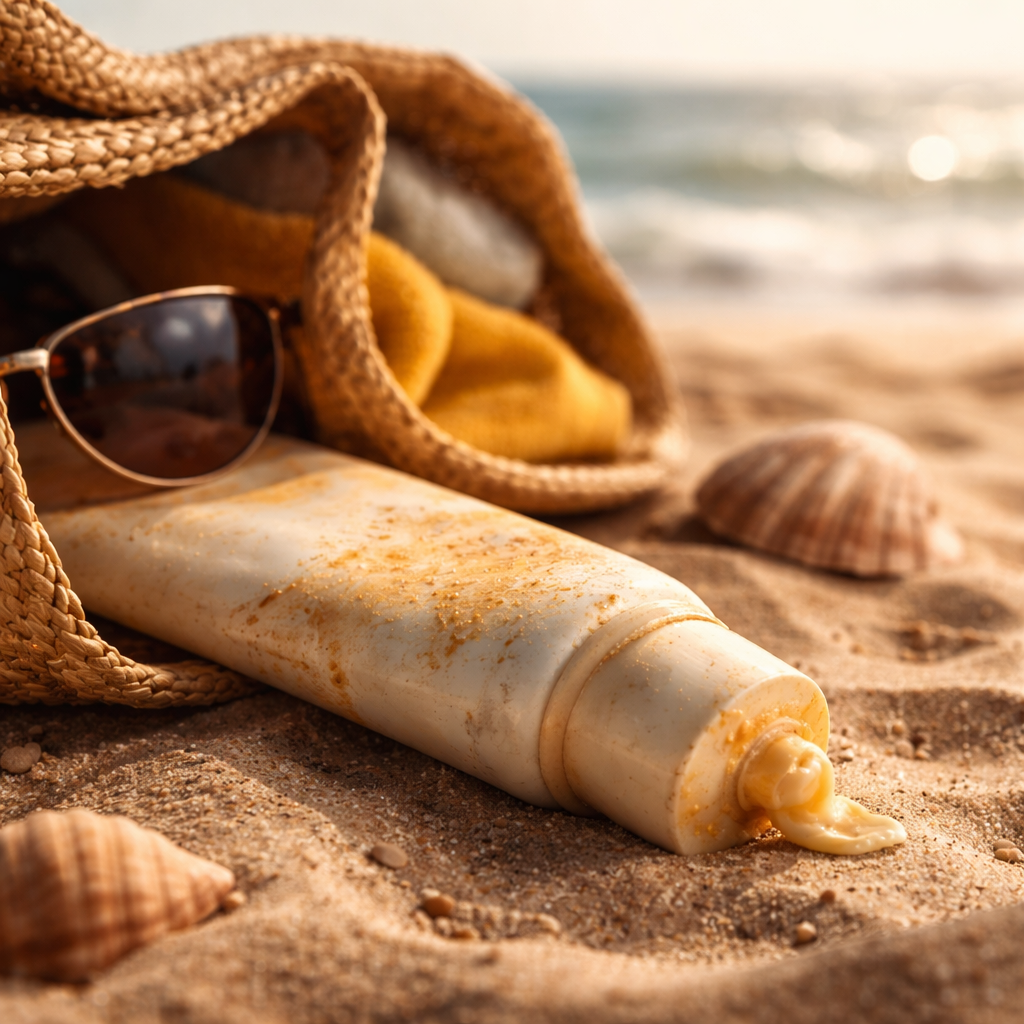
Most people have found a forgotten bottle of sunscreen at the back of a beach bag and wondered — is it safe to use old sunscreen, or is that just asking for trouble? It turns out the answer isn’t as simple as checking the expiration date. Sunscreen chemistry is more nuanced than most of us realize, and understanding what actually changes over time can make a real difference for your skin health.
What happens to sunscreen as it ages
Sunscreen contains active UV-filtering ingredients — either chemical (organic) filters like avobenzone and octinoxate, or physical (mineral) filters like zinc oxide and titanium dioxide. Over time, especially after the product has been opened, these ingredients begin to break down. Chemical filters are particularly vulnerable to degradation when exposed to heat, light, and air. Once they degrade, they no longer absorb UV radiation effectively — meaning the SPF on the label is no longer what you’re actually getting on your skin.
Mineral-based sunscreens tend to be more stable over time, since zinc oxide and titanium dioxide are physical particles that don’t break down in the same way. However, the base formula — emulsifiers, preservatives, moisturizing agents — can still deteriorate, affecting texture, smell, and overall product integrity.
Expiration dates: what they actually tell you
In many countries, sunscreen is regulated as an over-the-counter drug product, which means manufacturers are required to test and guarantee the stability and effectiveness of the formula up to the expiration date printed on the packaging. The FDA, for example, requires that sunscreens without a printed expiry date remain stable for at least three years from the date of manufacture.
Once you pass that date, there’s no guarantee the product performs as labeled. The SPF protection may be significantly reduced even if the lotion looks and smells completely normal. This is important: expired sunscreen can appear fine while offering very little actual protection against UVA and UVB radiation.
Using expired sunscreen is not the same as using no sunscreen at all — but it’s not something you should rely on for extended sun exposure or when UV index is high.
Signs that sunscreen has gone bad
Beyond checking the date stamp, there are physical clues that a product is no longer usable. Trust these signs even if the expiration hasn’t technically passed yet — storage conditions matter enormously.
- The texture has separated, become watery, or turned unusually thick and clumpy
- The color has shifted — yellowing or darkening of a once-white or beige formula is a red flag
- There’s an off smell — rancid, sour, or simply different from when you first opened it
- Mineral sunscreens have become difficult to blend or leave unusual streaks
- The formula feels grainy or gritty when it wasn’t before
Any of these changes indicate that the formulation has broken down, regardless of what the date on the tube says.
How storage conditions dramatically shorten sunscreen shelf life
Here’s something most people overlook: even a brand-new, within-date sunscreen can degrade quickly if stored improperly. Leaving it in a hot car, on a sunny poolside table, or in a bathroom with high humidity can accelerate the breakdown of active ingredients significantly — sometimes within a single season.
| Storage condition | Effect on sunscreen |
|---|---|
| Left in a hot car or direct sunlight | Rapid degradation of chemical UV filters |
| Stored in a cool, dark place | Maintains stability closer to labeled expiration |
| Repeated opening and air exposure | Oxidation of formula; preservative breakdown |
| High humidity environment | Risk of microbial growth and texture change |
The takeaway here is that the expiration date assumes ideal storage. In real-world conditions — beach bags, glove compartments, bathroom shelves — products often don’t last as long as the label suggests.
A practical note on sunscreen habits worth keeping
Dermatologists generally recommend writing the date you opened a sunscreen product directly on the bottle. This small habit gives you a clearer sense of how long you’ve actually been using it. Most opened sunscreens should ideally be used within 12 months, especially if stored outside of climate-controlled conditions.
It’s also worth considering how much sunscreen you actually use per application. Studies have consistently shown that people apply far less than the recommended amount — about a teaspoon for the face alone, and roughly a shot glass worth for full-body coverage. Applying too little is one of the most common reasons sunscreen underperforms, and it’s also why bottles tend to last longer than they should, increasing the chance you’ll reach for an expired product.
If your sunscreen bottle lasts more than one full summer season with regular use, you’re likely not applying enough each time.
When in doubt, replace it
The stakes with sun protection are genuinely high. Prolonged UV exposure without adequate protection is directly linked to accelerated skin aging, sunburn, and increased risk of skin cancer — including melanoma, which is among the most serious forms. No amount of thrift is worth the risk of relying on degraded UV protection during peak sun hours.
If you’re unsure whether a product is still effective — whether it smells slightly different, has been sitting in a drawer for over a year, or simply has no visible date — replacing it is the straightforward call. Sunscreen is one of those products where peace of mind is genuinely worth the cost of a new bottle.
That said, if you find an unopened sunscreen that’s only a few months past its printed date and has been stored in a cool, dry place, it likely retains much of its effectiveness — though using it as your primary protection on a high UV index day is still not advisable.