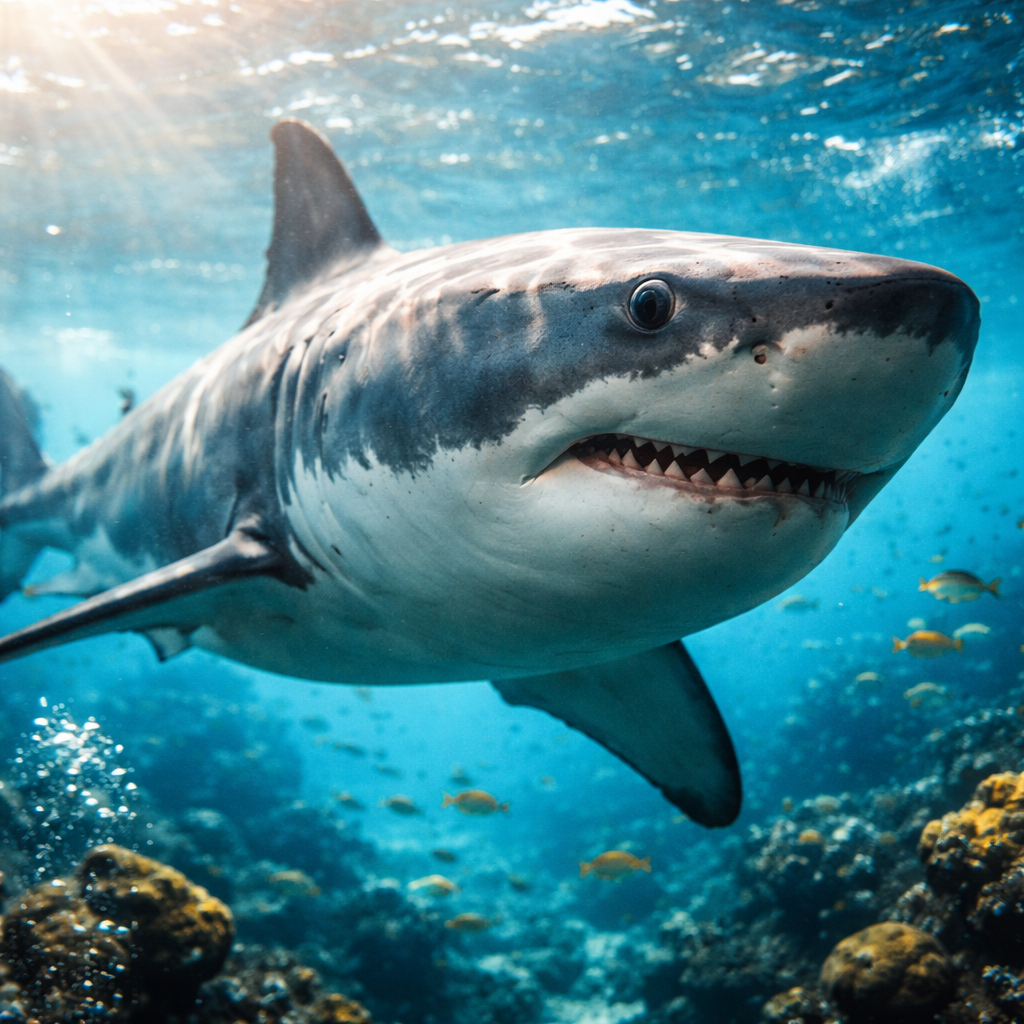
Most people picture a shark and immediately think of danger — but the facts about sharks tell a very different story from what Hollywood has spent decades selling us. These animals are far more complex, ecologically vital, and scientifically fascinating than their reputation suggests.
Why sharks have been around longer than trees
Sharks have existed on Earth for roughly 450 million years — predating trees, which appeared around 350 million years ago. They survived all five major mass extinction events, including the one that wiped out the dinosaurs. This extraordinary resilience comes from a body design that has barely needed to change: cartilaginous skeletons, multiple rows of replaceable teeth, and sensory systems that remain unmatched in the animal kingdom.
Unlike bony fish, sharks have skeletons made entirely of cartilage — the same flexible tissue found in human ears and noses. This makes them lighter and more agile in water. Their teeth are not embedded in the jawbone but sit in rows within the gum tissue, meaning a shark can shed and replace thousands of teeth over a lifetime.
The sensory world of a shark
One of the most underappreciated aspects of shark biology is how they perceive the world around them. Sharks use a combination of senses that no other group of animals has in quite the same combination.
- The lateral line system detects vibrations and pressure changes in water up to hundreds of meters away.
- Electroreceptors called the ampullae of Lorenzini allow sharks to detect the weak electrical fields produced by the muscle movements of other animals — even those hidden under sand.
- Their sense of smell is powerful, but contrary to popular belief, they do not detect a single drop of blood from miles away. They can, however, follow a scent trail over considerable distances in the right current conditions.
- Sharks have a tapetum lucidum behind their retinas — the same reflective layer found in cat eyes — which enhances vision in low light.
Sharks don’t just swim through the ocean — they read it. Every ripple, electrical signal, and chemical trace tells them something about their environment that we can barely begin to replicate with technology.
Diversity you probably didn’t expect
There are more than 500 known species of sharks, and they vary wildly in size, behavior, and habitat. The whale shark is the largest fish on the planet, reaching up to 12 meters in length, yet it feeds exclusively on plankton and tiny fish. At the other end of the spectrum, the dwarf lanternshark measures only about 20 centimeters and lives in deep water off the coasts of Colombia and Venezuela.
| Species | Average Length | Diet | Habitat |
|---|---|---|---|
| Whale shark | Up to 12 m | Plankton, small fish | Warm open ocean |
| Great white shark | 4–6 m | Marine mammals, fish | Coastal and offshore |
| Dwarf lanternshark | ~20 cm | Small crustaceans | Deep water |
| Hammerhead shark | 3–4 m | Fish, rays, squid | Coastal warm waters |
| Nurse shark | 2.5–3 m | Bottom-dwelling prey | Shallow tropical reefs |
Some sharks are solitary hunters, while others — like scalloped hammerheads — form large schools that can number in the hundreds. Certain deep-sea species produce their own bioluminescent light. The Greenland shark, which lives in the frigid waters of the Arctic and North Atlantic, has been found to live for over 270 years, making it the longest-lived vertebrate known to science.
Reproduction: three strategies, not one
Shark reproduction is another area where oversimplification does these animals a disservice. Sharks use three distinct reproductive strategies depending on the species.
- Oviparous species lay eggs in protective cases sometimes called “mermaid’s purses.” Port Jackson sharks and some catsharks reproduce this way.
- Viviparous species give birth to live young that are nourished through a placenta — similar in structure to mammalian pregnancy. This is seen in hammerheads and reef sharks.
- Ovoviviparous species develop eggs internally, with embryos hatching inside the mother and being born live. Great white sharks and whale sharks use this method.
Some species, including bonnethead and zebra sharks, have been documented reproducing through parthenogenesis — essentially producing offspring without a male. This has been observed in captive females kept isolated from males for extended periods, and it challenges the assumption that sexual reproduction is the only path for these animals.
Their role in ocean health is not optional
Apex predators like great white sharks, tiger sharks, and bull sharks regulate the populations of species below them in the food chain. Without this top-down pressure, prey species can overpopulate, leading to the collapse of seagrass beds and coral reefs — habitats that support thousands of other species and generate significant economic value for coastal communities through fishing and tourism.
Research in areas where shark populations have declined sharply has shown measurable negative effects on reef ecosystems. The removal of a single apex predator can trigger what ecologists call a trophic cascade — a chain reaction affecting every level of the food web. This is why shark conservation is increasingly framed not as sentiment, but as basic ecological management.
A useful perspective on shark attacks
Globally, unprovoked shark attacks on humans are recorded in the dozens per year, with fatalities typically in single figures. To put that in context: vending machines, cows, and even champagne corks cause more human deaths annually than sharks do. The vast majority of encounters — even in areas with high shark activity — end with the shark swimming away without incident.
Most bites that do occur are believed to be investigatory rather than predatory. Sharks explore their environment with their mouths since they lack hands, and a single bite — often immediately released — causes injury primarily due to the size of the animal rather than aggressive intent. Tiger sharks and bull sharks are responsible for the highest number of incidents, partly because they inhabit coastal areas with high human activity.
What actually threatens sharks
The more pressing story is what humans are doing to sharks. It is estimated that between 70 and 100 million sharks are killed by humans every year — primarily through commercial fishing, bycatch, and the shark fin trade. Many species are now listed as vulnerable, endangered, or critically endangered on the IUCN Red List.
Sharks are particularly vulnerable to overfishing because of their slow reproductive rates. Unlike many fish species that reach sexual maturity quickly and produce thousands of offspring, many shark species mature slowly, reproduce infrequently, and have small litters. A population that has been reduced takes decades — sometimes generations — to recover, if it recovers at all.
Sharks are still teaching us things
Shark skin is structured with tiny tooth-like scales called dermal denticles, which reduce drag and turbulence as the animal moves through water. This design has directly influenced the development of swimsuit fabrics and is being studied for applications in ship hull coatings and aircraft surfaces. Their immune systems are also being researched for potential insights into disease resistance — sharks rarely develop tumors, and their wounds heal with unusual speed.
The more researchers look, the more there is to find. Deep-sea shark species remain largely unstudied, migration patterns are still being mapped with electronic tagging, and the full complexity of shark social behavior is only beginning to be understood. These are not simple predators frozen in evolutionary time — they are dynamic, adaptive animals that have a great deal left to reveal.