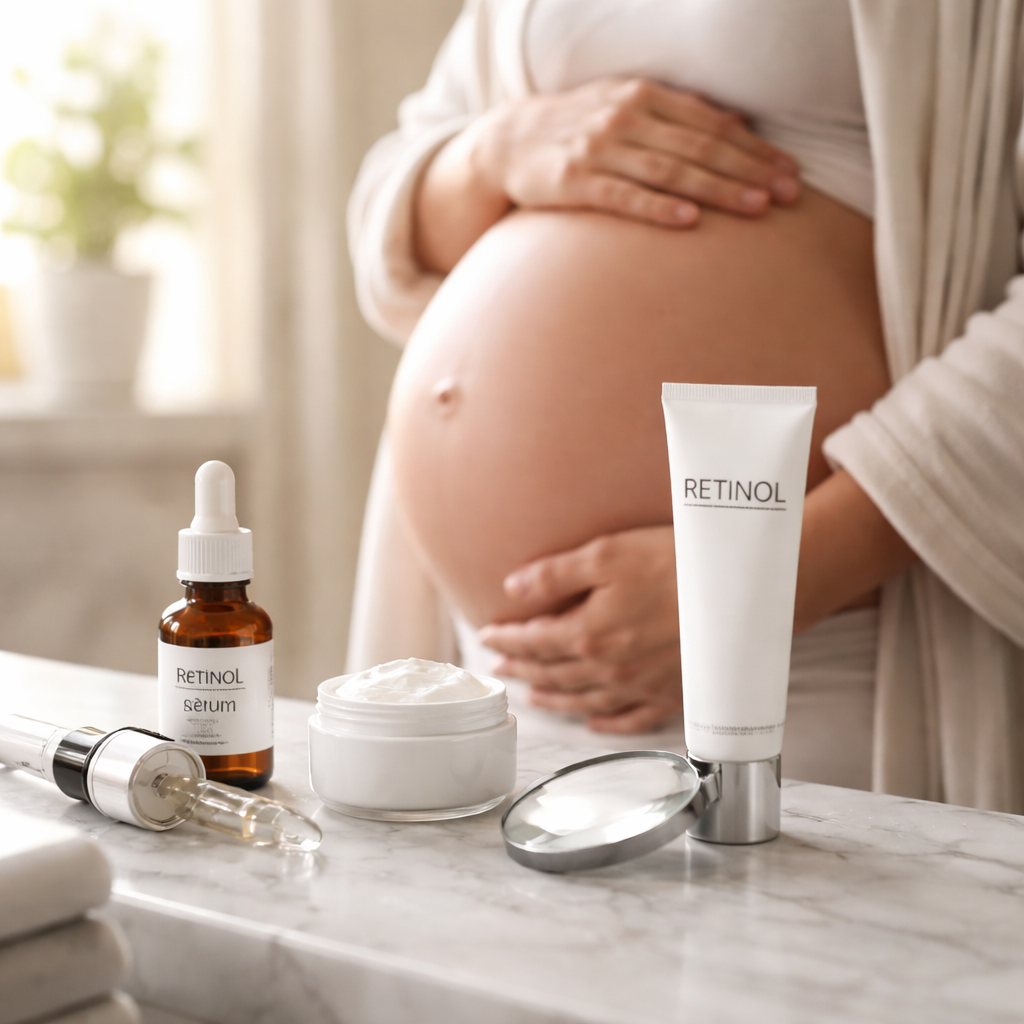
Pregnancy changes almost everything about how you care for your body — including your skincare routine. One question that comes up constantly among expecting mothers is: is it safe to use retinol while pregnant? The short answer dermatologists and OBGYNs consistently give is no, and the reasoning behind it is worth understanding fully before you reach for that serum.
What retinol actually does in your skin
Retinol belongs to the retinoid family — a group of compounds derived from vitamin A. When applied topically, it speeds up cell turnover, stimulates collagen production, and reduces the appearance of fine lines, uneven skin tone, and acne. It’s one of the most well-researched active ingredients in skincare, which is exactly why so many people rely on it.
The problem isn’t what retinol does on the surface. The concern is what happens when vitamin A derivatives are absorbed into the bloodstream at elevated levels — particularly during fetal development.
Why vitamin A becomes a risk during pregnancy
Vitamin A is essential for healthy development, but in excessive amounts, it becomes teratogenic — meaning it can interfere with normal fetal development. This risk is well-documented with oral retinoids like isotretinoin (commonly known as Accutane), which is strictly contraindicated during pregnancy and requires mandatory pregnancy testing before prescribing.
Topical retinoids — including prescription tretinoin and over-the-counter retinol — are considered lower risk because skin absorption is less than with oral forms. However, absorption does occur, and because the developing fetus is sensitive to even small fluctuations in vitamin A levels during the first trimester in particular, most medical guidelines recommend avoiding all retinoids throughout pregnancy.
“We don’t have large-scale controlled studies on topical retinoids in pregnant women, and that absence of data is itself a reason for caution. When in doubt, we advise patients to stop.”
— A position commonly reflected in guidance from dermatology and obstetric organizations worldwide
Retinol vs. prescription retinoids: is there a meaningful difference in pregnancy?
Many people assume that because retinol is available without a prescription, it must be fine. But the category it belongs to — vitamin A derivatives — is the key issue, not the potency level. Here’s a quick breakdown of retinoids you’ll commonly encounter:
| Ingredient | Type | Pregnancy safety |
|---|---|---|
| Retinol | OTC retinoid | Avoid |
| Retinaldehyde (retinal) | OTC retinoid | Avoid |
| Tretinoin | Prescription retinoid | Avoid |
| Adapalene | Prescription retinoid | Avoid |
| Isotretinoin (oral) | Oral retinoid | Strictly contraindicated |
All of the above should be discussed with your healthcare provider before use during pregnancy, and most practitioners will advise stopping entirely.
Ingredients you can actually use instead
Pausing retinol doesn’t mean your skin has to suffer. Several ingredients are considered safe during pregnancy and can address many of the same concerns — from texture and brightness to hydration and mild acne.
- Bakuchiol — a plant-derived alternative that studies suggest mimics some of retinol’s effects on cell turnover without the vitamin A classification. It’s gentle and generally considered pregnancy-compatible.
- Azelaic acid — effective for hyperpigmentation, acne, and rosacea. It’s actually Category B in pregnancy, meaning animal studies show no risk and it’s widely used by dermatologists during pregnancy.
- Niacinamide — excellent for pore appearance, uneven tone, and inflammation. It’s well-tolerated and considered safe throughout pregnancy.
- Hyaluronic acid — deeply hydrating, structurally simple, and poses no known risk during pregnancy.
- Vitamin C (ascorbic acid) — supports collagen synthesis and brightness. Generally regarded as safe when used topically in standard concentrations.
What about products you used before you knew you were pregnant?
This is one of the most anxiety-inducing scenarios, and it’s more common than people realize. If you used a retinol product in the weeks before you discovered your pregnancy, try not to panic. The risk associated with topical retinoids is largely theoretical based on extrapolation from oral retinoid data — there is no documented pattern of birth defects specifically linked to topical retinol use. That said, the appropriate step is always to inform your OB or midwife and let them assess your specific situation.
The key shift in mindset during pregnancy is this: the absence of proven harm is not the same as proven safety, and for a developing fetus, that distinction matters.
Building a pregnancy-safe skincare routine that actually works
Pregnancy skin is unpredictable. Hormonal shifts can trigger melasma, dryness, breakouts, or sensitivity that you haven’t experienced before. The goal of a pregnancy-safe routine isn’t just to remove harmful ingredients — it’s to actively support your skin through these changes with ingredients that are both effective and appropriate.
A straightforward approach that many dermatologists recommend during pregnancy looks something like this:
- A gentle, fragrance-free cleanser — hormonal sensitivity often makes even previously tolerated products irritating.
- A niacinamide or azelaic acid serum — depending on your primary concern (acne vs. pigmentation).
- A hyaluronic acid moisturizer — hydration becomes especially important as skin barrier function can fluctuate.
- A broad-spectrum SPF 30 or higher — daily sunscreen is non-negotiable, especially because melasma is sun-triggered and common in pregnancy.
Beyond the ingredient list, consistency matters more than complexity. A simple routine done daily beats an elaborate one that gets skipped because it feels like too much effort.
When you can return to retinol
Most guidelines advise waiting until after pregnancy and, if breastfeeding, until after weaning — since small amounts of topical ingredients can potentially pass into breast milk. Once you’re in the clear, reintroducing retinol gradually (starting with a low concentration a few times per week) is the standard approach to minimize irritation, especially if your skin became more sensitive during pregnancy.
Your skin went through significant changes over nine months. Giving it a few weeks to readjust before jumping back into actives is rarely a mistake.
Your skin will thank you for the pause
Stepping away from retinol for the duration of pregnancy — and potentially breastfeeding — feels like a sacrifice for anyone who’s relied on it. But the skin concerns retinol was managing don’t disappear permanently; they can be addressed again postpartum. What matters right now is giving your body and your baby the most protective environment possible, which includes being thoughtful about every ingredient that could enter your system. Bakuchiol, azelaic acid, and a solid SPF routine can carry you through, and your retinol will still be waiting when you’re ready to come back to it.