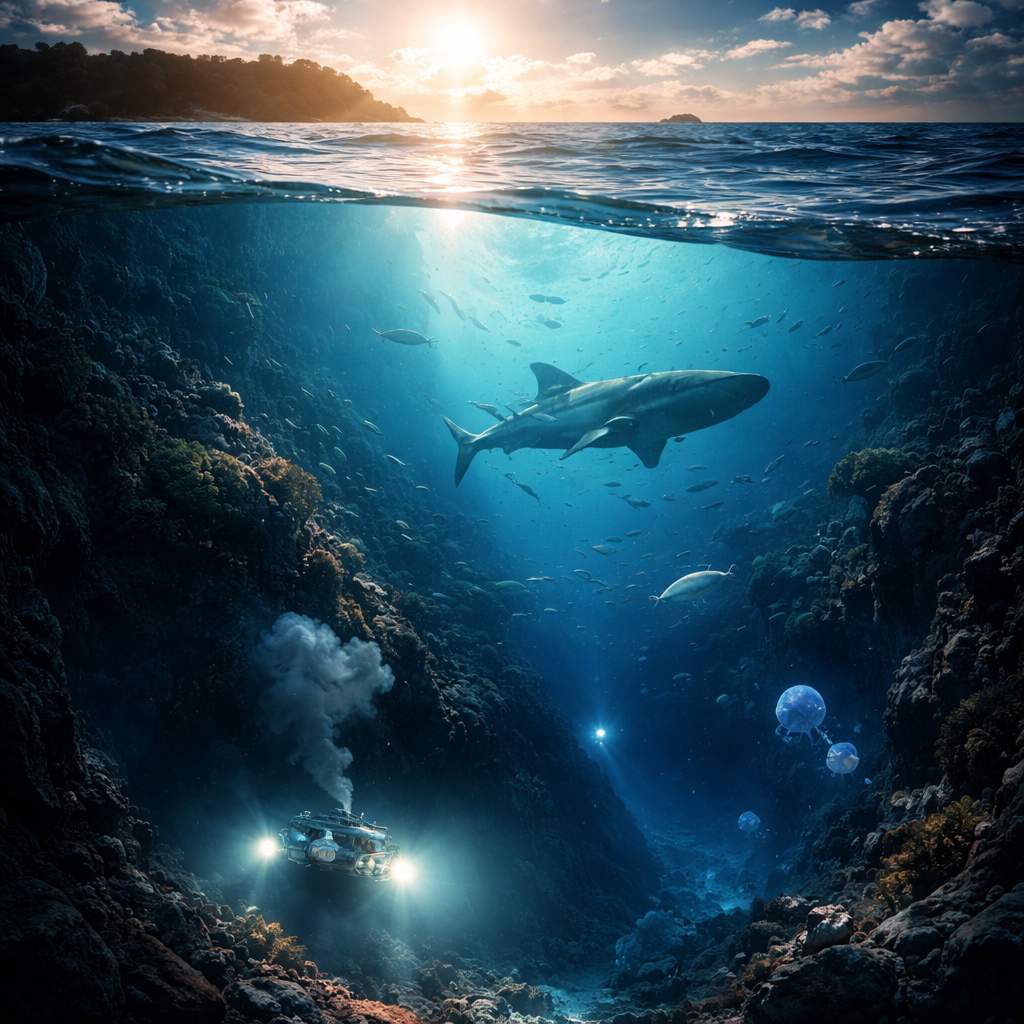
The ocean covers more than 70% of our planet’s surface, yet over 80% of it remains unexplored. When you start digging into facts about the ocean, the numbers and phenomena you encounter are genuinely staggering — not in an abstract, textbook kind of way, but in a “wait, I didn’t know that” kind of way that makes you rethink how much you actually understand about Earth.
The ocean is not one body of water — it’s five
Most people grow up thinking of “the ocean” as a single, continuous mass of water. Technically, geographers divide it into five distinct ocean basins: the Pacific, Atlantic, Indian, Southern, and Arctic. The Pacific alone is larger than all of Earth’s landmasses combined. That’s not a metaphor — the total land area on the planet simply doesn’t match up to what that one basin holds.
Each ocean has its own circulation patterns, temperature ranges, salinity levels, and biodiversity. The Southern Ocean, which surrounds Antarctica, was officially recognized as a separate ocean relatively recently and plays a critical role in global climate regulation by absorbing massive amounts of heat and carbon dioxide.
Depth, pressure, and the limits of human exploration
The deepest known point on Earth is Challenger Deep in the Mariana Trench, located in the western Pacific Ocean. It sits approximately 11,000 meters below sea level. To put that in perspective, if you dropped Mount Everest into that trench, its peak would still be more than a mile underwater.
At such depths, water pressure reaches over 1,000 times the atmospheric pressure at sea level. Despite these conditions, life thrives there — including single-celled organisms, amphipods, and even certain fish species. The adaptations these creatures have developed challenge long-held assumptions about the limits of biology.
Scientists have mapped the surface of the Moon and Mars in greater detail than the floor of Earth’s own oceans. Seafloor mapping remains one of the most underfunded and overlooked fields in planetary science.
Ocean temperature layers and why they matter
The ocean isn’t uniformly mixed from top to bottom. It’s organized into distinct thermal layers that behave almost like separate systems:
- The sunlit zone (epipelagic), down to about 200 meters, where most marine photosynthesis occurs
- The twilight zone (mesopelagic), from 200 to 1,000 meters, where bioluminescence becomes common
- The midnight zone (bathypelagic), from 1,000 to 4,000 meters, with near-freezing temperatures and no sunlight
- The abyssal zone, from 4,000 to 6,000 meters, covering the majority of the ocean floor
- The hadal zone, below 6,000 meters, found only in deep-sea trenches
These layers are separated by what’s called the thermocline — a boundary where temperature drops sharply with depth. This gradient affects everything from nutrient distribution to submarine sonar performance.
Ocean chemistry and the carbon cycle
Seawater is a complex chemical solution. On average, it contains about 3.5% dissolved salts, primarily sodium chloride, but also magnesium, sulfate, calcium, and potassium. The specific composition varies by region — the Red Sea, for instance, is significantly saltier than the open Pacific due to high evaporation rates and limited freshwater input.
One of the ocean’s most critical roles is as a carbon sink. It absorbs roughly a quarter of all carbon dioxide released by human activity. This process, while beneficial for slowing atmospheric warming, is causing ocean acidification — a shift in seawater pH that affects shell-forming organisms like oysters, corals, and certain plankton species.
| Ocean Zone | Depth Range | Key Characteristic |
|---|---|---|
| Epipelagic | 0–200 m | Sunlight, photosynthesis, most marine life |
| Mesopelagic | 200–1,000 m | Low light, bioluminescent organisms |
| Bathypelagic | 1,000–4,000 m | Complete darkness, cold, high pressure |
| Abyssal | 4,000–6,000 m | Near-freezing, sparse but diverse life |
| Hadal | 6,000 m+ | Trenches, extreme pressure, unique fauna |
Marine biodiversity — what we know and what we don’t
Scientists estimate there are somewhere between 700,000 and 1 million species living in the ocean, but fewer than 250,000 have been formally described. New species are discovered regularly, including large ones. The fact that we continue to find previously unknown sharks, squid, and deep-sea fish is a reminder of how little systematic coverage the ocean has received.
Coral reefs, despite covering less than 1% of the ocean floor, support roughly 25% of all marine species. They’re often called the rainforests of the sea — not just as a poetic comparison, but as an accurate description of their ecological density and the interdependence of species within them.
Phytoplankton — microscopic plant-like organisms floating near the ocean surface — produce approximately half of all oxygen on Earth. Every second breath you take has its origin in the sea.
Ocean currents as Earth’s circulatory system
Ocean currents don’t just move water — they redistribute heat across the planet and regulate regional climates. The Gulf Stream, for example, carries warm water from the Gulf of Mexico northward toward Europe, keeping countries like the United Kingdom and Norway significantly warmer than their latitudes would otherwise allow.
The global conveyor belt, or thermohaline circulation, is a slow-moving system driven by differences in water temperature and salinity. It takes water from the surface, pulls it deep into the abyss, and eventually brings it back up thousands of years later. Disruptions to this system — which climate research suggests are already occurring — can have far-reaching consequences for weather patterns on every continent.
Understanding the ocean isn’t just a matter of scientific curiosity. Its chemistry, biology, and physics are directly tied to the air we breathe, the food we eat, and the climate we live in. The more closely you look at these systems, the harder it becomes to think of the ocean as something separate from everyday life — because in every meaningful sense, it isn’t.