Most people start planning ideas for christmas decor only when December is already knocking at the door — and that’s exactly when the best garlands are sold out, the wreaths look picked-over, and inspiration feels rushed. A little earlier thinking changes everything, and it doesn’t require a big budget or a designer’s eye.
Why the “less is more” approach actually works during the holidays
There’s a common assumption that a beautifully decorated home for Christmas means every surface covered with something sparkly. In reality, spaces that feel most festive tend to use restraint — a single oversized wreath, one thoughtfully styled mantle, candles grouped in odd numbers. The visual weight of too many competing elements makes a room feel chaotic rather than warm.
Interior stylists often talk about “anchor pieces” — one or two statement decorations that set the mood, with everything else supporting rather than competing. Your Christmas tree is probably already the anchor. The question is what you build around it.
Room-by-room thinking: where to focus your effort
Rather than decorating every corner equally, consider which spaces your household actually uses and sees. Here’s a simple way to prioritize:
- Entryway — the first impression for guests; a wreath on the door and a small lantern or basket near the entrance go a long way
- Living room — where the tree lives; focus on cohesive color and texture rather than quantity of ornaments
- Dining table — even a simple centerpiece of pinecones, candles, and greenery transforms a meal into an occasion
- Kitchen — often overlooked, but a string of lights above the window or a few cinnamon sticks in a jar adds unexpected charm
- Bedroom — optional, but a subtle touch like eucalyptus on the nightstand or a woven star on the wall can make mornings feel special
This room-by-room lens helps you spend thoughtfully instead of scattering effort without visible results.
Natural materials: the most timeless direction
Synthetic decorations have their place, but natural materials bring something genuinely irreplaceable — texture, scent, and imperfection that reads as warmth. Fir branches, dried orange slices, cotton stems, walnut clusters, and raw linen ribbon have been used in seasonal decor for generations because they simply work.
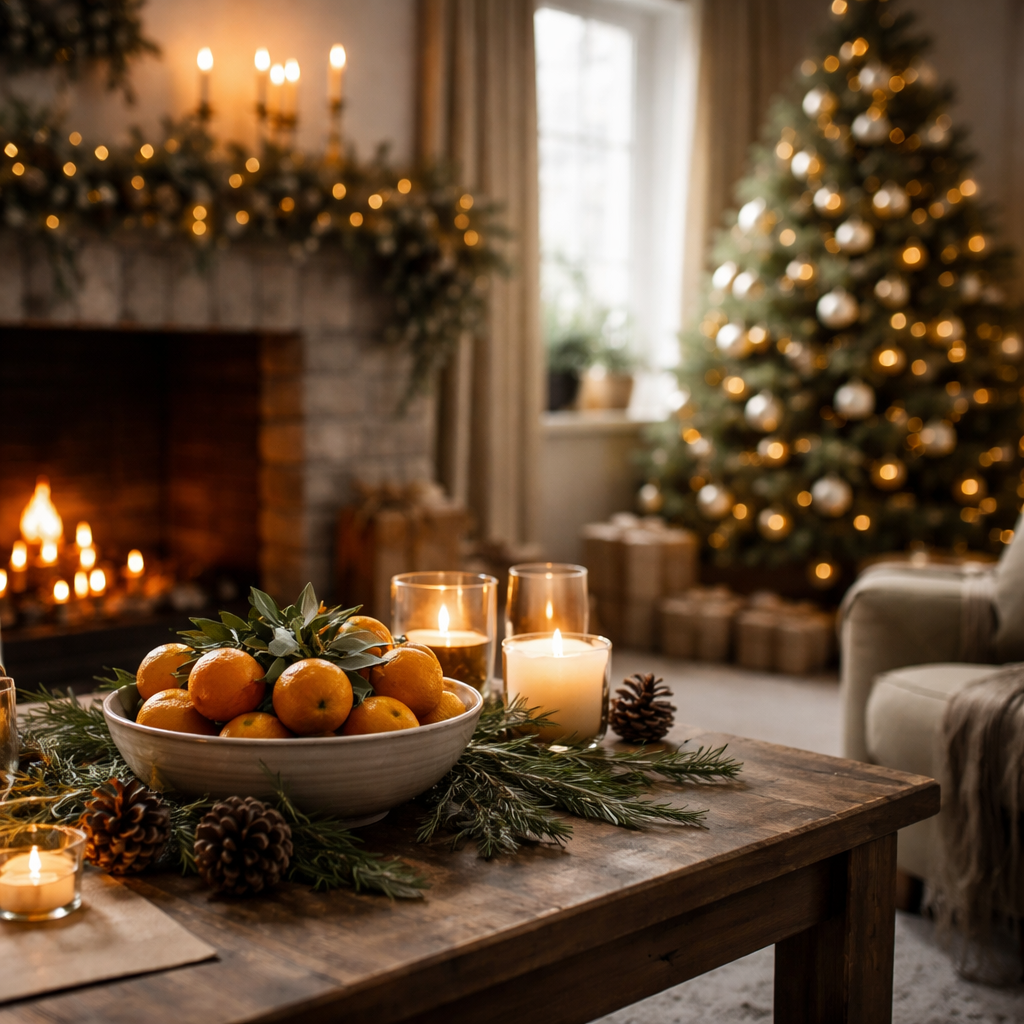
A bowl of clementines with their leaves still attached, placed on a wooden surface with a few sprigs of rosemary, costs almost nothing and looks like something from a Scandinavian design magazine.
The natural direction also tends to age better through the season — fresh greenery dries gracefully, dried citrus lasts for weeks, and cotton stems look identical on December 1st and December 30th.
Color palette: picking a direction before you buy anything
One of the most practical decisions you can make before purchasing a single ornament is choosing a color palette. This single step prevents the “collected over the years” chaos that many homes end up with.
| Palette | Main tones | Works best for |
|---|---|---|
| Classic warm | Deep red, gold, forest green | Traditional, cozy interiors |
| Nordic minimal | White, grey, natural wood | Modern or Scandinavian spaces |
| Moody jewel tones | Burgundy, navy, copper | Dramatic, layered rooms |
| Soft neutral | Cream, sage, dried wheat | Cottagecore or earthy aesthetics |
| Monochrome white | Pure white, silver, ice blue | Contemporary, open-plan homes |
Once you commit to a palette, shopping becomes faster and the end result looks intentional rather than accidental.
DIY touches that don’t look handmade in a bad way
There’s a meaningful difference between handmade decor that looks crafted with care and projects that clearly belong on a school bulletin board. The key is knowing which DIY ideas stay elegant at home.
Some consistently well-received options:
- Dried citrus garlands — slice oranges thin, dry them in the oven at low heat, thread them with twine
- Wax-dipped pinecones — melt plain white or cream wax, dip the tips, let them cool; they look like fresh snow
- Brown paper gift wrapping with foliage — skip the printed gift wrap and use kraft paper, adding a sprig of rosemary or holly under the twine bow
- Glass jar clusters — group three mismatched glass jars, fill with fairy lights or pillar candles, and place on any surface that needs warmth
Lighting: the element most people underestimate
Christmas lighting isn’t just functional — it defines the entire atmosphere of a decorated space. The difference between a warm, glowing living room and a flat, overlit one often comes down to bulb tone alone. Warm white (around 2700K) creates the amber glow associated with festive comfort; cool white reads more clinical and tends to flatten the visual effect of other decorations.
Beyond the tree, consider adding light in unexpected places: inside a glass cloche over a small figurine, tucked into a bowl of ornaments, or draped loosely along a bookshelf. These secondary light sources add depth and make a room feel like it was decorated with intention.
Let the house guide you, not the trend
Social media has made it genuinely harder to decorate for Christmas without second-guessing every choice. There’s always a more elaborate version, a trendier palette, or a styling approach you haven’t tried. The most satisfying holiday interiors, though, are ones that reflect the people who live in them — not a curated feed.
If your family has ornaments collected across twenty years, lean into that history rather than hiding it behind a matching set. If your home has a low ceiling and small rooms, don’t force a towering tree — a well-dressed tabletop version can be just as striking. Christmas decor works best when it responds to the actual space and the actual people, not an idealized version of either.