Most people who share their lives with dogs still find themselves surprised by how little they actually know about them. The facts about dogs go far beyond “loyal companions” and “good boys” — they reveal a species shaped by thousands of years of co-evolution with humans, packed with biological quirks, emotional depth, and capabilities that researchers are still working to fully understand.
A nose that works like a second brain
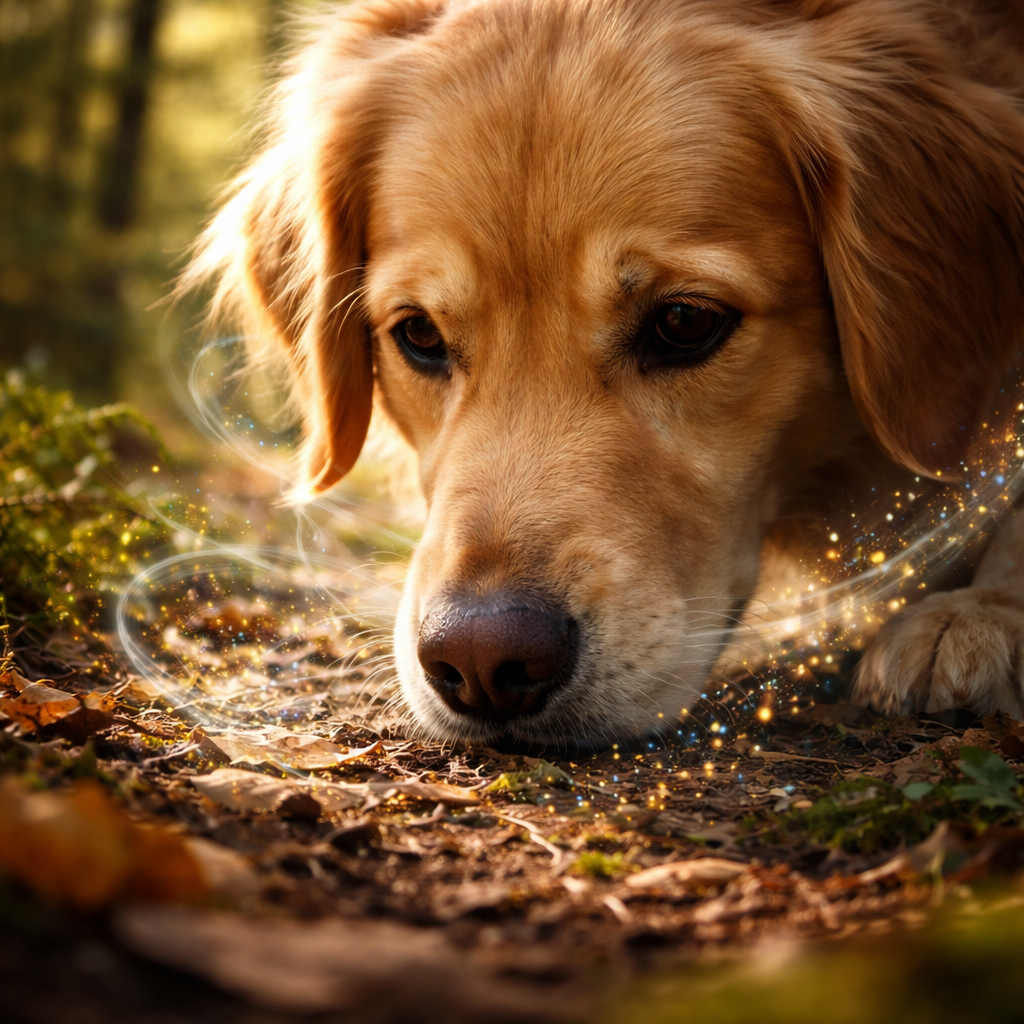
A dog’s sense of smell is estimated to be between 10,000 and 100,000 times more sensitive than a human’s. This isn’t just an impressive statistic — it shapes nearly every interaction a dog has with its environment. While we rely primarily on vision, dogs interpret the world through scent. They have up to 300 million olfactory receptors in their noses, compared to about 6 million in humans, and the part of a dog’s brain dedicated to analyzing smells is proportionally 40 times larger than ours.
This is why dogs are used for medical detection, search and rescue, border security, and even identifying certain types of cancer. Their noses aren’t just sharp — they’re structurally different. Dogs can breathe in and out simultaneously, meaning they get a continuous, uninterrupted stream of scent information rather than the broken sample we get with each sniff.
Dog intelligence is more layered than a single score
When people talk about dog intelligence, they often default to breed rankings — but canine cognition researchers point out that intelligence in dogs isn’t one-dimensional. Dr. Stanley Coren, a neuropsychologist who has studied dogs extensively, identifies at least three types of dog intelligence: instinctive (what the breed was developed to do), adaptive (problem-solving and learning from the environment), and working/obedience intelligence (following human commands).
“The average dog is about as smart as a two-year-old child in terms of language comprehension, and can understand up to 165 words and signals.” — Dr. Stanley Coren, The Intelligence of Dogs
Some dogs with exceptional training have demonstrated vocabulary sizes of over 1,000 words. Border collies, in particular, have been studied for their ability to learn object names rapidly — a skill previously thought to be uniquely human.
Physical facts that most owners overlook
Beyond behavior, dogs have some genuinely unusual physical traits that are easy to miss in daily life.
- Dogs have three eyelids — the third, called the nictitating membrane, helps protect and moisten the eye.
- Their body temperature is naturally higher than ours, ranging from 38°C to 39.2°C (101°F to 102.5°F).
- Dogs sweat primarily through their paw pads, not through their skin like humans.
- Puppies are born deaf and blind — their ear canals are closed at birth and open around two to three weeks of age.
- A dog’s nose print is unique, much like a human fingerprint.
- Dogs have a wider field of vision than humans — approximately 250 degrees compared to our 180 degrees.
One thing that surprises many dog owners is that dogs don’t see in black and white — that’s a long-standing myth. They do see color, just differently from humans. Their vision is similar to that of a person with red-green color blindness, meaning they can distinguish blue and yellow clearly but struggle with red and green.
The human-dog bond has a biological foundation
The connection between dogs and people isn’t just emotional — it’s biochemical. When a dog and its owner make eye contact, both experience a rise in oxytocin, the same hormone associated with bonding between parents and infants. This mutual gaze response is not observed between wolves and humans, which suggests it developed specifically during domestication — a process that began somewhere between 15,000 and 40,000 years ago, depending on the study.
Dogs also read human facial expressions with surprising accuracy. Studies using eye-tracking technology show that dogs focus on the left side of a human face first — the same side we use to read emotions — which is a behavior seen only in humans and, now, in domestic dogs.
Breed diversity is biologically remarkable
All domestic dogs belong to the same species — Canis lupus familiaris — yet the variation in their size, shape, coat, and behavior is unlike anything else in the mammalian world. A Chihuahua and a Great Dane are the same species, despite having body masses that differ by a factor of 40 or more. This level of physical variation within a single species is extraordinary in nature.
| Breed group | Original purpose | Common traits |
|---|---|---|
| Herding | Managing livestock | High energy, responsive to commands |
| Hound | Tracking by scent or sight | Strong prey drive, independent |
| Terrier | Hunting small animals | Tenacious, bold, feisty |
| Toy | Companionship | Affectionate, apartment-friendly |
| Working | Guard, sled, water rescue | Powerful, protective, trainable |
Understanding a dog’s breed group can actually help owners set realistic expectations around training, energy levels, and behavior — something that prevents a lot of frustration on both sides of the leash.
What dogs quietly teach us about ourselves
Spending time with dogs has measurable effects on human health. Interacting with a dog lowers cortisol levels, reduces blood pressure, and increases serotonin and dopamine activity. Dog owners, on average, tend to get more physical activity simply through daily walks. In clinical settings, animal-assisted therapy has shown positive outcomes for people dealing with anxiety, PTSD, autism spectrum conditions, and recovery from illness.
There’s something genuinely reciprocal about the relationship. Dogs didn’t just become useful to us — we became important to them, too. They read our moods, respond to our stress, and in many cases show signs of distress when separated from their owners. That’s not training. That’s attachment.
The more science digs into canine behavior and biology, the more it becomes clear that dogs are not simply domesticated wolves wearing a friendly face. They’re a genuinely unique kind of animal — one that evolved alongside human civilization and, in the process, became something the natural world had never quite seen before.