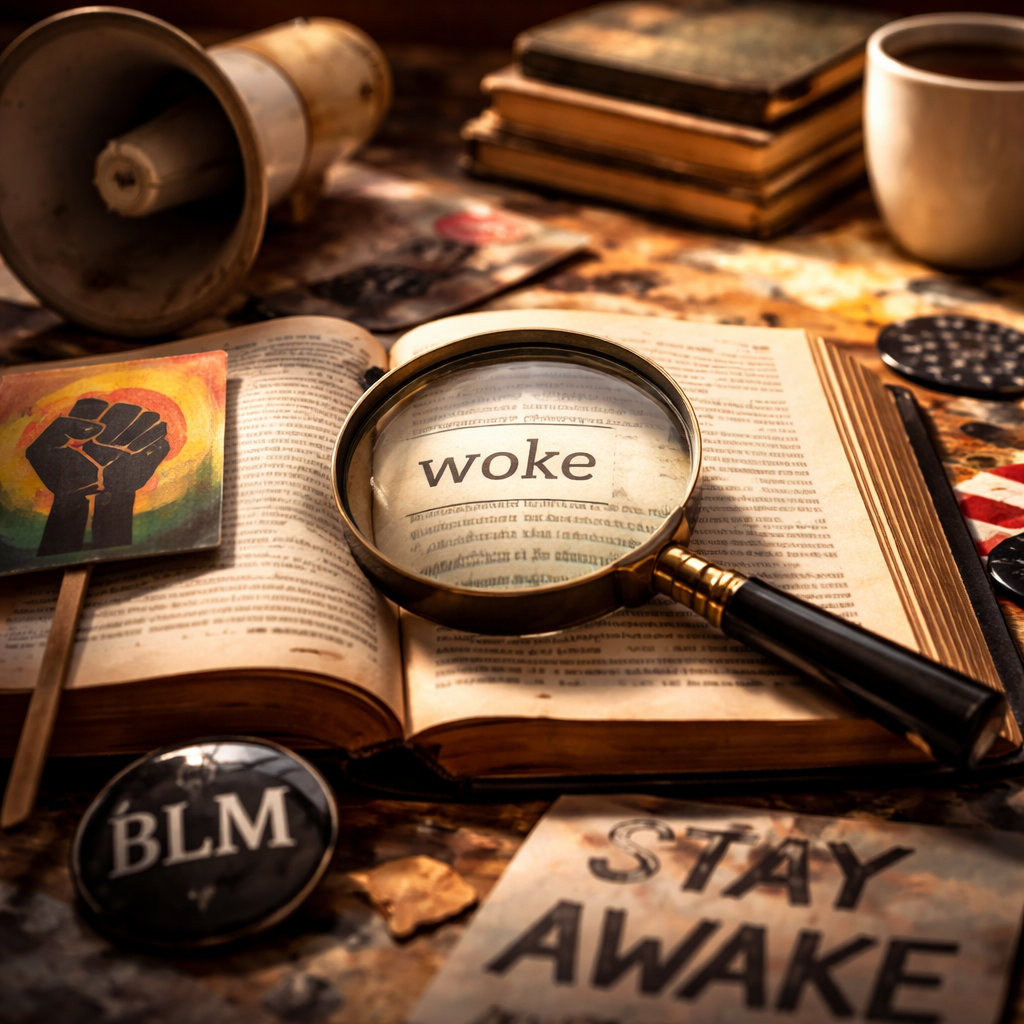
Few words in recent years have sparked as much debate, confusion, and passionate discussion as “woke” — and understanding the meaning of the word woke goes far beyond a simple dictionary definition. It carries layers of history, cultural context, and shifting political weight that make it genuinely worth unpacking.
Where the Word Actually Comes From
The origins of “woke” trace back to African American Vernacular English (AAVE), where it functioned as the past tense of “wake” but carried a figurative meaning: to be awake to social injustice, particularly racial discrimination. Its earliest documented uses in this sense appear in the context of the American civil rights movement, when activists urged communities to stay alert to systemic racism and inequality.
One of the earliest recorded uses of the term in its social sense appeared in a 1962 New York Times Magazine article by novelist William Melvin Kelley, who described the word’s use in Black communities. Decades later, the phrase “stay woke” gained broader visibility through musical culture — most notably Erykah Badu’s 2008 song “Master Teacher,” which included the lyric “I stay woke.” From there, the word began its long journey into mainstream consciousness.
How the Meaning Evolved Over Time
By the time the Black Lives Matter movement gained national attention, “stay woke” had become a rallying phrase — a call to remain conscious of racial injustice, police brutality, and systemic inequality. At this stage, the word carried clear progressive social justice connotations and was used largely with sincerity and solidarity within activist communities.
The shift happened gradually, as the term moved from community-specific usage into broader cultural and political discourse. As it crossed over into mainstream media and political commentary, “woke” began to mean different things to different people. For many, it remained a positive descriptor — someone who is informed, empathetic, and conscious of social issues. For others, particularly critics from more conservative perspectives, it became shorthand for what they saw as excessive political correctness, identity politics, or ideological overreach.
“The evolution of ‘woke’ from an in-group term of empowerment to a widely contested political label reflects how language becomes a battleground for culture and values.”
What “Woke” Means in Different Contexts Today
Depending on who is using the word and in what setting, “woke” can carry dramatically different meanings. Here is a practical breakdown:
| Context | How “woke” is used | Typical connotation |
|---|---|---|
| Social justice activism | Being aware of systemic inequalities | Positive, empowering |
| Corporate branding | Aligning with progressive social causes | Mixed — often criticized as performative |
| Conservative political rhetoric | Criticizing progressive ideology | Negative, used as a pejorative |
| Everyday conversation | Describing someone open-minded or socially aware | Neutral to positive |
This fragmentation of meaning is what makes the word so loaded. When someone calls a policy, a company, or a person “woke,” the listener’s reaction depends almost entirely on their own values and beliefs. The word has essentially become a political Rorschach test.
The Linguistic Phenomenon Behind the Word’s Journey
Linguists refer to the process that “woke” has undergone as semantic broadening and politicization — when a word expands beyond its original meaning and becomes charged with ideological associations. This is not uncommon in the history of language. Words like “liberal,” “conservative,” “elite,” and even “identity” have all traveled similar roads.
What makes “woke” particularly interesting from a linguistic standpoint is how rapidly this transformation occurred. Within roughly a decade, the word moved from niche cultural usage to mainstream political vocabulary to a term so contested that its mere mention can signal group membership or opposition. Sociolinguists note that this kind of charged trajectory often reflects deeper societal tensions playing out through language.
Common Misconceptions Worth Clearing Up
Because the word sits at the intersection of culture, politics, and language, there are several recurring misunderstandings about what it means and where it comes from:
- It is not a new word invented by social media — its roots go back decades in African American communities.
- Being described as “woke” is not inherently an insult or a compliment — it entirely depends on who is saying it and why.
- The word does not belong to any single political ideology; its meaning has been claimed and reshaped by multiple sides of the cultural debate.
- “Woke capitalism” is a separate concept referring to corporations publicly adopting progressive stances — often criticized as marketing rather than genuine commitment.
- The word’s original meaning, focused on racial consciousness, has been largely diluted as it has expanded into a broader cultural signifier.
Why This Word Matters Beyond the Debate
You might wonder whether any of this is worth thinking about if you are not personally engaged in political or social justice discussions. The honest answer is: yes, and here is why. Language shapes perception. The words we use to describe ideas influence how we think about them and how we communicate with people who see the world differently.
Understanding what “woke” meant originally, how it changed, and why it provokes strong reactions gives you a clearer lens for reading news, understanding cultural discourse, and having more informed conversations. It is also a vivid case study in how language gets politicized — a process that happens constantly and affects far more words than just this one.
If someone uses the word in your presence, the most useful question you can ask — either to yourself or directly — is not “is woke good or bad?” but rather “what does this person mean by it, and what does that tell me about their perspective?” That shift alone can transform a heated exchange into an actual conversation.
A Word in Motion, Not a Word with a Fixed Address
Language is never static, and “woke” is living proof of that. From its origins in Black American vernacular as a call to stay alert to injustice, through its rise as an activist rallying cry, to its current status as a deeply contested political term — the word has traveled an extraordinary distance in a relatively short time.
That journey does not make the word meaningless. If anything, it makes it more meaningful — as a mirror for the tensions, values, and conversations that define this particular moment in culture. Whether you use it, avoid it, or simply try to understand it, knowing its full story puts you in a much better position to engage with the world around you.