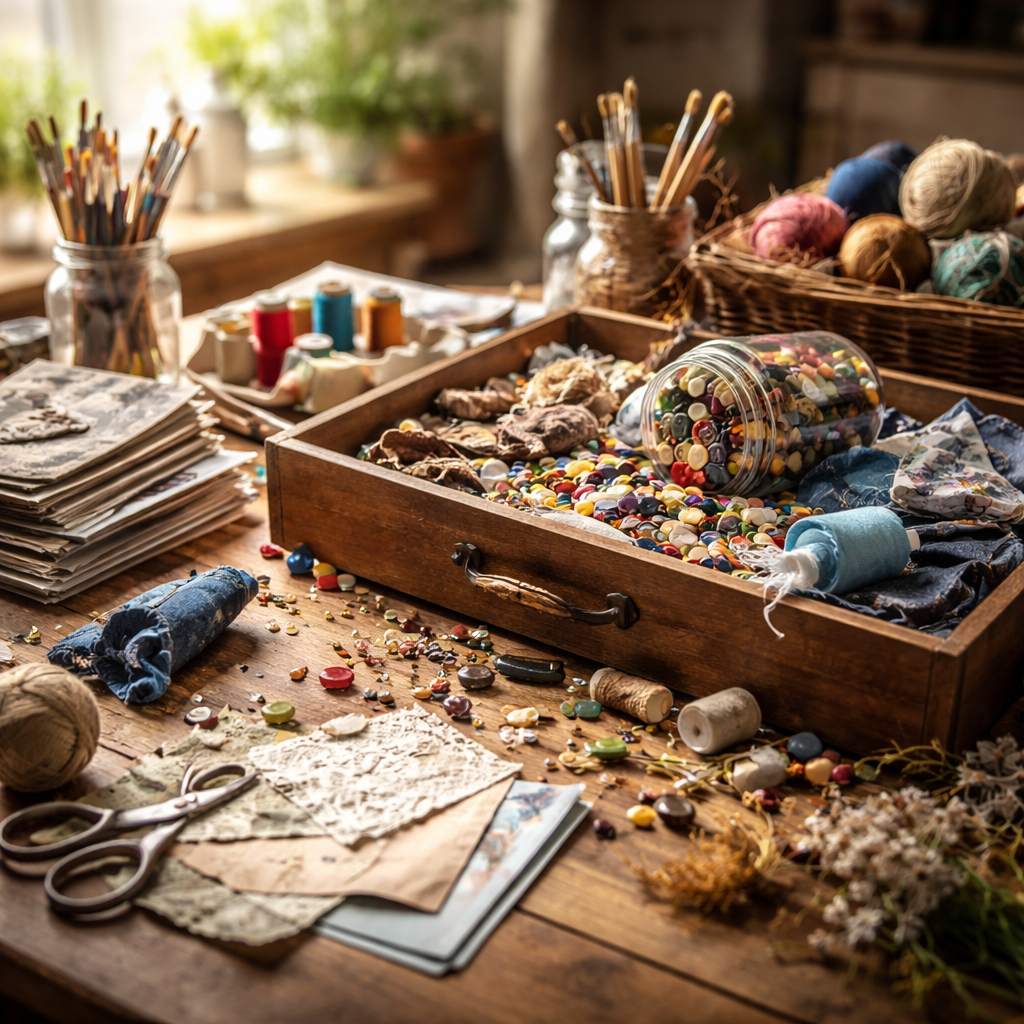
Most people underestimate how many ideas for crafts are hiding in plain sight — inside a kitchen drawer, a pile of old magazines, or a jar of leftover buttons. Crafting isn’t about having a fully stocked studio or expensive tools. It’s about looking at everyday materials differently and letting curiosity lead the way.
Where do good craft ideas actually come from?
Inspiration for handmade projects rarely arrives as a lightning bolt. More often, it grows from noticing what’s already around you. A worn-out denim jacket becomes a canvas for embroidery. A stack of old newspapers transforms into papier-mâché bowls. Empty glass jars turn into lanterns or herb planters. The raw material for creative work is almost always closer than you think.
That said, it helps to know which directions are worth exploring — especially if you’re just starting out or looking to try something genuinely new. The craft world is broader than most beginners expect, and different techniques suit different personalities, budgets, and available time.
Craft directions worth exploring
Rather than listing hundreds of random project ideas, it makes more sense to think in categories. Each craft family has its own logic, its own learning curve, and its own kind of satisfaction. Here’s a practical overview:
| Craft category | Best for | Typical materials |
|---|---|---|
| Paper crafts | Beginners, kids, low budget | Cardstock, magazines, tissue paper |
| Textile and fiber arts | Patient crafters who enjoy repetition | Yarn, fabric scraps, needles, hoops |
| Upcycling projects | Eco-conscious creators | Old clothing, bottles, furniture |
| Resin and polymer clay | Detail-oriented crafters | Resin, molds, pigments, clay |
| Natural and botanical crafts | Nature lovers | Dried flowers, leaves, beeswax |
Choosing a direction that matches your natural tendencies matters more than chasing trends. Someone who loves precision and fine detail will struggle with loose, expressive macramé — and thrive with resin jewelry or miniature book-binding. Someone who finds slow, meditative rhythm relaxing will likely fall in love with hand embroidery or loom weaving.
Handmade gifts that people actually want to receive
One of the most motivating reasons to craft is creating something meaningful for someone else. Handmade gifts carry a weight that store-bought items rarely do — not because they’re cheaper, but because they’re irreplaceable. A few DIY gift ideas that are genuinely well-received:
- Hand-poured soy candles with custom scent blends
- Personalized linen pouches with embroidered initials
- Botanical bookmarks made with pressed flowers and resin
- Knitted or crocheted accessories — scarves, headbands, market bags
- Handmade journals with decorated covers and sewn bindings
- Ceramic plant pots painted and sealed at home
What makes these work isn’t complexity — it’s intention. A simple candle made with care and packed thoughtfully will always outperform a generic gift set from a big-box store.
When you have limited time or space
A common barrier to crafting isn’t lack of ideas — it’s lack of a proper setup. Not everyone has a dedicated workspace, and not every project fits into a spare hour between responsibilities. The good news is that plenty of satisfying craft projects are compact, fast, and mess-minimal.
The most sustainable creative habit isn’t an ambitious project you never finish — it’s a small, repeatable one you actually enjoy doing.
Some formats work especially well for busy people:
- Needle felting — no drying time, no mess, works on a small tray
- Watercolor journaling — all you need is a notebook and a travel palette
- Wire wrapping jewelry — minimal tools, portable, no heat required
- Collage making — uses found materials, no special skills needed
- Hand lettering practice — just a brush pen and paper
These aren’t “lesser” crafts — some of them have deep skill ceilings and passionate communities built around them. Starting small doesn’t mean staying small.
Building a creative habit without burning out
One of the quieter challenges in creative work is sustainability. It’s easy to start strong — buy the supplies, watch the tutorials, make the first few things with genuine enthusiasm. The harder part is keeping that momentum when the novelty fades and you hit the inevitable awkward middle phase of learning a new skill.
A few things that genuinely help:
- Rotate between techniques instead of forcing yourself to stick to one
- Keep a small “ideas notebook” where you sketch or write down things you want to try
- Follow communities rather than just tutorials — seeing what others make is more motivating than passive watching
- Give yourself permission to make ugly things — skill comes from volume, not from waiting until you’re “ready”
The crafters who stick with it long-term aren’t the most talented ones — they’re the ones who found a way to make the process itself enjoyable, regardless of the outcome.
The craft that fits your lifestyle is the right craft
There’s no universal answer to what someone should make. The best DIY project is the one that fits your actual life — your budget, your time, your hands, your living space. Someone in a small apartment with an hour on weekday evenings has completely different options than someone with a garage workshop and free weekends.
What matters is starting somewhere — even imperfectly, even with borrowed supplies, even with a project that ends up looking nothing like the tutorial photo. That gap between the expected result and the actual result is exactly where skill develops. And somewhere in that messy, frustrating, occasionally glorious process, most people discover that the making itself is the point.