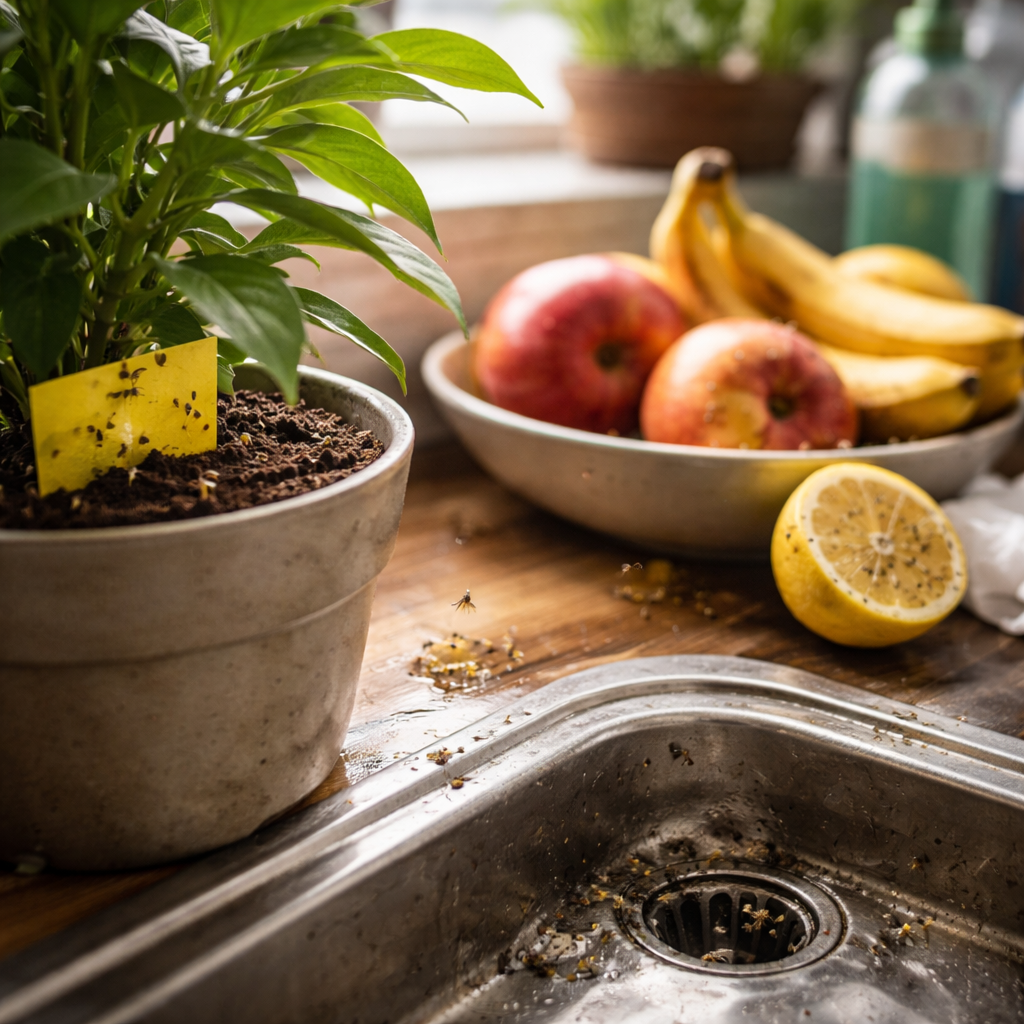
You water your plants, wipe down the kitchen counters, and take the trash out regularly — yet somehow, a cloud of tiny flying insects still appears out of nowhere. Figuring out how to get rid of gnats is one of those frustratingly common household challenges that most people face at least once, and the solution is almost never as simple as it first seems.
Why gnats seem impossible to eliminate
The reason gnat infestations feel so persistent comes down to their reproductive speed. A single female fungus gnat, for example, can lay up to 200 eggs in moist soil over the course of her short lifespan. By the time you notice the adults flying around your face, there are likely hundreds of larvae already developing just beneath the surface of your potted plants or inside a drain.
Another overlooked factor is misidentification. Not all small flying insects are the same, and treating a fruit fly problem like a fungus gnat problem — or vice versa — will get you nowhere fast. Before reaching for any remedy, it pays to take a closer look at what you’re actually dealing with.
Know your enemy: common types of gnats indoors
| Type | Where they breed | Key sign |
|---|---|---|
| Fungus gnats | Moist potting soil | Flying near houseplants |
| Fruit flies | Overripe fruit, spilled juice, drains | Hovering over food or sink |
| Drain flies | Organic buildup inside drains | Moth-like wings, near bathroom |
| Phorid flies | Decaying organic matter | Running rather than flying |
Each of these insects responds to different treatments, which is why a one-size-fits-all spray rarely solves anything long-term. Once you’ve identified the culprit, the path forward becomes much clearer.
Practical methods that actually work
Getting rid of gnats requires tackling both the adult insects you can see and the larvae or eggs you can’t. Adults are actually the easier part — it’s the source that needs your real attention.
For fungus gnats in houseplants
Overwatering is the single biggest contributor to fungus gnat infestations. These insects cannot complete their life cycle without consistently moist soil. Allowing the top two inches of soil to dry out completely between waterings disrupts breeding and gradually collapses the population without any chemicals involved.
If drying out the soil isn’t enough on its own, a soil drench with diluted hydrogen peroxide (one part 3% hydrogen peroxide to four parts water) kills larvae on contact while being harmless to the plant roots once it breaks down into water and oxygen.
Sticky yellow traps placed at soil level catch adult fungus gnats effectively — yellow specifically, because research on insect phototaxis shows it attracts these flies better than other colors.
For fruit flies and drain flies
Fruit flies need fermentable organic material to breed. Removing the source — storing fruit in the refrigerator, sealing compost bins tightly, and cleaning up spills immediately — cuts the infestation off at its root. A simple apple cider vinegar trap speeds up the process considerably: pour a small amount into a glass, add a drop of dish soap to break surface tension, and cover with cling wrap pierced with small holes. Flies enter but can’t escape.
Drain flies are trickier because their breeding ground is literally inside your pipes. Pouring boiling water down affected drains once a day for a week helps, but a more thorough approach involves using a drain brush to physically scrub out the biofilm that accumulates on pipe walls — that organic layer is exactly what drain fly larvae feed on.
What to avoid when dealing with a gnat problem
A lot of the advice circulating online about gnat removal either wastes your time or makes the situation worse. Here’s what experienced pest control professionals consistently flag as counterproductive:
- Spraying adult gnats with insecticide without addressing the breeding source — the adults will be replaced within days.
- Covering soil with sand as a top layer — while sometimes recommended, it doesn’t eliminate larvae already present deeper in the soil.
- Using essential oil sprays as a standalone solution — they may repel adults temporarily but have no effect on eggs or larvae.
- Ignoring secondary sources — a small forgotten bag of potatoes or onions in a cabinet can sustain a fruit fly population indefinitely.
When the infestation is larger than expected
Most gnat problems resolve within two to three weeks of consistent treatment. If yours doesn’t, the source likely hasn’t been fully identified. Walk through your space methodically — check beneath sink cabinets for moisture, inspect every houseplant including those in less-visited rooms, and look behind appliances for spills or standing water.
Biological control is worth considering for persistent fungus gnat problems in larger plant collections. Bacillus thuringiensis var. israelensis (Bti) is a naturally occurring soil bacterium available in granule or liquid form that specifically targets fungus gnat larvae without harming beneficial insects, pets, or people. Beneficial nematodes of the Steinernema feltiae species work similarly and can be watered into infested soil.
Patience is part of the strategy. Gnat life cycles run roughly three to four weeks depending on temperature, so you need to maintain control measures long enough to break the cycle completely — not just reduce visible numbers.
Keeping gnats from coming back
Prevention is considerably less effort than elimination. Once you’ve dealt with an infestation, a few consistent habits make a significant difference in keeping things under control long-term.
- Water houseplants only when the top layer of soil is visibly dry — consistency here prevents fungus gnat reinfestations almost entirely.
- Keep kitchen surfaces free of standing moisture and rinse recycling containers before storing them.
- Check newly purchased houseplants before bringing them inside — gnats spread easily through infested potting mix.
- Clean drains monthly with an enzymatic drain cleaner designed to break down organic buildup.
- Store fruit and vegetables properly, especially during warmer months when fermentation happens faster.
None of these habits require much effort individually. Together, they create an environment that’s genuinely inhospitable to gnats — which is far more effective than any trap or spray used reactively.
Small insects, solvable problem
Gnats are annoying precisely because they seem disproportionate to their size — tiny insects causing outsized frustration. But their persistence is almost always tied to a specific, identifiable source that can be addressed with targeted, low-cost methods. The key is shifting from swatting individual flies to understanding the environment that’s supporting them. Once that shift happens, the problem typically resolves faster than most people expect.