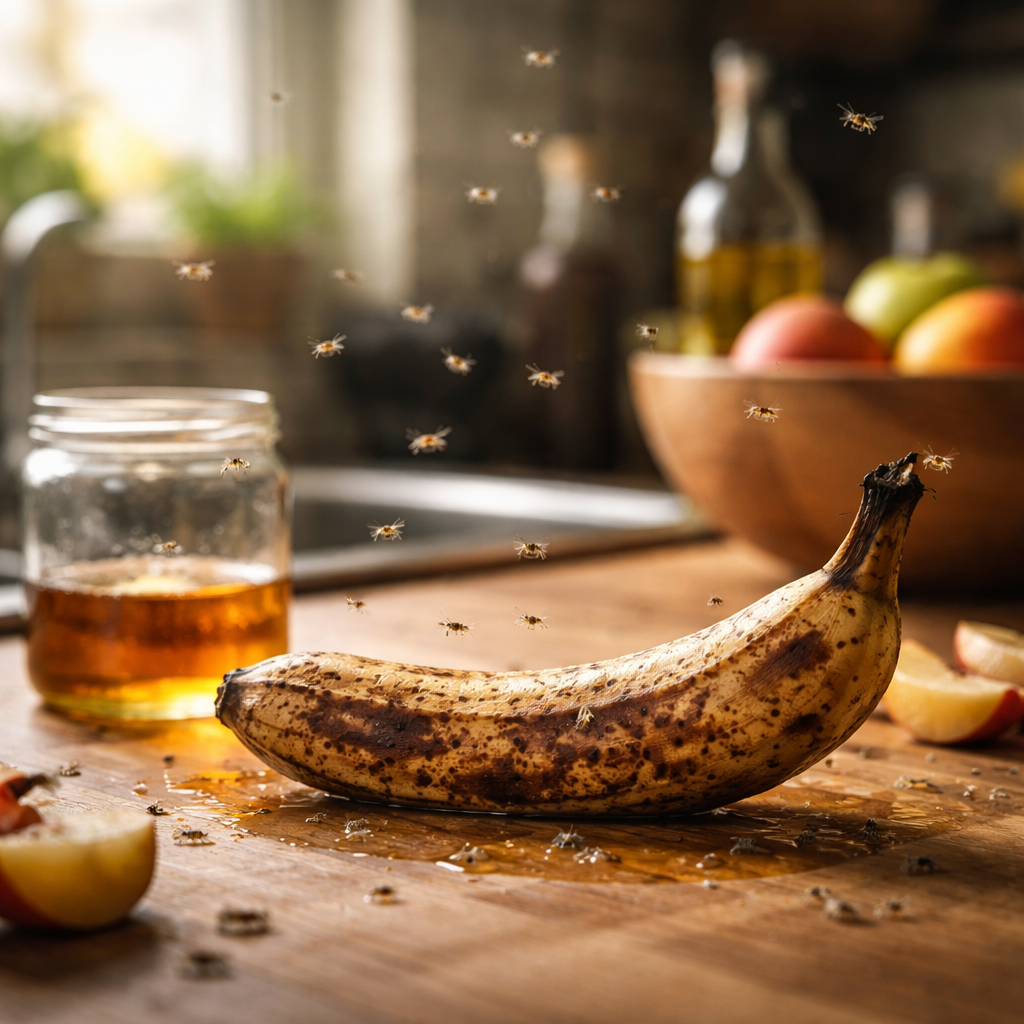
You leave a single overripe banana on the counter, and within what feels like hours, you have company — the uninvited, hovering kind. Knowing how to get rid of fruit flies is one of those practical life skills nobody teaches you, yet almost everyone eventually needs. The good news: you do not need a pest control specialist or a cabinet full of chemicals to deal with them.
Why your kitchen keeps attracting them
Fruit flies, known scientifically as Drosophila melanogaster, are not just attracted to fruit. They are drawn to fermentation. Any surface where sugars break down — a sticky juice spill you almost cleaned up, a wine glass left out overnight, the residue inside a recycling bin — becomes a landing zone and a potential breeding site.
What makes them particularly persistent is their reproductive speed. A single female can lay around 500 eggs over her lifetime, and those eggs hatch in as little as 24 hours under warm conditions. By the time you notice the swarm, several generations may already be living in your kitchen. That is why surface-level swatting never actually solves anything — you need to address the source.
Finding the source before anything else
Before setting traps or spraying anything, spend five minutes doing a proper scan of your space. Fruit flies breed in moist organic matter, and the breeding site is not always obvious.
- Check the bottom of your fruit bowl for any soft or rotting produce
- Inspect your sink drain — organic buildup inside pipes is a classic breeding ground
- Look at the area beneath and behind appliances where spills accumulate unnoticed
- Check your recycling bin, especially if it holds empty bottles or cans
- Do not overlook houseplants — overwatered soil can attract fungus gnats, which are often confused with fruit flies
Eliminating the breeding source is the only step that produces lasting results. Traps alone will thin the population, but without removing what draws them in the first place, the cycle continues.
DIY traps that actually work
Once the source is under control, traps help capture the adults already flying around. The most reliable homemade option requires almost nothing:
Take a small glass or jar, add about two tablespoons of apple cider vinegar, a drop of dish soap, and cover the top with plastic wrap secured with a rubber band. Poke a few small holes in the wrap. Fruit flies are drawn to the vinegar smell, enter through the holes, and the soap breaks the surface tension so they cannot escape.
Apple cider vinegar outperforms regular white vinegar here because of its stronger fermented scent. Red wine or a small piece of very ripe fruit placed inside a paper funnel set into a jar works just as well if you do not have vinegar on hand.
| Trap type | Main attractant | Effectiveness |
|---|---|---|
| Apple cider vinegar + dish soap | Fermented scent | High |
| Red wine trap | Fermented sugars | High |
| Overripe fruit in jar with funnel | Decomposing organic matter | Medium-high |
| Commercial sticky traps | Visual + scent lure | Medium |
Cleaning habits that cut the problem at its root
Traps and source removal handle the immediate situation, but prevention is what keeps fruit flies from returning. A few consistent habits go a long way.
Wipe down kitchen surfaces daily, paying particular attention to the areas around the stove and under the dish rack. Rinse glasses, bottles, and cans before placing them in recycling. Store ripe fruit in the refrigerator rather than on the counter during warmer months. Pour boiling water or a baking soda and vinegar mixture down your drain once a week to prevent organic buildup inside the pipes.
A clean drain is one of the most underestimated prevention tools. Most people treat the surfaces they can see and ignore what is happening inside the plumbing.
When the problem goes beyond the kitchen
If you have addressed all the obvious sources and traps are still filling up daily, the infestation may be coming from a less visible location. Bathroom drains with organic residue, a forgotten potato or onion stored in a dark cabinet, or even a mop head left damp in a corner can all sustain a population independently of your kitchen.
In these situations, a systematic room-by-room inspection is worth the effort. Place small vinegar traps in different areas of your home and check which ones attract the most activity — this helps you triangulate where the hidden source might be.
A few things worth knowing before you reach for a spray
Aerosol insecticide sprays will kill adult fruit flies on contact, but they do nothing to address larvae or eggs, and they have no residual effect on a breeding population. Unless you are dealing with a severe and widespread infestation that has resisted all other methods, sprays are more of a short-term frustration reliever than a solution.
Essential oils like peppermint, eucalyptus, and lavender are sometimes suggested as natural repellents. While there is some evidence they can deter fruit flies temporarily when applied to surfaces, they are not a reliable standalone solution and work best as a complementary measure alongside proper sanitation.
Small changes, lasting results
Getting rid of fruit flies is less about a single intervention and more about a short-term combination of source removal, trapping, and adjusted habits. Most infestations resolve within one to two weeks once the breeding environment is eliminated. The flies you see after that are simply the remaining adults with nowhere left to reproduce — and the traps take care of them.
What tends to bring them back is not bad luck — it is an overlooked spill, a piece of fruit left out a day too long, or a drain that needs attention. Keep those in check, and you are unlikely to deal with them again for a long while.