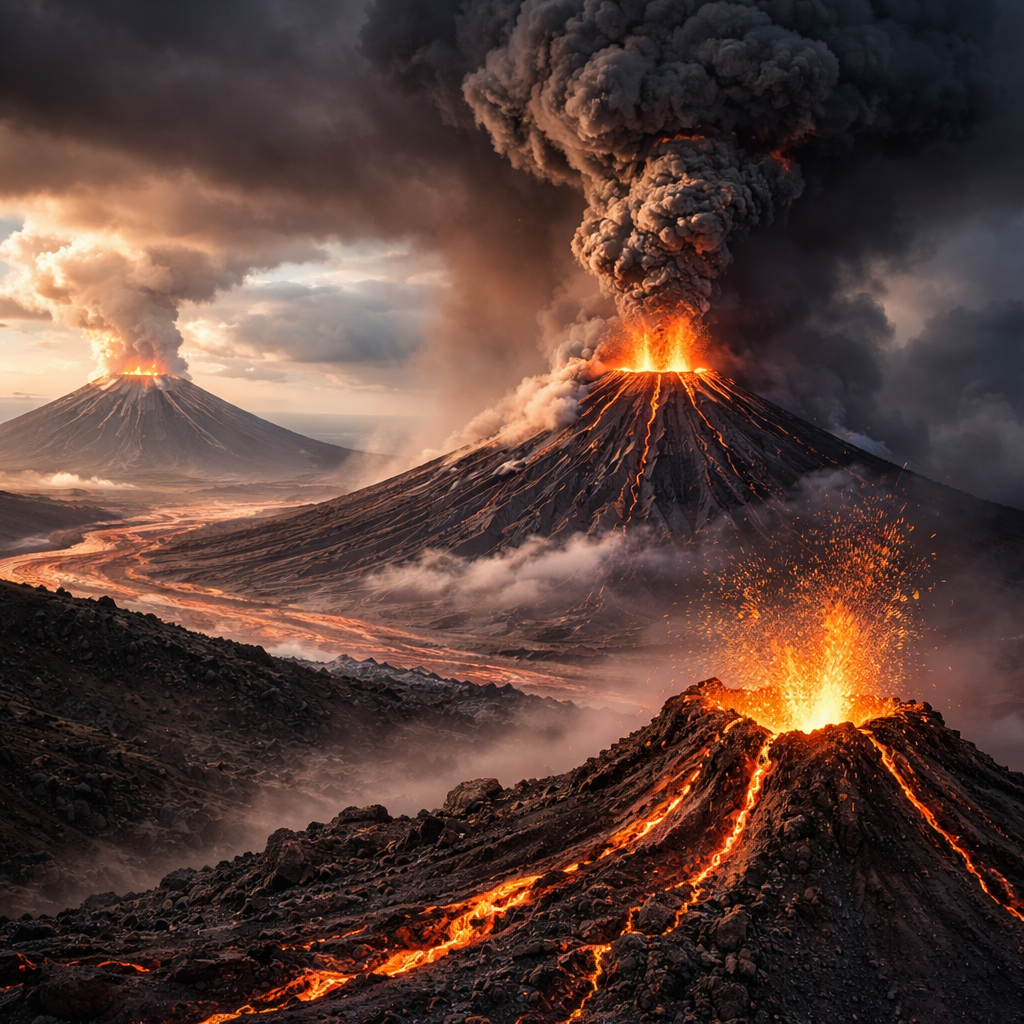
Beneath our feet, the Earth is anything but still — and facts about volcanoes remind us just how alive this planet truly is. These geological giants have shaped continents, altered climates, and even influenced the course of human history in ways most people never consider. What makes volcanoes so fascinating isn’t just the fire and spectacle — it’s the science, the unpredictability, and the sheer scale of forces involved.
Not all volcanoes look the same
Most people picture a cone-shaped mountain when they hear the word “volcano,” but that’s only one type. In reality, volcanoes come in several distinct forms, each shaped by the chemistry of their magma and the nature of their eruptions.
- Shield volcanoes — broad and flat, built from low-viscosity lava that flows easily. Mauna Loa in Hawaii is a classic example.
- Stratovolcanoes (composite volcanoes) — steep, cone-shaped, and capable of explosive eruptions. Mount Fuji and Mount St. Helens fall into this category.
- Cinder cone volcanoes — the smallest and simplest type, usually formed from a single eruptive vent.
- Calderas — massive collapsed craters formed after a volcano empties its magma chamber. Yellowstone sits above one of the world’s largest calderas.
Understanding the type of volcano matters enormously for predicting eruption behavior. A shield volcano might release rivers of lava for weeks with relatively little explosive activity, while a stratovolcano can produce catastrophic blasts with almost no warning.
The numbers behind volcanic activity
Volcanic activity is far more common than most people realize. At any given moment, around 20 volcanoes are erupting somewhere on Earth. Over the course of a year, that number rises to roughly 50 to 70 individual volcanoes showing significant activity.
| Region | Notable Volcanoes | Type of Activity |
|---|---|---|
| Pacific Ring of Fire | Krakatoa, Pinatubo, Popocatépetl | Highly explosive |
| Hawaii | Kilauea, Mauna Loa | Effusive lava flows |
| Iceland | Eyjafjallajökull, Fagradalsfjall | Fissure eruptions |
| Italy | Etna, Stromboli | Persistent mild activity |
The Pacific Ring of Fire accounts for roughly 75% of the world’s active volcanoes and about 90% of the world’s earthquakes. This zone stretches from New Zealand through Southeast Asia, up along the Japanese archipelago, across to Alaska, and down the western coasts of North and South America.
What actually happens underground
Magma forms when rock in the Earth’s mantle partially melts due to intense heat, pressure changes, or the introduction of water from subducting tectonic plates. This molten rock is less dense than the surrounding solid rock, so it gradually rises through cracks and fractures toward the surface.
Once magma reaches the surface, it’s technically called lava — the same material, just a different name depending on location.
The viscosity of magma — essentially how thick or runny it is — determines how explosive an eruption will be. High-silica magma is thick and traps gases, which build up pressure and lead to violent explosions. Low-silica magma is runnier, allowing gases to escape more easily and producing gentler, flowing eruptions.
Volcanoes and the world around them
It might seem counterintuitive, but volcanic regions are often among the most fertile on Earth. Volcanic ash and lava break down over time into mineral-rich soil that supports dense agriculture. The slopes of Mount Etna in Sicily, for instance, have been farmed for thousands of years precisely because the soil is so productive.
On the other hand, large-scale eruptions can have serious global consequences. When Mount Tambora erupted in 1815, it injected so much ash and sulfur dioxide into the stratosphere that global temperatures dropped noticeably the following year — a period historically referred to as the “Year Without a Summer.” Crops failed across Europe and North America, leading to widespread food shortages.
Volcanic gases and their effects
An eruption isn’t just about lava. Volcanoes release a complex mix of gases that can be just as dangerous — sometimes more so — than the molten rock itself. The main volcanic gases include:
- Water vapor — the most abundant volcanic gas, generally harmless
- Carbon dioxide — can accumulate in low-lying areas and displace oxygen
- Sulfur dioxide — reacts with water in the atmosphere to form sulfuric acid, contributing to acid rain
- Hydrogen sulfide — toxic even in relatively small concentrations
- Hydrogen fluoride — particularly dangerous to livestock and soil in volcanic regions
The 1986 Lake Nyos disaster in Cameroon, though not a traditional eruption, demonstrated the deadly potential of volcanic CO2. A sudden release of carbon dioxide from a crater lake suffocated approximately 1,700 people and thousands of livestock in surrounding villages overnight.
Monitoring and living with volcanoes
Modern volcanology has advanced dramatically. Scientists now use seismographs to detect magma movement underground, GPS sensors to measure ground deformation, and satellite imagery to track surface temperature changes and gas emissions. These tools can sometimes provide days or even weeks of warning before a significant eruption.
Still, prediction is never perfect. Volcanoes can remain dormant for centuries and then reactivate with little forewarning. That’s why communities living near active volcanic systems — from the Philippines to Italy to Central America — maintain evacuation plans and work closely with geological agencies to stay informed.
There’s something genuinely humbling about volcanoes. They operate on geological timescales that dwarf human experience, yet their effects can reshape entire landscapes within hours. Learning about them isn’t just an academic exercise — it connects us to the deep, dynamic processes that have been building and rebuilding this planet for billions of years.
Where Earth keeps its oldest secrets
Some of the most ancient rocks on Earth were formed by volcanic activity. The study of volcanic rock layers — a field called volcanotectonics — gives geologists a window into the planet’s past, including ancient climate shifts, mass extinction events, and even the early conditions that made life possible.
The Deccan Traps in India, for example, are a vast expanse of volcanic rock formed by massive eruptions that occurred around the same time as the extinction of the dinosaurs. Whether those eruptions played a role in that extinction — alongside the asteroid impact — remains an active area of scientific debate.
Volcanoes are not simply destructive forces. They are architects of the world as we know it — responsible for the atmosphere, much of the ocean water, and the fertile lands that sustain human civilization. The more we understand them, the better we can appreciate both their power and their essential role in keeping Earth geologically alive.