Most people know tigers are big and striped — but the facts about tigers go far deeper than their appearance. These animals carry biological quirks, behavioral patterns, and conservation stories that genuinely surprise even people who think they already know the basics.
A body built for ambush, not marathon
Tigers are not endurance hunters. Unlike wolves or African wild dogs that chase prey over long distances, tigers rely entirely on stealth and explosive bursts of speed. They can reach up to 65 km/h in short sprints, but only for a few seconds. If the first lunge misses, the tiger usually abandons the chase.
Their hind legs are longer than their front legs, which gives them an unusual forward-leaning posture when standing still — and an extraordinary ability to leap. A tiger can jump up to 9–10 meters horizontally in a single bound. That’s roughly the length of a large school bus.
What makes their hunting even more effective is their night vision. Tigers have a layer of cells behind the retina called the tapetum lucidum, which reflects light back through the eye. This gives them vision roughly six times more powerful than a human’s in low-light conditions — a critical advantage when most of their hunting happens at dusk or dawn.
The stripe pattern is more personal than you think
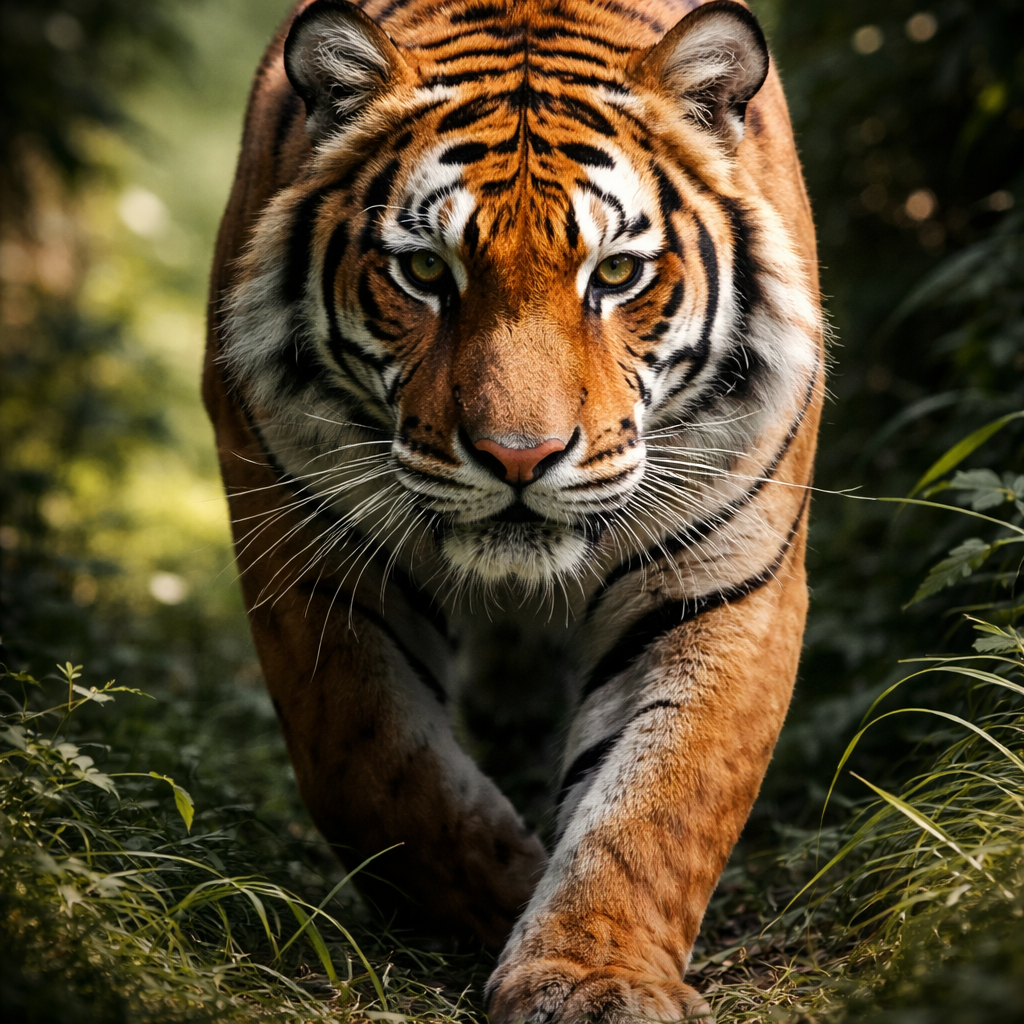
No two tigers have identical stripe patterns. Much like human fingerprints, the arrangement of stripes on a tiger’s coat is unique to each individual. Researchers and wildlife conservationists actually use stripe pattern photography to identify and track individual tigers in the wild — a non-invasive method that doesn’t require tranquilizers or tagging.
Interestingly, the stripes are not just on the fur. The skin beneath carries the same pattern. Shave a tiger — which no one should attempt — and the markings remain.
Tigers are the only big cats whose stripes extend to the skin, not just the coat — making their identity literally skin-deep.
Tiger subspecies: fewer than most people realize
There are six recognized living subspecies of tigers, each adapted to a specific environment and region.
| Subspecies | Region | Estimated wild population |
|---|---|---|
| Bengal tiger | Indian subcontinent | ~2,500–3,000 |
| Amur (Siberian) tiger | Russian Far East, China | ~500–600 |
| Sumatran tiger | Sumatra, Indonesia | ~400–600 |
| Indochinese tiger | Southeast Asia | ~250–350 |
| South China tiger | Southern China | Functionally extinct in wild |
| Malayan tiger | Malay Peninsula | ~80–150 |
Three subspecies — the Bali, Javan, and Caspian tigers — have already gone extinct in the 20th century. The South China tiger has not been confirmed in the wild for decades and is considered functionally extinct outside of captivity.
Social behavior that defies the “lone predator” label
Tigers are largely solitary, but calling them purely antisocial is an oversimplification. They maintain awareness of other tigers through scent marking, scratch marks on trees, and vocalizations. Males and females overlap in territory, and a male’s range often covers the territories of several females.
Cubs stay with their mother for two to three years, learning to hunt through observation and practice. During this period, sibling cubs frequently play-fight — a behavior that isn’t just entertainment but active preparation for the challenges of independent life.
Tigers are also one of the few big cat species comfortable in water. They actively seek out rivers and lakes to cool down, and they are strong swimmers capable of crossing rivers several kilometers wide. Unlike domestic cats, tigers are not water-averse — they often play and soak voluntarily.
Communication beyond the roar
The roar of a tiger can travel over three kilometers through dense forest. But tigers use a much wider range of vocalizations than most people associate with them. Here are some of the key sounds tigers produce:
- Chuffing (prusten) — a soft, non-threatening puff through the nostrils used as a greeting between tigers who know each other
- Moaning — a long, low sound used during mating or when a tiger is searching for a mate
- Growling and hissing — defensive signals indicating agitation or threat
- Roaring — territorial announcement or response to competition
The chuff, in particular, is a remarkably gentle sound coming from an animal of this size. Wildlife researchers describe it as one of the clearest indicators of a relaxed, non-aggressive tiger — and it’s the sound captive tigers often use to greet familiar caretakers.
Diet, territory, and the scale of their needs
A tiger needs to eat roughly 7–8% of its body weight in meat at a single meal and may go several days between successful hunts. An adult male Bengal tiger can weigh up to 300 kg, meaning a single kill might need to provide 20–25 kg of meat or more.
Their preferred prey varies by region. Bengal tigers commonly hunt deer, wild boar, and gaur. Amur tigers, living in colder climates with lower prey density, hunt elk and wild boar across enormous territories — a single male may patrol an area of 1,000 square kilometers or more.
What actually threatens tiger survival
The global tiger population dropped by more than 95% over the course of the 20th century. At the start of the 1900s, an estimated 100,000 tigers roamed across Asia. The primary drivers of this collapse were habitat loss, poaching, and prey depletion — and all three remain active threats today.
Tiger bones, skin, and organs are still in demand on illegal markets, particularly in parts of Asia where they are used in traditional medicine — despite a complete lack of scientific evidence supporting their medicinal value. International trade in tiger parts has been banned under CITES since 1975, yet enforcement remains inconsistent across range countries.
Habitat fragmentation is arguably the more complicated problem. As forests are converted for agriculture and development, tiger populations become isolated in small patches of land. Isolated populations lose genetic diversity over generations and become more vulnerable to disease and reproductive failure.
Tigers are closer to us geographically than most people imagine
People often picture tigers as remote jungle creatures entirely disconnected from human life. The reality is quite different. Bengal tigers in the Sundarbans mangrove delta live in direct proximity to one of the most densely populated regions on Earth — the border area of Bangladesh and India. Human-tiger conflicts in these regions are documented and ongoing.
This proximity is one of the reasons conservation requires community involvement, not just protected reserves. Programs that compensate local farmers for livestock losses attributed to tigers, or that train communities to reduce conflict, have shown measurable results in reducing retaliatory killings of wild tigers.
Understanding tigers — their biology, behavior, and the pressures they face — doesn’t require a wildlife degree. It starts with moving past the surface-level image of the “king of the jungle” (a title that belongs to lions, anyway — tigers prefer forests and grasslands) and engaging with what these animals actually are: highly adapted, biologically complex, and genuinely at risk without continued global attention.