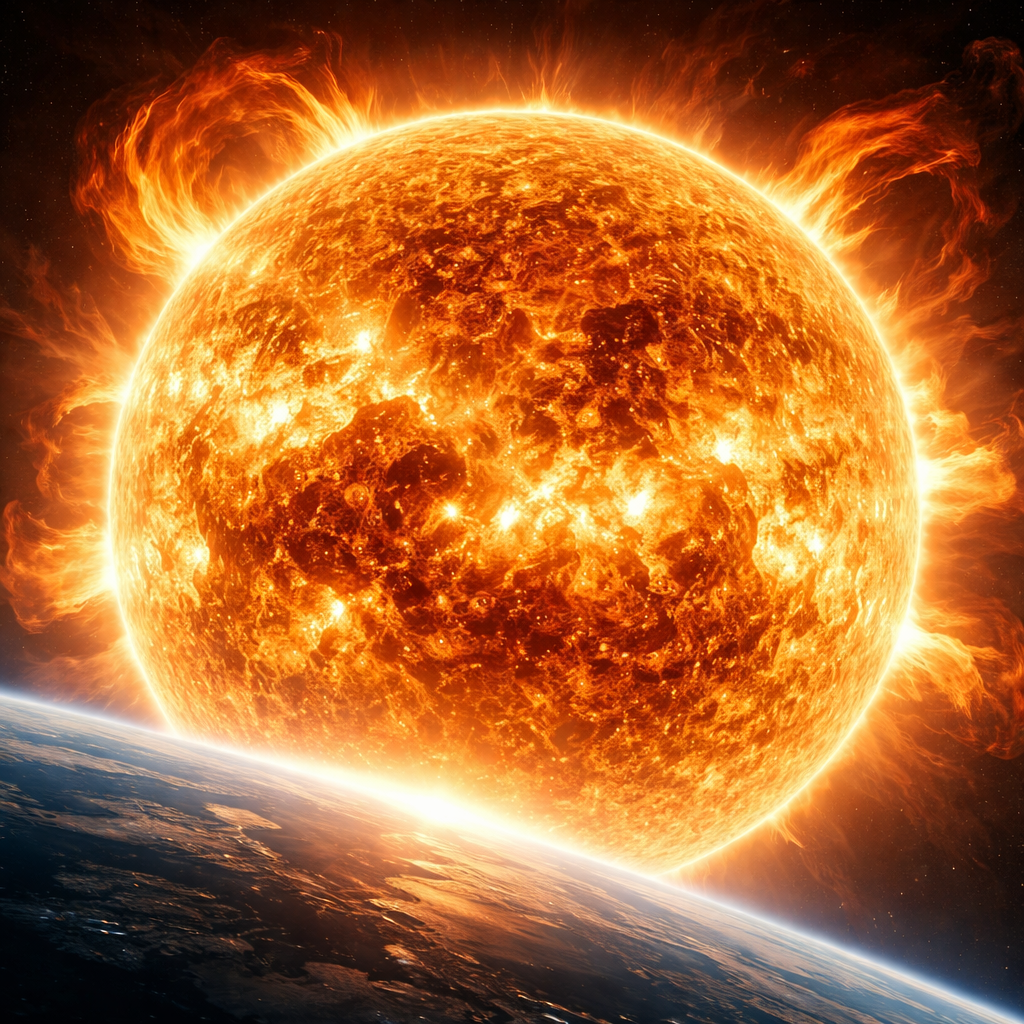
Every single day, facts about the sun pass us by unnoticed — the warmth on your skin, the light pouring through the window, the way shadows shift across the floor. Yet most people know surprisingly little about the star that makes all of this possible. What exactly is happening 93 million miles away, and why should you care?
The sun is not what most people picture
When people imagine the sun, they often think of a glowing ball of fire. In reality, fire is a chemical reaction that requires oxygen — and there is no oxygen burning in the sun’s core. What we see is something far more extreme: a nuclear fusion reactor, where hydrogen atoms are crushed together under enormous pressure and temperature to form helium, releasing staggering amounts of energy in the process.
The temperature at the sun’s core reaches approximately 15 million degrees Celsius. The surface, called the photosphere, is a comparatively cool 5,500 degrees Celsius. What makes this paradoxical is that the outer atmosphere — the corona — reaches temperatures of over 1 million degrees Celsius, despite being farther from the core. Scientists call this the coronal heating problem, and it remains one of the biggest unsolved mysteries in solar physics.
Numbers that are hard to wrap your head around
The sheer scale of the sun is genuinely difficult to grasp without some context. Here are a few figures that put it into perspective:
- The sun accounts for about 99.86% of the total mass of the entire solar system.
- Approximately 1.3 million Earths could fit inside the sun by volume.
- Light from the sun takes about 8 minutes and 20 seconds to reach Earth.
- The sun completes one rotation at its equator roughly every 25 days, but its poles rotate more slowly — around 35 days. This is called differential rotation and happens because the sun is not a solid body.
- Every second, the sun converts about 600 million tons of hydrogen into helium.
These numbers are not metaphors — they are measured values derived from decades of observation, spacecraft data, and helioseismology, the science of studying the sun’s interior through the vibrations it produces.
Solar activity and its real impact on Earth
The sun is not a quiet, passive light source. It has weather of its own — and that weather can directly affect life on Earth in ways that are easy to overlook.
| Solar phenomenon | What it is | Effect on Earth |
|---|---|---|
| Solar flare | A sudden burst of radiation from the sun’s surface | Can disrupt radio communications and GPS signals |
| Coronal mass ejection (CME) | A large expulsion of plasma and magnetic field | Can cause geomagnetic storms, damage satellites and power grids |
| Solar wind | A continuous stream of charged particles from the sun | Creates auroras, interacts with Earth’s magnetosphere |
| Sunspots | Cooler, magnetically intense regions on the photosphere | Associated with increased solar activity cycles |
The sun follows an approximately 11-year solar cycle, during which its magnetic activity rises and falls. At solar maximum, sunspot activity increases significantly, and the likelihood of powerful flares and CMEs goes up. During the Carrington Event of 1859 — the most powerful geomagnetic storm ever recorded — telegraph systems across Europe and North America failed, and auroras were visible as far south as Cuba and Hawaii.
A geomagnetic storm of similar magnitude today could knock out power grids across entire continents and cause trillions of dollars in damage — a risk that space agencies and governments actively monitor.
The sun’s structure, layer by layer
Understanding how the sun is built helps make sense of how it works. The sun has a distinct layered structure, each zone playing a different role in energy transport.
- Core — where nuclear fusion occurs and energy is generated.
- Radiative zone — energy travels outward as radiation, bouncing between particles. A single photon can take hundreds of thousands of years to cross this layer.
- Convective zone — energy moves through rising and falling columns of plasma, similar to boiling water.
- Photosphere — the visible surface where sunlight is emitted.
- Chromosphere — a thin, reddish layer visible during solar eclipses.
- Corona — the vast outer atmosphere that extends millions of kilometers into space.
One detail that often surprises people: the photon of light warming your face right now was generated in the sun’s core possibly a million years ago. It spent nearly all of that time bouncing through dense solar material before finally escaping into space — and reaching Earth in just over eight minutes.
A practical tip worth knowing
Where the sun stands in the bigger picture
The sun is classified as a G-type main-sequence star, often called a yellow dwarf — though it actually emits white light. It sits roughly 26,000 light-years from the center of the Milky Way galaxy and takes about 225 to 250 million years to complete one orbit around the galactic center. Astronomers call this span of time a cosmic year or a galactic year.
In stellar terms, the sun is middle-aged. It has been fusing hydrogen for approximately 4.6 billion years and is expected to continue doing so for roughly the same amount of time again. When it eventually exhausts its hydrogen fuel, it will expand into a red giant, likely engulfing Mercury and Venus, before shedding its outer layers and leaving behind a dense remnant called a white dwarf.
That timeline is so vast that it has no practical relevance for anyone alive today — but it does put our moment in cosmic history into an oddly grounding perspective. We happen to exist at a stable, hospitable point in the sun’s long life, close enough to benefit from its energy, far enough to survive it.