Most people can name the planet they live on, but very few can say with confidence what actually makes it so unusual. The facts about the earth reveal a world that is far stranger, more dynamic, and more finely balanced than it appears from the surface — and understanding them changes the way you see everything around you.
The planet is not the shape you picture
Earth is not a perfect sphere. Scientists describe its true shape as an oblate spheroid — slightly flattened at the poles and bulging at the equator due to the planet’s rotation. The equatorial diameter is about 43 kilometers greater than the polar diameter. This means that the summit of Mount Everest is the highest point above sea level, but the peak of Mount Chimborazo in Ecuador is actually the farthest point from Earth’s center.
That subtle bulge has real consequences. It affects satellite orbits, GPS calculations, and even the way gravitational force is distributed across different latitudes. You weigh very slightly less at the equator than at the poles — not because of any change in your body, but because of where you’re standing on a spinning, imperfect sphere.
What the interior is actually doing right now
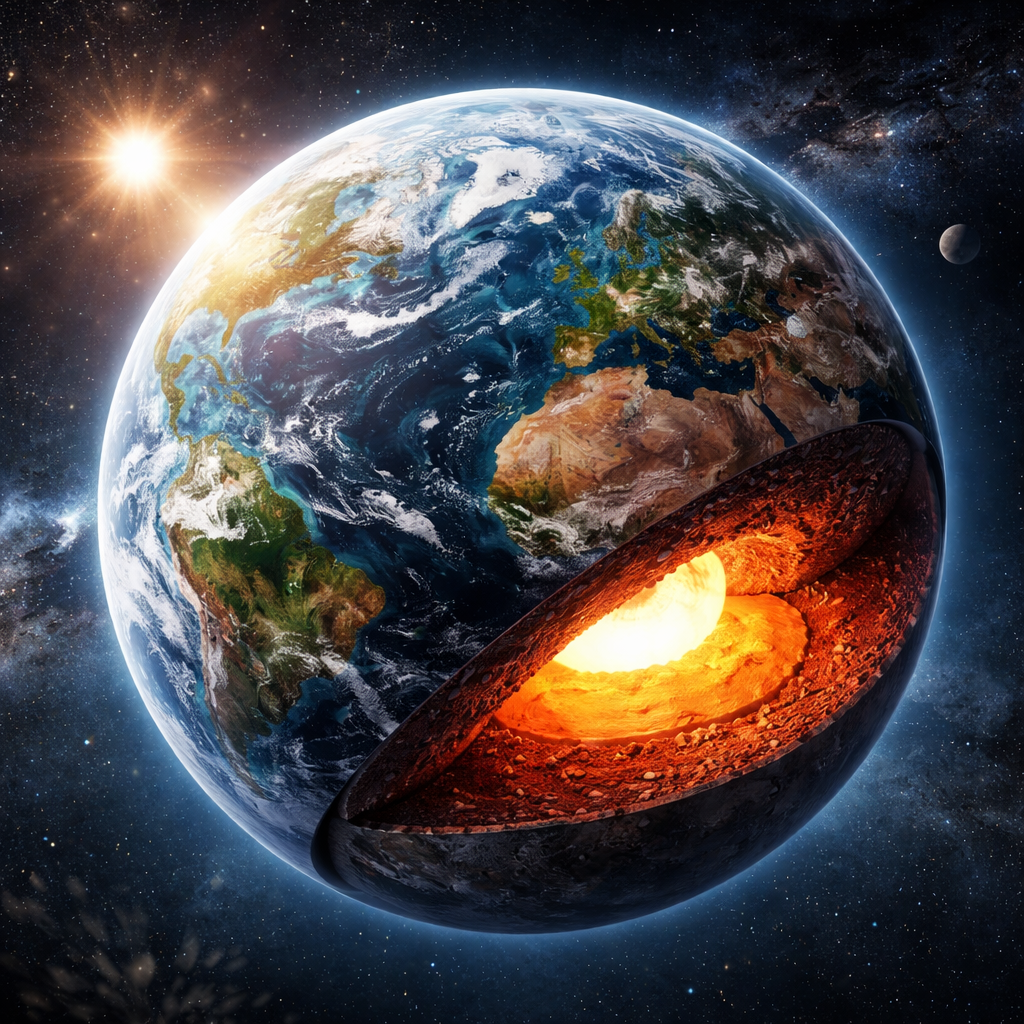
The ground beneath your feet feels stable, but the interior of the planet is in constant motion. Earth’s structure consists of four main layers, each with distinct properties:
- The inner core is a solid ball of iron and nickel, roughly the size of the Moon, with temperatures reaching around 5,400°C — comparable to the surface of the Sun.
- The outer core is liquid iron and nickel. Its movement generates Earth’s magnetic field through a process called the geodynamo.
- The mantle makes up about 84% of the planet’s total volume and behaves plastically over geological timescales, allowing tectonic plates to drift.
- The crust, where all life exists, is the thinnest layer — ranging from about 5 km under the oceans to up to 70 km under mountain ranges.
The magnetic field produced by the outer core is one of the reasons life on Earth is possible at all. It deflects harmful solar wind particles that would otherwise strip away the atmosphere over millions of years — something that likely happened to Mars after its own core cooled and solidified.
Earth’s magnetic field is not fixed. The magnetic north pole migrates continuously and has reversed its polarity hundreds of times throughout geological history — a process called geomagnetic reversal.
Water, atmosphere, and a very narrow window for life
Earth is sometimes called the “water planet,” and for good reason. About 71% of the surface is covered by water. However, the distribution of that water is striking when you look at the actual numbers:
| Type of water | Share of total water on Earth |
|---|---|
| Saltwater (oceans) | ~96.5% |
| Ice caps and glaciers | ~1.74% |
| Groundwater | ~1.69% |
| Surface freshwater (rivers, lakes) | ~0.013% |
The atmosphere is equally precise in its composition. Nitrogen makes up about 78%, oxygen around 21%, with the remaining 1% mostly argon and trace gases including carbon dioxide. That small fraction of CO₂ plays an outsized role in regulating surface temperature through the greenhouse effect — a natural process that has kept the planet warm enough for liquid water to persist for billions of years.
Earth sits within what astronomers call the habitable zone of the Solar System — close enough to the Sun to prevent oceans from freezing permanently, and far enough to prevent them from evaporating entirely. But distance alone is not the full explanation. Venus is closer to the habitable zone than Mars, yet its surface temperature exceeds 460°C due to a runaway greenhouse effect. Earth’s balance is maintained by multiple overlapping systems working together.
Motion, time, and a few numbers worth knowing
At any moment, you are moving through space at several different speeds simultaneously — you just cannot feel it. Here is what is actually happening:
- Earth rotates on its axis at about 1,670 km/h at the equator (slower toward the poles).
- Earth orbits the Sun at approximately 107,000 km/h.
- The entire Solar System moves through the Milky Way at roughly 828,000 km/h.
A single day is not exactly 24 hours. A solar day — the time it takes for the Sun to return to the same position in the sky — averages about 24 hours, but Earth’s rotation is gradually slowing due to tidal friction caused by the Moon. Hundreds of millions of years ago, a day lasted closer to 22 hours. Leap seconds are occasionally added to coordinated universal time to account for this ongoing deceleration.
Age, history, and the scale of geological time
Earth formed approximately 4.54 billion years ago from the same cloud of gas and dust as the rest of the Solar System. The Moon is thought to have formed shortly after, when a Mars-sized body called Theia collided with the early Earth. The debris from that impact coalesced into the Moon we see today — a companion that stabilizes Earth’s axial tilt and drives ocean tides.
Life appeared on Earth surprisingly early in its history. Microbial fossils suggest life existed at least 3.5 billion years ago, and some chemical evidence points to even earlier origins. Multicellular life, however, only became diverse and complex during the Cambrian explosion, roughly 540 million years ago. In the grand timeline of Earth’s existence, humans have been present for an extraordinarily small fraction — anatomically modern humans have existed for perhaps 300,000 years.
The planet keeps reshaping itself
Plate tectonics is one of the defining features of Earth among rocky planets in our Solar System. The crust is divided into several major plates and many smaller ones, all of which move continuously — typically at speeds comparable to how fast fingernails grow. Over hundreds of millions of years, these movements have assembled and broken apart supercontinents multiple times. The last supercontinent, Pangaea, began breaking apart around 175 million years ago, and the continents are still moving today.
This geological activity is not just a curiosity — it plays a role in regulating the carbon cycle, recycling minerals to the surface, and creating the diverse landscapes that have allowed ecosystems to develop in so many different directions. Volcanic activity, driven by the same internal heat, has shaped the atmosphere over geological time and continues to release gases that influence climate on long timescales.
What makes Earth genuinely remarkable is not any single feature — it is the combination of all of them working in concert. The right distance from the right kind of star, a large stabilizing moon, an active interior, liquid water, and a protective magnetic field. Remove any one element, and the planet becomes unrecognizable. Understanding these connections does not make the planet feel smaller — it makes it feel considerably more extraordinary.