Most people can name the eight planets in our solar system, but the facts about planets that scientists have uncovered over decades of space exploration go far beyond simple memorization. Some of these discoveries are genuinely counterintuitive — and a few of them will completely change how you picture our cosmic neighborhood.
Size is more deceptive than you think
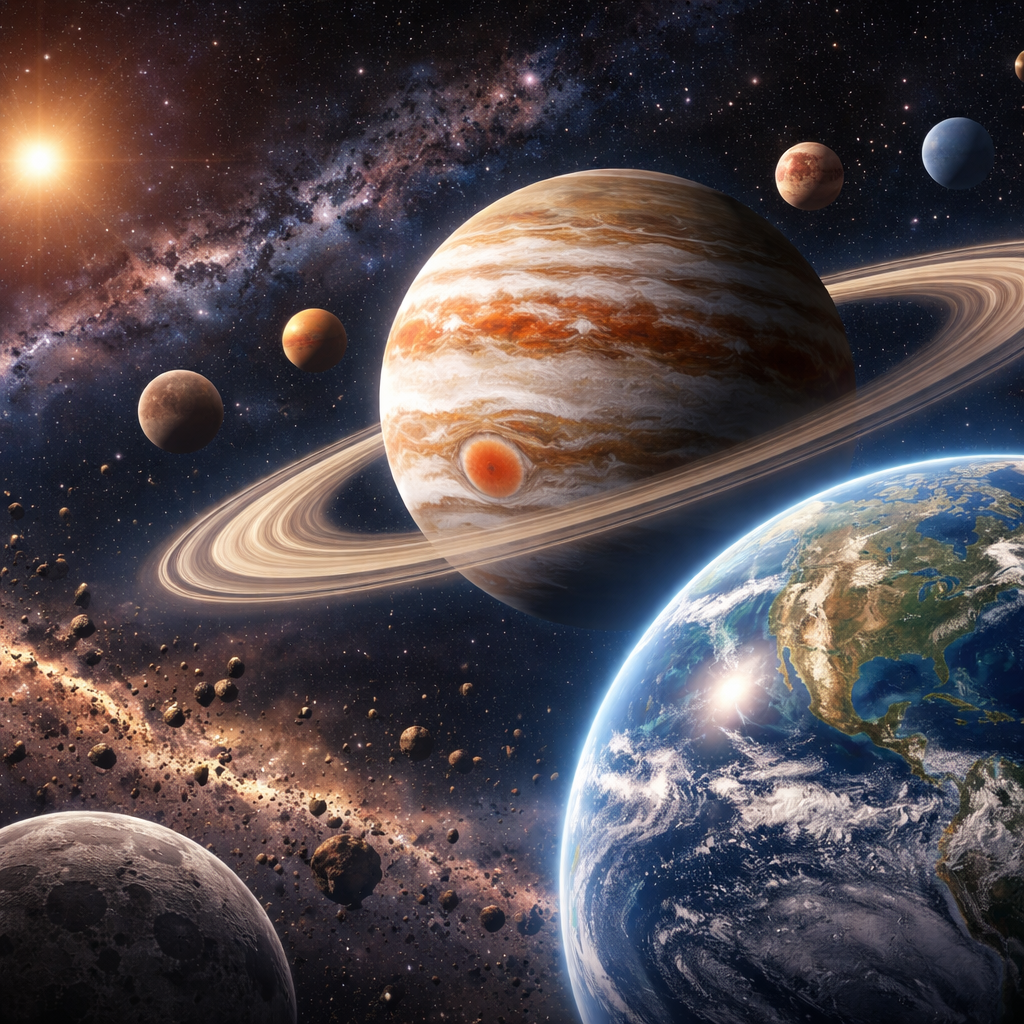
Jupiter alone is so massive that all other planets in the solar system could fit inside it with room to spare. Its volume is roughly 1,321 times that of Earth. Yet despite this enormous size, Jupiter rotates faster than any other planet — completing a full spin in just under 10 hours. That rapid rotation is actually responsible for the visible bands and storms on its surface, including the Great Red Spot, a storm that has been raging for centuries.
Saturn, the second-largest planet, offers its own surprise: it is the least dense object in the solar system. Its average density is lower than that of liquid water, which means that — theoretically — it would float if placed in a large enough ocean.
Temperature extremes that defy expectations
Venus is not the closest planet to the Sun, yet it holds the record for the hottest surface temperature in the solar system — around 465°C on average. Mercury, which is much closer to the Sun, has no substantial atmosphere to retain heat, so its temperature swings between roughly -180°C at night and 430°C during the day.
The atmosphere of Venus is so thick with carbon dioxide and sulfuric acid clouds that it creates a runaway greenhouse effect — trapping heat far more effectively than any human-made pollution has managed on Earth.
Uranus is another temperature anomaly. It radiates almost no internal heat into space, unlike Jupiter, Saturn, and Neptune, which all emit more energy than they receive from the Sun. Scientists still debate why Uranus behaves so differently from its gas giant siblings.
Planetary motion: what orbits actually look like
Planets do not travel in perfect circles around the Sun — they follow elliptical paths, as Johannes Kepler described in the early 17th century. This means that each planet has a closest point to the Sun (perihelion) and a farthest point (aphelion). Earth’s distance from the Sun varies by about 5 million kilometers between these two points.
Orbital speed also changes along this path. When a planet is closer to the Sun, gravitational pull accelerates it; when it moves farther away, it slows down. Earth travels at about 30 km/s on average — fast enough to circle the globe in roughly 13 minutes.
| Planet | Orbital period (Earth days/years) | Average distance from Sun |
|---|---|---|
| Mercury | 88 days | 57.9 million km |
| Venus | 225 days | 108.2 million km |
| Earth | 365 days | 149.6 million km |
| Mars | 687 days | 227.9 million km |
| Jupiter | ~12 years | 778.5 million km |
| Saturn | ~29 years | 1.43 billion km |
| Uranus | ~84 years | 2.87 billion km |
| Neptune | ~165 years | 4.50 billion km |
Moons, rings, and other companions
Saturn’s ring system is the most visually dramatic in the solar system, but it is not unique — Jupiter, Uranus, and Neptune also have rings, just far less prominent. Saturn’s rings are made mostly of ice particles and rocky debris, ranging in size from tiny grains to chunks as large as a house.
When it comes to moons, the numbers are striking. Saturn and Jupiter are locked in a competition for the most natural satellites, each hosting dozens of confirmed moons. Some of these moons are scientifically more interesting than several planets. Europa, a moon of Jupiter, has a liquid water ocean beneath its icy crust, making it one of the most compelling candidates in the search for extraterrestrial life.
- Ganymede (Jupiter’s moon) is larger than the planet Mercury
- Titan (Saturn’s moon) has a thick atmosphere and lakes of liquid methane
- Io (Jupiter’s moon) is the most volcanically active body in the solar system
- Triton (Neptune’s moon) orbits in the opposite direction to Neptune’s rotation
The inner and outer solar system think differently
Planetary scientists divide the solar system into terrestrial planets — Mercury, Venus, Earth, and Mars — and gas or ice giants — Jupiter, Saturn, Uranus, and Neptune. The terrestrial planets are small, rocky, and relatively close to the Sun. The giant planets formed farther out, where temperatures were cold enough for volatile compounds like water, ammonia, and methane to condense and contribute to their massive bulk.
This division is not just a classification convenience. It reflects how planetary formation works: the composition of a planet depends heavily on where in the protoplanetary disk it formed. The so-called “snow line” — the distance beyond which water ice could exist in the early solar system — played a crucial role in shaping which worlds became rocky and which became giants.
What keeps planetary science surprising
Every new mission to the outer solar system brings adjustments to existing models. Neptune’s largest moon, Triton, is believed to be a captured Kuiper Belt object — meaning it likely formed in a completely different part of the solar system before being pulled into Neptune’s gravity. That kind of discovery reshapes how researchers think about planetary system dynamics as a whole.
Closer to home, Mars continues to yield surprises. Evidence of ancient river valleys, mineral deposits formed in liquid water, and seasonal methane fluctuations in its thin atmosphere all point to a history far more dynamic than its current barren appearance suggests. Whether that history ever included life remains one of the most open questions in planetary science.
The more closely scientists examine even the planets we think we know well, the more complex the picture becomes. Earth’s own formation, internal structure, and magnetic field are still subjects of active research. That ongoing process of discovery is precisely what makes planetary science such a rewarding area to follow — whether you are a researcher, a student, or simply someone who looks up at the night sky and wonders what is really out there.