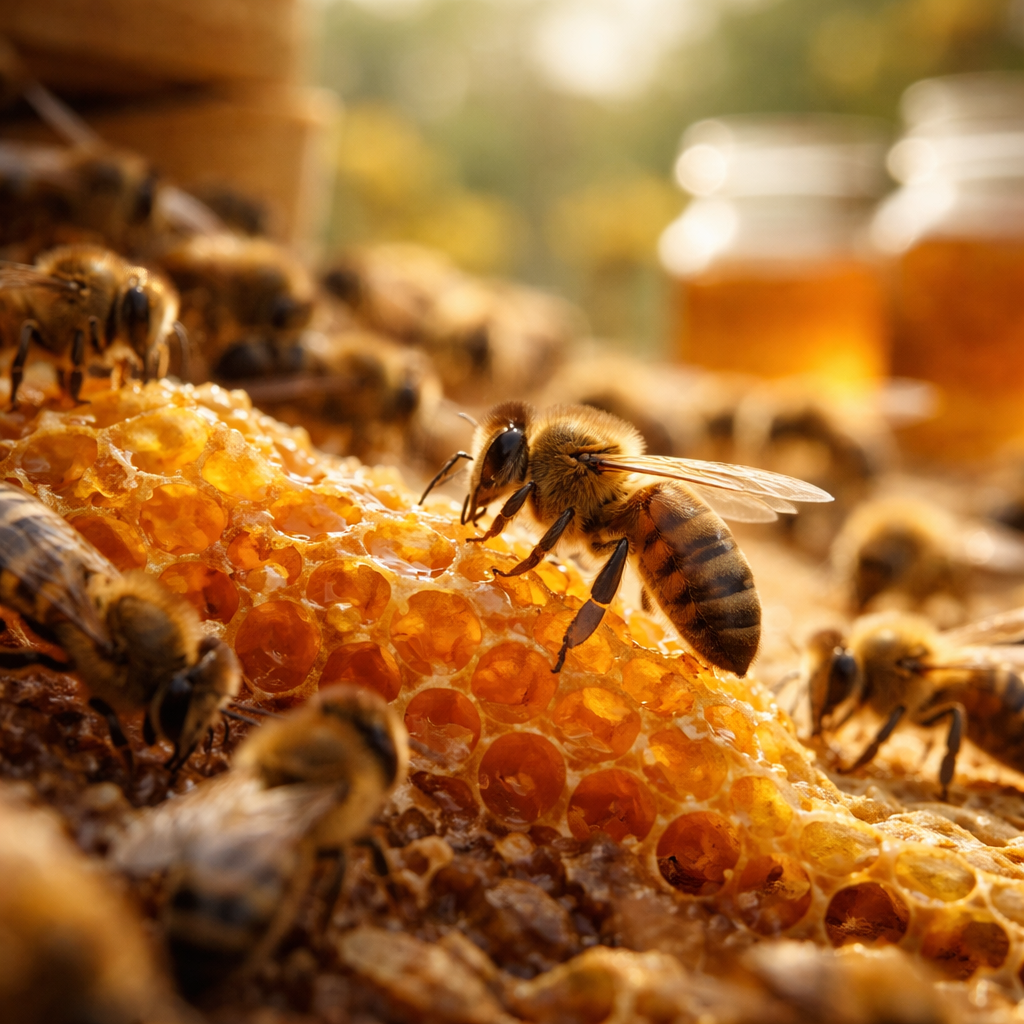
A single honey bee will produce only about one-twelfth of a teaspoon of honey in its entire lifetime — and yet, a healthy hive can store up to 40 pounds of it before winter. That contrast alone captures why the facts about honey bees continue to fascinate scientists, beekeepers, and curious minds alike. These insects have been living alongside humans for thousands of years, yet most people still have only a surface-level understanding of how remarkably complex their world actually is.
The colony is not just a group — it’s a superorganism
One of the most striking things about honey bees is that a single bee, on its own, cannot survive for long. The colony functions as a unified biological entity — often described by researchers as a superorganism — where every individual has a defined role that shifts depending on age, season, and the colony’s current needs.
A typical hive contains three types of bees: one queen, thousands of female worker bees, and a smaller number of male drones. The queen’s primary function is reproduction — she can lay up to 2,000 eggs per day during peak season. Worker bees handle everything else: foraging, nursing larvae, producing wax, guarding the entrance, and maintaining the temperature inside the hive. Drones exist solely to mate with a queen, after which they die.
What’s particularly interesting is that worker bees don’t stay in one role permanently. Younger bees typically work inside the hive — cleaning cells, feeding larvae, and building comb. As they age, they transition to outside work, eventually becoming foragers. This age-based division of labor is regulated by hormones and pheromones, not by any central authority.
Communication that doesn’t rely on words
Honey bees have developed one of the most sophisticated non-verbal communication systems in the animal kingdom. When a forager bee discovers a rich source of nectar or pollen, it returns to the hive and performs what researchers call the waggle dance — a figure-eight movement that encodes both the direction and distance of the food source relative to the sun’s position.
“The waggle dance of the honey bee is the only known example in the animal world of a symbolic communication system that refers to a location in space and time — outside the immediate environment of the communicator.” — Karl von Frisch, Nobel Prize-winning zoologist
Beyond the waggle dance, bees also communicate through chemical signals known as pheromones. The queen releases a specific chemical blend that suppresses the reproductive instincts of worker bees and signals her presence and health to the colony. When a bee stings, it releases an alarm pheromone that triggers nearby bees to become defensive — which is why disturbing one bee near a hive can quickly escalate.
Numbers that put things in perspective
| Fact | Detail |
|---|---|
| Average lifespan of a worker bee (summer) | About 6 weeks |
| Eggs laid by a queen per day | Up to 2,000 |
| Flowers visited to make 1 pound of honey | Approximately 2 million |
| Flight speed of a forager bee | Around 15 mph (24 km/h) |
| Number of bees in a healthy hive | 20,000 to 80,000 |
| Temperature inside a hive (brood area) | Maintained at 93–95°F (34–35°C) |
These numbers reveal something important: the efficiency of a honey bee colony is not accidental. It’s the result of millions of years of evolution, fine-tuned to maximize productivity and resilience under a wide range of environmental conditions.
What bees actually do for the world’s food supply
Honey bees are among the most important pollinators on the planet. Their foraging behavior — visiting flowers to collect nectar and pollen — results in cross-pollination that is essential for the reproduction of a vast number of plant species. Many of the fruits, vegetables, and nuts that make up a significant portion of the human diet depend on bee pollination to produce viable yields.
Crops like almonds, blueberries, cucumbers, apples, and avocados are heavily dependent on managed or wild bee pollination. In commercial agriculture, honey bee colonies are often transported to farms specifically for this purpose — a practice known as migratory beekeeping.
- Almonds are almost entirely dependent on honey bee pollination — without bees, the crop would collapse.
- Approximately one-third of the food humans consume globally relies on insect pollination, with honey bees playing a leading role.
- Wild plants, which form the basis of many natural ecosystems, also depend heavily on bee activity for reproduction.
It’s worth noting that honey bees are not native to all parts of the world. In North America, for instance, the Western honey bee was introduced by European settlers. Yet today, both managed and feral honey bee populations play a central role in agricultural systems across the continent.
The biology behind honey — it’s more complex than it looks
Most people know that bees make honey, but few understand the process in any detail. It begins when a forager bee collects nectar from flowers using its proboscis and stores it in a special stomach called the honey stomach, separate from its digestive stomach. During the flight back to the hive, enzymes begin breaking down the nectar’s complex sugars.
Back at the hive, the nectar is passed mouth-to-mouth between worker bees — a process that adds more enzymes and reduces water content. It’s then deposited into wax cells, where bees fan it with their wings to evaporate remaining moisture. Once the water content drops below about 20%, the cell is capped with wax, and the honey is shelf-stable essentially indefinitely. Archaeological excavations have recovered honey from ancient Egyptian tombs that was still technically edible after thousands of years.
Threats facing honey bee populations
Over the past several decades, honey bee populations — both managed and wild — have faced significant pressure from a combination of factors. Understanding these threats is important not just for beekeepers, but for anyone interested in the health of food systems and ecosystems more broadly.
The Varroa mite, a parasitic mite that feeds on bee larvae and adults while spreading viruses, is widely considered the most serious biological threat to honey bees globally. Combined with habitat loss, pesticide exposure (particularly neonicotinoids), nutritional deficiencies from monoculture farming, and the stress of migratory beekeeping, colonies are under sustained pressure that many struggle to survive.
- Colony Collapse Disorder (CCD) describes a phenomenon where the majority of worker bees disappear from a hive, leaving behind the queen and food stores. Its exact causes are still debated among researchers.
- Habitat loss reduces the diversity of flowering plants available to bees, limiting their nutritional intake and weakening colony immunity.
- Some pesticide classes affect bees’ navigation systems, making it difficult for foragers to find their way back to the hive.
Small details that make bees genuinely remarkable
Beyond the well-known facts, honey bees have a number of biological traits that are easy to overlook but worth appreciating. Their compound eyes allow them to detect ultraviolet light invisible to humans, helping them identify flower patterns that act as guides to nectar. Their sense of smell is extraordinarily sensitive — they can detect floral scents from significant distances and distinguish between thousands of different chemical compounds.
Bees also have a built-in magnetic sense. Research suggests they can detect Earth’s magnetic field, which may help with navigation and even with the alignment of honeycombs within the hive. Their memory — both individual and collective — is genuinely impressive: worker bees remember flower locations, routes, and even the timing of nectar availability at specific plants.
Perhaps the most quietly astonishing aspect of honey bee biology is how the colony makes group decisions. When a hive becomes too large and a swarm leaves to find a new home, scout bees explore potential nesting sites and report back through their dances. The colony eventually reaches a consensus — sometimes after days of democratic-style deliberation — before the entire swarm moves together. Biologist Thomas Seeley documented this process in detail, comparing it to the way neurons reach a decision in a brain.
Whether you’re approaching honey bees from a scientific angle, an agricultural one, or simply out of curiosity, the deeper you look, the more there is to find. These small insects hold together systems far larger than themselves — and the more people understand about how they live, the better positioned we are to support the conditions that allow them to thrive.