Most people assume they already know the basics — giant lizards, extinction, Jurassic Park. But the real facts about dinosaurs are far stranger, more nuanced, and honestly more exciting than anything Hollywood has put on screen. Paleontology keeps rewriting what we thought was settled science, and the picture that emerges is one of the most compelling stories in natural history.
They were not the slow, cold-blooded creatures we once imagined
For decades, dinosaurs were depicted as sluggish reptiles dragging their tails across swamps. That image has been thoroughly dismantled. Evidence from bone microstructure, isotopic analysis, and biomechanical modeling points strongly toward many dinosaur species being warm-blooded or at least capable of regulating their body temperature in ways far more sophisticated than modern reptiles.
Theropods — the group that includes Velociraptor and Tyrannosaurus rex — show rapid bone growth patterns similar to those seen in birds and mammals today. This isn’t a minor detail. It changes how we understand their metabolism, behavior, and ecological role entirely.
“The more we dig, the more dinosaurs look like the ancestors of modern birds — not the ancestors of crocodiles.” — a common sentiment among contemporary vertebrate paleontologists
Size extremes that are hard to wrap your head around
Yes, some dinosaurs were enormous. But the range of sizes across the group is genuinely astonishing. The dinosaur family includes animals smaller than a domestic chicken and titans that remain among the largest land animals to have ever lived on Earth.
| Species | Estimated length | Estimated weight |
|---|---|---|
| Microraptor | ~0.5 m | ~1 kg |
| Velociraptor mongoliensis | ~2 m | ~15 kg |
| Tyrannosaurus rex | ~12–13 m | ~8–14 tonnes |
| Patagotitan mayorum | ~37 m | ~69 tonnes |
Patagotitan mayorum, discovered in Argentina, is currently considered one of the largest dinosaurs ever found. Its femur alone is taller than most adult humans. These sauropods didn’t just eat constantly — they had to, given the sheer energy demands of maintaining those bodies.
Feathers, color, and behavior — the details that change everything
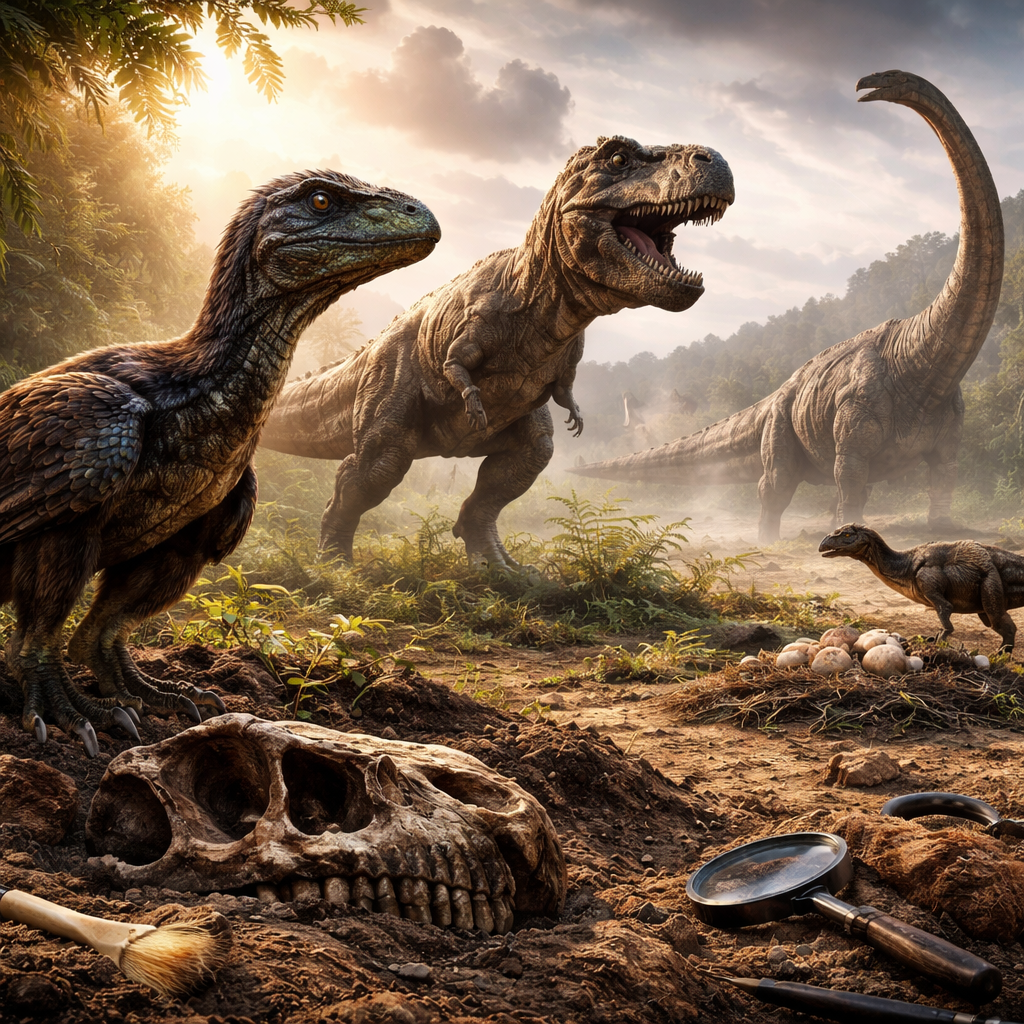
One of the most significant shifts in our understanding of dinosaur biology came from fossil sites in China, particularly in Liaoning Province. Exceptionally preserved specimens revealed soft tissue impressions, including clear evidence of feathers on numerous theropod species.
This wasn’t just a cosmetic finding. Feathers imply thermoregulation, possible display behavior, and an evolutionary link to modern birds that is now considered scientifically established, not theoretical. Birds are, technically and taxonomically, living dinosaurs — a classification that modern paleontology fully supports.
- Sinosauropteryx was the first non-avian dinosaur confirmed to have feather-like structures
- Yi qi had membranous wings somewhat resembling a bat, unique among dinosaurs
- Anchiornis had feathers covering even its legs and feet, resembling a four-winged glider
- Chemical analysis of melanosomes has allowed scientists to reconstruct the coloring of some species with reasonable confidence
The timeline is longer than most people realize
Dinosaurs didn’t exist as one continuous blob of time. They dominated terrestrial ecosystems for roughly 165 to 170 million years — a span so vast that Stegosaurus and Tyrannosaurus rex are separated by more time than T. rex and us. When T. rex was alive, Stegosaurus was already ancient history.
To put it differently: the gap between those two species is larger than the gap between the mass extinction event and the present day. That sense of deep time is something the casual dinosaur enthusiast rarely sits with, but it’s fundamental to understanding dinosaur diversity and evolution.
How did they communicate and care for offspring?
Nesting behavior has been documented in multiple dinosaur species. Maiasaura — whose name literally means “good mother lizard” — was among the first dinosaurs found with clear evidence of parental care, including nests with juveniles at different developmental stages. This wasn’t accidental discovery; it suggested active feeding and protection of young, behavior more associated with birds or mammals than with reptiles.
Communication is harder to assess from fossils, but cranial structures in hadrosaurs like Parasaurolophus suggest these dinosaurs could produce resonant sounds through hollow crests — potentially used for social signaling, mate attraction, or species recognition across dense Cretaceous forests.
What the extinction event actually looked like
The Chicxulub impact event — a massive asteroid strike in the region of present-day Mexico — is widely accepted as the primary trigger of the end-Cretaceous mass extinction. But the picture is more complex than a single impact wiping everything out overnight.
Volcanic activity in the Deccan Traps region of India had been ongoing and contributing to environmental stress before the impact. The asteroid essentially delivered a catastrophic blow to an ecosystem already under pressure. The resulting darkness from debris clouds, acid rain, and temperature collapse cascaded through food webs over months and years — not days.
- Non-avian dinosaurs disappeared; avian dinosaurs (birds) survived and diversified
- Marine reptiles like mosasaurs and plesiosaurs also went extinct — though they were not dinosaurs
- Small, burrowing, or aquatic animals had significantly higher survival rates
- The recovery of ecosystems took millions of years
New discoveries keep arriving, and the field is far from settled
Paleontology is not a closed science. New species are described regularly, and advances in CT scanning, isotopic analysis, and ancient protein research continue to reveal information that older excavation techniques simply couldn’t access. Scientists have begun extracting molecular data from fossilized bone — opening potential windows into soft tissue biology that were previously unimaginable.
What makes dinosaur research genuinely exciting right now is not just the new fossils — it’s the new tools. Understanding growth rates, social structures, migration patterns, and even possible disease history from bone tissue is changing how paleontologists reconstruct ancient ecosystems rather than just cataloguing species.
Every major museum collection in the world holds specimens that have not yet been fully analyzed. The answers to some of the field’s biggest questions may already be sitting in a drawer somewhere.
If there’s one thing that studying dinosaurs genuinely teaches, it’s intellectual humility. The confident reconstructions of one generation become the outdated assumptions of the next. And somehow, that process of revision is exactly what makes the science worth following.