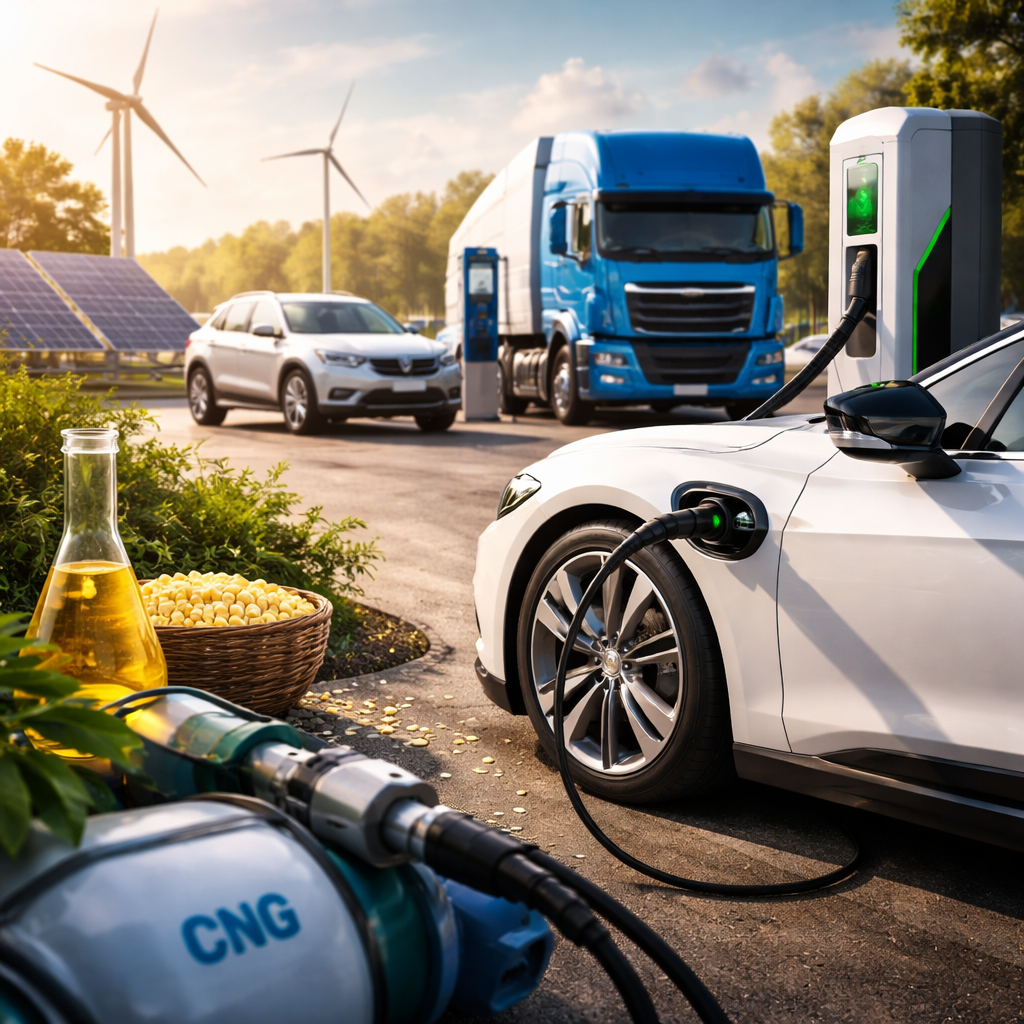
Every time you fill up your tank, you’re paying not just with money but with something harder to get back — clean air, stable climate, and energy independence. The good news is that a genuine alternative to gasoline isn’t a distant dream or a niche experiment anymore. It’s parked in driveways, powering city buses, and running farm equipment across the world right now. The question isn’t whether these alternatives work — it’s which one fits your life best.
Why the shift away from gasoline is already happening
Gasoline has dominated transportation for over a century, and it’s easy to forget that this was never inevitable. Combustion engines won out over steam and early electric vehicles largely because of infrastructure and economics — not because they were the cleanest or most efficient option. Today, the same forces that once locked in gasoline are now pushing in the opposite direction. Fuel prices fluctuate unpredictably, urban air quality standards are tightening, and the true cost of fossil fuel dependence has become impossible to ignore.
What’s changed most dramatically is the range of practical, road-tested options now available. Understanding those options clearly is the first step toward making a smarter choice.
Electric power: the option everyone is talking about for good reason
Battery electric vehicles (BEVs) run entirely on electricity stored in onboard battery packs. There is no combustion, no exhaust pipe, and no oil change. Charging happens at home overnight or at public stations — a network that has grown significantly in recent years across North America, Europe, and parts of Asia.
Electric motors convert around 85–90% of stored energy into motion. Internal combustion engines typically manage 20–40%. That gap alone explains why electricity costs per kilometer are so much lower than gasoline.
Range anxiety — the fear of running out of charge — used to be a legitimate concern. Modern electric vehicles now routinely offer 400 to 600 kilometers on a single charge, and fast-charging infrastructure makes longer trips increasingly manageable. For daily commuters and urban drivers, range is rarely the limiting factor it once was.
Hybrid and plug-in hybrid vehicles: the practical middle ground
Not everyone can charge at home, and not every driving pattern suits a fully electric vehicle. Hybrid technology addresses this by combining a conventional engine with an electric motor and a smaller battery. The system switches between power sources automatically, recovering energy during braking and reducing fuel consumption in stop-and-go traffic where combustion engines are least efficient.
Plug-in hybrids (PHEVs) go a step further. They carry a larger battery that can be charged from an external source, allowing many drivers to complete their entire daily commute on electricity alone — while still having a gasoline engine available for longer trips. For people who live in apartments or travel frequently, this flexibility is genuinely useful.
Hydrogen, natural gas, and biofuels: the broader picture
The conversation about fuel alternatives doesn’t start and end with electricity. Several other technologies are active in real-world use, each with distinct advantages depending on the application.
| Fuel Type | Main Advantage | Primary Use Case | Key Limitation |
|---|---|---|---|
| Hydrogen (fuel cell) | Fast refueling, zero tailpipe emissions | Heavy transport, buses, trucks | Limited refueling infrastructure |
| Compressed Natural Gas (CNG) | Lower emissions than gasoline, widely available in some regions | Fleet vehicles, taxis, buses | Requires dedicated tanks and stations |
| Biofuels (ethanol, biodiesel) | Compatible with existing engines | Agriculture, aviation, legacy fleets | Land use competition, variable sustainability |
| LPG (liquefied petroleum gas) | Cheaper than gasoline in many markets | Passenger cars, light commercial | Fewer stations outside dedicated markets |
Hydrogen fuel cell vehicles produce only water vapor as a byproduct and refuel in about the same time as a gasoline car. The technology is mature enough to be in commercial use, particularly in heavy transport where battery weight becomes a serious limitation. The challenge is infrastructure — hydrogen refueling stations remain sparse outside a handful of regions.
Biofuels occupy an interesting position because they can run in modified or even unmodified existing engines. Ethanol blends are already standard fuel in countries like Brazil, and biodiesel is commonly used in agricultural and industrial equipment. Sustainability depends heavily on what the biofuel is made from and how it’s produced — feedstocks like agricultural waste or algae carry a very different environmental profile than food crops converted to fuel.
What to actually consider before switching
Choosing between these options isn’t just a matter of environmental values — it’s a practical calculation that depends on your specific situation. A few factors consistently matter most:
- Daily driving distance and whether you can charge or refuel at home
- Access to public charging or alternative fuel stations in your area
- Whether you need to carry heavy loads or travel long distances regularly
- Upfront cost versus long-term fuel and maintenance savings
- Local incentives, tax credits, or rebates available for alternative fuel vehicles
It’s worth noting that maintenance costs for electric and hybrid vehicles tend to be lower over time. Fewer moving parts, no oil changes, and regenerative braking that reduces brake wear all contribute to lower running costs — an advantage that often offsets a higher purchase price within a few years of ownership.
The energy behind the energy
One question that comes up often — and fairly — is how clean an electric vehicle actually is when the electricity itself comes from coal or gas. It’s a legitimate point. An EV charged on a coal-heavy grid produces more lifecycle emissions than one charged on renewable power. But even on average grids in most countries, electric vehicles produce significantly fewer emissions per kilometer than gasoline vehicles, and that margin improves as grids add more renewable capacity over time.
The same logic applies to hydrogen: green hydrogen produced through electrolysis powered by renewables is a fundamentally different product from grey hydrogen made from natural gas. The fuel itself is only part of the story — the supply chain behind it matters equally.
Picking a direction without waiting for perfect
The most common mistake people make when researching fuel alternatives is waiting for a single technology to become the obvious winner before acting. That clarity may never arrive — different solutions genuinely suit different needs, and that’s not a flaw in the transition, it’s a feature of it. A long-haul trucker, a city apartment dweller, and a farmer in a rural area will likely end up with different answers, and all three of those answers can be correct.
What matters more than picking the “best” technology in the abstract is understanding your own usage well enough to make a decision that will hold up in practice. The alternatives to gasoline are real, tested, and widely available. Choosing among them is less about waiting for the future and more about reading your own present situation clearly.